

120
J. 1. Hedges
O2
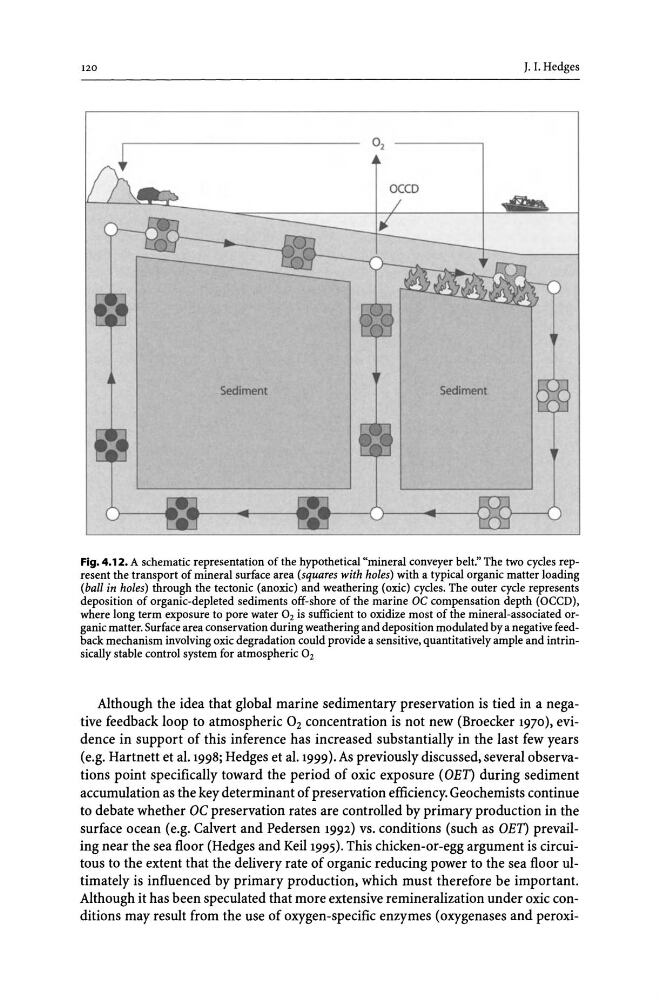
Fig. 4.12. A schematic representation of the hypothetical "mineral conveyer belt:' The two cycles represent the transport of mineral surface area (squares with holes) with a typical organic matter loading
(ball in holes) through the tectonic (anoxic) and weathering (oxic) cycles. The outer cycle represents
deposition of organic-depleted sediments off-shore of the marine DC compensation depth (OCCD),
where long term exposure to pore water O2 is sufficient to oxidize most of the mineral-associated organic matter. Surface area conservation during weathering and deposition modulated by a negative feedback mechanism involving oxic degradation could provide a sensitive, quantitatively ample and intrinsically stable control system for atmospheric O2
Although the idea that global marine sedimentary preservation is tied in a negative feedback loop to atmospheric O 2 concentration is not new (Broecker 1970), evidence in support of this inference has increased substantially in the last few years
(e.g. Hartnett et al. 1998; Hedges et al. 1999). As previously discussed, several observations point specifically toward the period of oxic exposure (OET) during sediment
accumulation as the key determinant of preservation efficiency. Geochemists continue
to debate whether OC preservation rates are controlled by primary production in the
surface ocean (e.g. Calvert and Pedersen 1992) vs. conditions (such as OET) prevailing near the sea floor (Hedges and KeiI1995). This chicken-or-egg argument is circuitous to the extent that the delivery rate of organic reducing power to the sea floor ultimately is influenced by primary production, which must therefore be important.
Although it has been speculated that more extensive remineralization under oxic conditions may result from the use of oxygen-specific enzymes (oxygenases and peroxi-
J. 1. Hedges
O2
Fig. 4.12. A schematic representation of the hypothetical "mineral conveyer belt:' The two cycles represent the transport of mineral surface area (squares with holes) with a typical organic matter loading
(ball in holes) through the tectonic (anoxic) and weathering (oxic) cycles. The outer cycle represents
deposition of organic-depleted sediments off-shore of the marine DC compensation depth (OCCD),
where long term exposure to pore water O2 is sufficient to oxidize most of the mineral-associated organic matter. Surface area conservation during weathering and deposition modulated by a negative feedback mechanism involving oxic degradation could provide a sensitive, quantitatively ample and intrinsically stable control system for atmospheric O2
Although the idea that global marine sedimentary preservation is tied in a negative feedback loop to atmospheric O 2 concentration is not new (Broecker 1970), evidence in support of this inference has increased substantially in the last few years
(e.g. Hartnett et al. 1998; Hedges et al. 1999). As previously discussed, several observations point specifically toward the period of oxic exposure (OET) during sediment
accumulation as the key determinant of preservation efficiency. Geochemists continue
to debate whether OC preservation rates are controlled by primary production in the
surface ocean (e.g. Calvert and Pedersen 1992) vs. conditions (such as OET) prevailing near the sea floor (Hedges and KeiI1995). This chicken-or-egg argument is circuitous to the extent that the delivery rate of organic reducing power to the sea floor ultimately is influenced by primary production, which must therefore be important.
Although it has been speculated that more extensive remineralization under oxic conditions may result from the use of oxygen-specific enzymes (oxygenases and peroxi-