

106
J. 1. Hedges
4.2
Global Cycles of Carbon and Oxygen
Photosynthesis, in its simplest chemical representation (excluding nutrients), can
be thought of as the solar-powered conversion of carbon dioxide and water into organic matter (CH 2 0) and molecular oxygen (0 2 ), The net result of this highly endothermic reaction is the production of one mole each of both the strongest naturally
occurring reducing agent (organic matter) and oxidizing agent (molecular oxygen)
on Earth.
CO2 + H20 ~ CH20 + O2
(4.1)
In this greatly simplified formulation, CH20 represents organic matter of all types
and forms. Among all the reactants and products of photosynthesis, organic matter is
unique in that it is predominantly: (a) nonvolatile, (b) solid, and (c) macroscopic. One
outcome of this combination of characteristics is that in natural environments, particulate organic matter tends to sink and collect within a thin layer of solids deposited at the base of the atmosphere (in soils and peats) and ocean (in sediments). In
contrast, oxidizing power represented by gaseous O 2 primarily "floats" in the Earth's
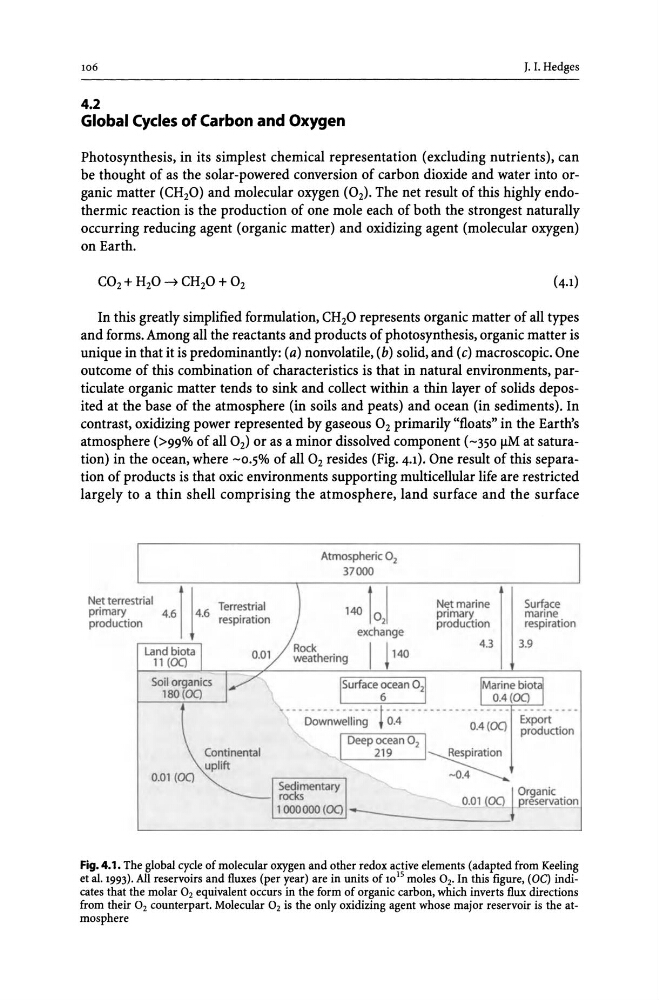
atmosphere (>99% of all O2) or as a minor dissolved component (-350 fLM at saturation) in the ocean, where -0.5% of all O2 resides (Fig. 4.1). One result of this separation of products is that oxic environments supporting multicellular life are restricted
largely to a thin shell comprising the atmosphere, land surface and the surface
Net terrestrial
1 j
pnmary
4.6
4.6
production
Land biota
11 (OC)
Terrestrial
respiration
Atmospheric 02
37000
140 loJ
exchange
I ! 140
Deep ocean 0 2
219
Net marine
primary
production
43
~iration ,
-0.4_____....
Surface
marine
respiration
3.9
Export
production
0.01 lOC) preserv~tion
1
Organic
-----Fig. 4.1. The global cycle of molecular oxygen and other redox active elements (adapted from Keeling
et al.1993). All reservoirs and fluxes (per year) are in units of 10 15 moles O2, In this figure, (Oe) indicates that the molar O2 equivalent occurs in the form of organic carbon, which inverts flux directions
from their O2 counterpart. Molecular O2 is the only oxidizing agent whose major reservoir is the atmosphere
J. 1. Hedges
4.2
Global Cycles of Carbon and Oxygen
Photosynthesis, in its simplest chemical representation (excluding nutrients), can
be thought of as the solar-powered conversion of carbon dioxide and water into organic matter (CH 2 0) and molecular oxygen (0 2 ), The net result of this highly endothermic reaction is the production of one mole each of both the strongest naturally
occurring reducing agent (organic matter) and oxidizing agent (molecular oxygen)
on Earth.
CO2 + H20 ~ CH20 + O2
(4.1)
In this greatly simplified formulation, CH20 represents organic matter of all types
and forms. Among all the reactants and products of photosynthesis, organic matter is
unique in that it is predominantly: (a) nonvolatile, (b) solid, and (c) macroscopic. One
outcome of this combination of characteristics is that in natural environments, particulate organic matter tends to sink and collect within a thin layer of solids deposited at the base of the atmosphere (in soils and peats) and ocean (in sediments). In
contrast, oxidizing power represented by gaseous O 2 primarily "floats" in the Earth's
atmosphere (>99% of all O2) or as a minor dissolved component (-350 fLM at saturation) in the ocean, where -0.5% of all O2 resides (Fig. 4.1). One result of this separation of products is that oxic environments supporting multicellular life are restricted
largely to a thin shell comprising the atmosphere, land surface and the surface
Net terrestrial
1 j
pnmary
4.6
4.6
production
Land biota
11 (OC)
Terrestrial
respiration
Atmospheric 02
37000
140 loJ
exchange
I ! 140
Deep ocean 0 2
219
Net marine
primary
production
43
~iration ,
-0.4_____....
Surface
marine
respiration
3.9
Export
production
0.01 lOC) preserv~tion
1
Organic
-----Fig. 4.1. The global cycle of molecular oxygen and other redox active elements (adapted from Keeling
et al.1993). All reservoirs and fluxes (per year) are in units of 10 15 moles O2, In this figure, (Oe) indicates that the molar O2 equivalent occurs in the form of organic carbon, which inverts flux directions
from their O2 counterpart. Molecular O2 is the only oxidizing agent whose major reservoir is the atmosphere