

CHAPTER 3 . Photochemical Processes in the Euphotic Zone of Sea Water
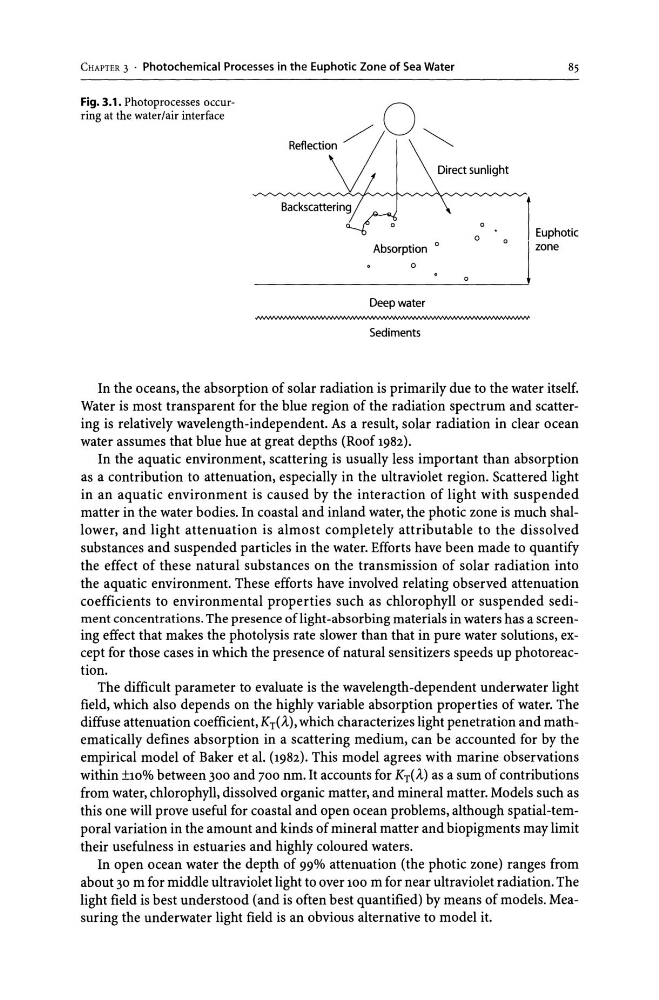
Fig. 3.1. Photoprocesses occurring at the water/air interface
Backscattering
Absorption 0
o
85
o
1 Euphotic
1 zone
--------------------------------~
Deepwater
Sediments
In the oceans, the absorption of solar radiation is primarily due to the water itself.
Water is most transparent for the blue region of the radiation spectrum and scattering is relatively wavelength-independent. As a result, solar radiation in clear ocean
water assumes that blue hue at great depths (Roof 1982).
In the aquatic environment, scattering is usually less important than absorption
as a contribution to attenuation, especially in the ultraviolet region. Scattered light
in an aquatic environment is caused by the interaction of light with suspended
matter in the water bodies. In coastal and inland water, the photic zone is much shallower, and light attenuation is almost completely attributable to the dissolved
substances and suspended particles in the water. Efforts have been made to quantify
the effect of these natural substances on the transmission of solar radiation into
the aquatic environment. These efforts have involved relating observed attenuation
coefficients to environmental properties such as chlorophyll or suspended sediment concentrations. The presence oflight-absorbing materials in waters has a screening effect that makes the photolysis rate slower than that in pure water solutions, except for those cases in which the presence of natural sensitizers speeds up photoreaction.
The difficult parameter to evaluate is the wavelength-dependent underwater light
field, which also depends on the highly variable absorption properties of water. The
diffuse attenuation coefficient, KrP") , which characterizes light penetration and mathematically defines absorption in a scattering medium, can be accounted for by the
empirical model of Baker et al. (1982). This model agrees with marine observations
within ±10% between 300 and 700 nm. It accounts for Kr(A) as a sum of contributions
from water, chlorophyll, dissolved organic matter, and mineral matter. Models such as
this one will prove useful for coastal and open ocean problems, although spatial-temporal variation in the amount and kinds of mineral matter and biopigments may limit
their usefulness in estuaries and highly coloured waters.
In open ocean water the depth of 99% attenuation (the photic zone) ranges from
about 30 m for middle ultraviolet light to over 100 m for near ultraviolet radiation. The
light field is best understood (and is often best quantified) by means of models. Measuring the underwater light field is an obvious alternative to model it.
Fig. 3.1. Photoprocesses occurring at the water/air interface
Backscattering
Absorption 0
o
85
o
1 Euphotic
1 zone
--------------------------------~
Deepwater
Sediments
In the oceans, the absorption of solar radiation is primarily due to the water itself.
Water is most transparent for the blue region of the radiation spectrum and scattering is relatively wavelength-independent. As a result, solar radiation in clear ocean
water assumes that blue hue at great depths (Roof 1982).
In the aquatic environment, scattering is usually less important than absorption
as a contribution to attenuation, especially in the ultraviolet region. Scattered light
in an aquatic environment is caused by the interaction of light with suspended
matter in the water bodies. In coastal and inland water, the photic zone is much shallower, and light attenuation is almost completely attributable to the dissolved
substances and suspended particles in the water. Efforts have been made to quantify
the effect of these natural substances on the transmission of solar radiation into
the aquatic environment. These efforts have involved relating observed attenuation
coefficients to environmental properties such as chlorophyll or suspended sediment concentrations. The presence oflight-absorbing materials in waters has a screening effect that makes the photolysis rate slower than that in pure water solutions, except for those cases in which the presence of natural sensitizers speeds up photoreaction.
The difficult parameter to evaluate is the wavelength-dependent underwater light
field, which also depends on the highly variable absorption properties of water. The
diffuse attenuation coefficient, KrP") , which characterizes light penetration and mathematically defines absorption in a scattering medium, can be accounted for by the
empirical model of Baker et al. (1982). This model agrees with marine observations
within ±10% between 300 and 700 nm. It accounts for Kr(A) as a sum of contributions
from water, chlorophyll, dissolved organic matter, and mineral matter. Models such as
this one will prove useful for coastal and open ocean problems, although spatial-temporal variation in the amount and kinds of mineral matter and biopigments may limit
their usefulness in estuaries and highly coloured waters.
In open ocean water the depth of 99% attenuation (the photic zone) ranges from
about 30 m for middle ultraviolet light to over 100 m for near ultraviolet radiation. The
light field is best understood (and is often best quantified) by means of models. Measuring the underwater light field is an obvious alternative to model it.