

General Properties, Occurrence, and Preparation
1.2
67
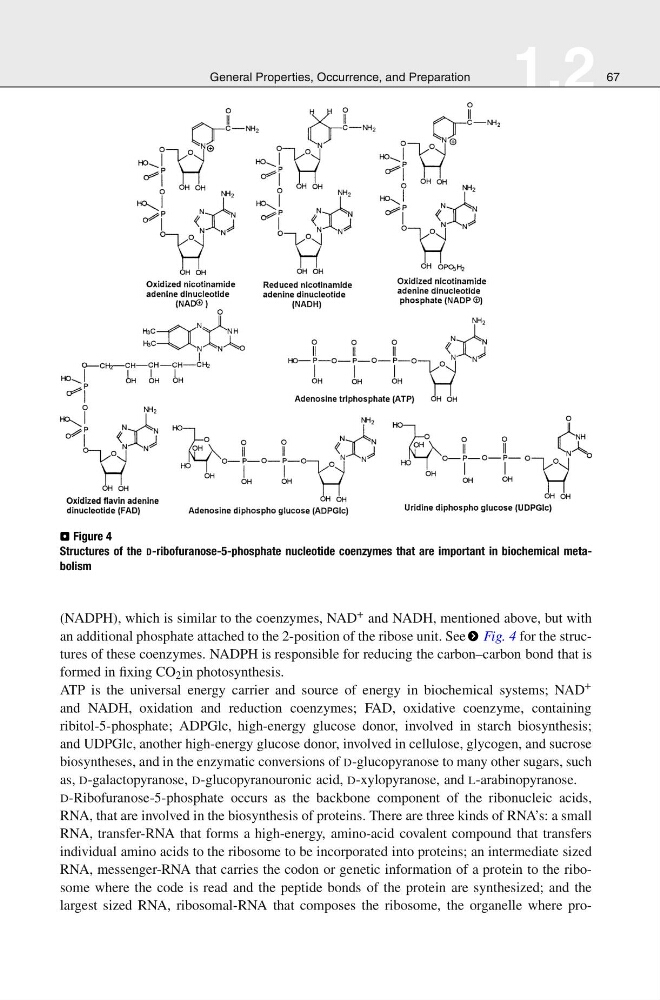
⊡ Figure 4
Structures of the D-ribofuranose-5-phosphate nucleotide coenzymes that are important in biochemical metabolism
(NADPH), which is similar to the coenzymes, NAD + and NADH, mentioned above, but with
an additional phosphate attached to the 2-position of the ribose unit. See > Fig. 4 for the structures of these coenzymes. NADPH is responsible for reducing the carbon–carbon bond that is
formed in fixing CO 2 in photosynthesis.
ATP is the universal energy carrier and source of energy in biochemical systems; NAD +
and NADH, oxidation and reduction coenzymes; FAD, oxidative coenzyme, containing
ribitol-5-phosphate; ADPGlc, high-energy glucose donor, involved in starch biosynthesis;
and UDPGlc, another high-energy glucose donor, involved in cellulose, glycogen, and sucrose
biosyntheses, and in the enzymatic conversions of D-glucopyranose to many other sugars, such
as, D-galactopyranose, D-glucopyranouronic acid, D-xylopyranose, and L-arabinopyranose.
D-Ribofuranose-5-phosphate occurs as the backbone component of the ribonucleic acids,
RNA, that are involved in the biosynthesis of proteins. There are three kinds of RNA’s: a small
RNA, transfer-RNA that forms a high-energy, amino-acid covalent compound that transfers
individual amino acids to the ribosome to be incorporated into proteins; an intermediate sized
RNA, messenger-RNA that carries the codon or genetic information of a protein to the ribosome where the code is read and the peptide bonds of the protein are synthesized; and the
largest sized RNA, ribosomal-RNA that composes the ribosome, the organelle where pro-
1.2
67
⊡ Figure 4
Structures of the D-ribofuranose-5-phosphate nucleotide coenzymes that are important in biochemical metabolism
(NADPH), which is similar to the coenzymes, NAD + and NADH, mentioned above, but with
an additional phosphate attached to the 2-position of the ribose unit. See > Fig. 4 for the structures of these coenzymes. NADPH is responsible for reducing the carbon–carbon bond that is
formed in fixing CO 2 in photosynthesis.
ATP is the universal energy carrier and source of energy in biochemical systems; NAD +
and NADH, oxidation and reduction coenzymes; FAD, oxidative coenzyme, containing
ribitol-5-phosphate; ADPGlc, high-energy glucose donor, involved in starch biosynthesis;
and UDPGlc, another high-energy glucose donor, involved in cellulose, glycogen, and sucrose
biosyntheses, and in the enzymatic conversions of D-glucopyranose to many other sugars, such
as, D-galactopyranose, D-glucopyranouronic acid, D-xylopyranose, and L-arabinopyranose.
D-Ribofuranose-5-phosphate occurs as the backbone component of the ribonucleic acids,
RNA, that are involved in the biosynthesis of proteins. There are three kinds of RNA’s: a small
RNA, transfer-RNA that forms a high-energy, amino-acid covalent compound that transfers
individual amino acids to the ribosome to be incorporated into proteins; an intermediate sized
RNA, messenger-RNA that carries the codon or genetic information of a protein to the ribosome where the code is read and the peptide bonds of the protein are synthesized; and the
largest sized RNA, ribosomal-RNA that composes the ribosome, the organelle where pro-