

C-Glycosylation
3.8
757
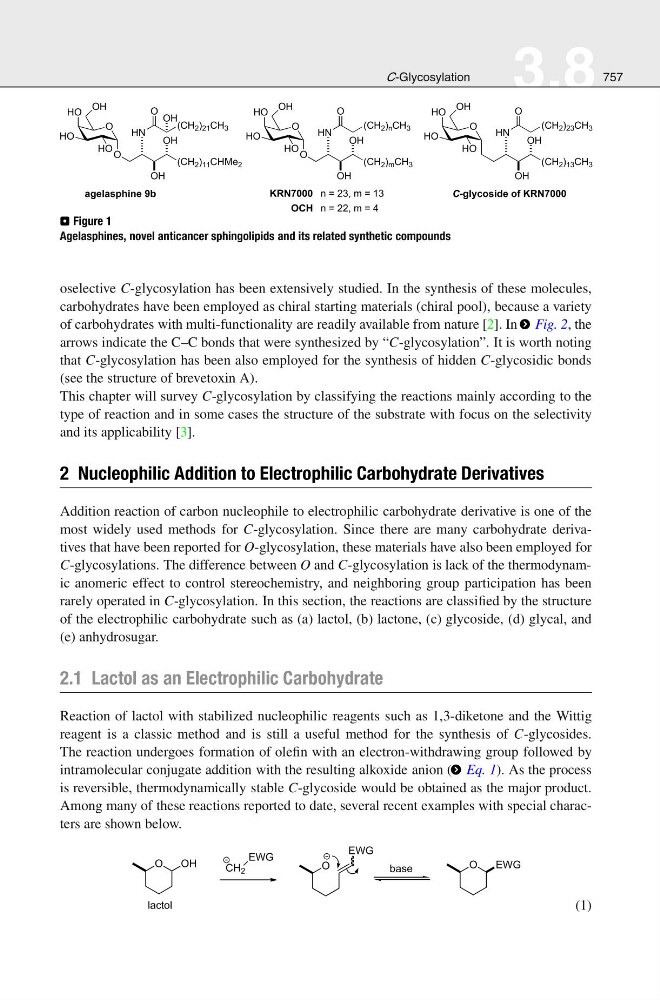
⊡ Figure 1
Agelasphines, novel anticancer sphingolipids and its related synthetic compounds
oselective C-glycosylation has been extensively studied. In the synthesis of these molecules,
carbohydrates have been employed as chiral starting materials (chiral pool), because a variety
of carbohydrates with multi-functionality are readily available from nature [2]. In > Fig. 2, the
arrows indicate the C–C bonds that were synthesized by “C-glycosylation”. It is worth noting
that C-glycosylation has been also employed for the synthesis of hidden C-glycosidic bonds
(see the structure of brevetoxin A).
This chapter will survey C-glycosylation by classifying the reactions mainly according to the
type of reaction and in some cases the structure of the substrate with focus on the selectivity
and its applicability [3].
2 Nucleophilic Addition to Electrophilic Carbohydrate Derivatives
Addition reaction of carbon nucleophile to electrophilic carbohydrate derivative is one of the
most widely used methods for C-glycosylation. Since there are many carbohydrate derivatives that have been reported for O-glycosylation, these materials have also been employed for
C-glycosylations. The difference between O and C-glycosylation is lack of the thermodynamic anomeric effect to control stereochemistry, and neighboring group participation has been
rarely operated in C-glycosylation. In this section, the reactions are classified by the structure
of the electrophilic carbohydrate such as (a) lactol, (b) lactone, (c) glycoside, (d) glycal, and
(e) anhydrosugar.
2.1 Lactol as an Electrophilic Carbohydrate
Reaction of lactol with stabilized nucleophilic reagents such as 1,3-diketone and the Wittig
reagent is a classic method and is still a useful method for the synthesis of C-glycosides.
The reaction undergoes formation of olefin with an electron-withdrawing group followed by
intramolecular conjugate addition with the resulting alkoxide anion ( > Eq. 1). As the process
is reversible, thermodynamically stable C-glycoside would be obtained as the major product.
Among many of these reactions reported to date, several recent examples with special characters are shown below.
(1)