

Anomeric Anhydro Sugars
3.7
751
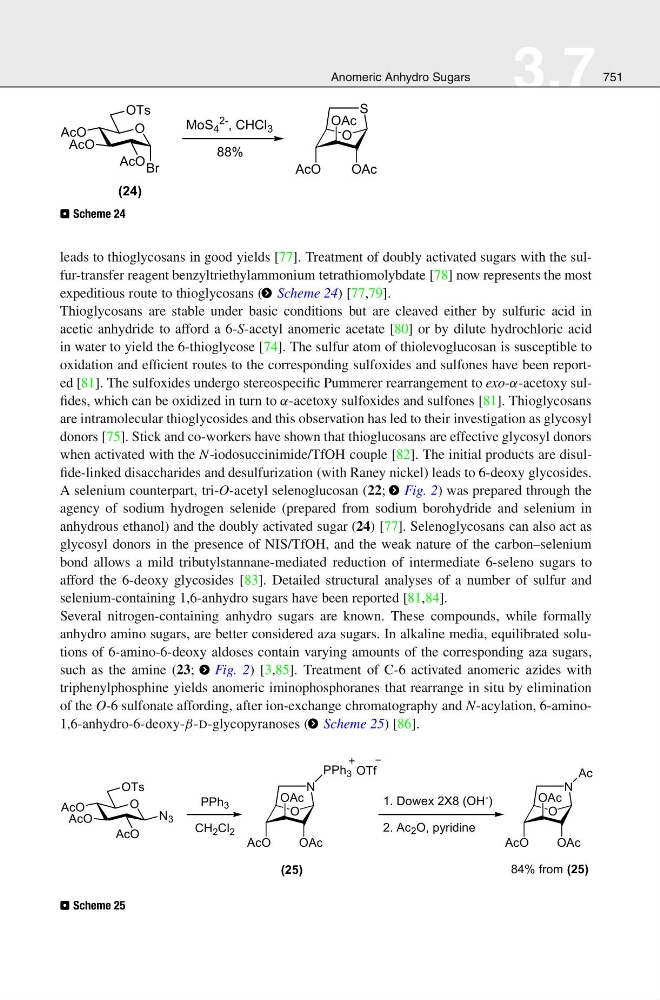
⊡ Scheme 24
leads to thioglycosans in good yields [77]. Treatment of doubly activated sugars with the sulfur-transfer reagent benzyltriethylammonium tetrathiomolybdate [78] now represents the most
expeditious route to thioglycosans ( > Scheme 24) [77,79].
Thioglycosans are stable under basic conditions but are cleaved either by sulfuric acid in
acetic anhydride to afford a 6-S-acetyl anomeric acetate [80] or by dilute hydrochloric acid
in water to yield the 6-thioglycose [74]. The sulfur atom of thiolevoglucosan is susceptible to
oxidation and efficient routes to the corresponding sulfoxides and sulfones have been reported [81]. The sulfoxides undergo stereospecific Pummerer rearrangement to exo-α-acetoxy sulfides, which can be oxidized in turn to α-acetoxy sulfoxides and sulfones [81]. Thioglycosans
are intramolecular thioglycosides and this observation has led to their investigation as glycosyl
donors [75]. Stick and co-workers have shown that thioglucosans are effective glycosyl donors
when activated with the N-iodosuccinimide/TfOH couple [82]. The initial products are disulfide-linked disaccharides and desulfurization (with Raney nickel) leads to 6-deoxy glycosides.
A selenium counterpart, tri-O-acetyl selenoglucosan (22; > Fig. 2) was prepared through the
agency of sodium hydrogen selenide (prepared from sodium borohydride and selenium in
anhydrous ethanol) and the doubly activated sugar (24) [77]. Selenoglycosans can also act as
glycosyl donors in the presence of NIS/TfOH, and the weak nature of the carbon–selenium
bond allows a mild tributylstannane-mediated reduction of intermediate 6-seleno sugars to
afford the 6-deoxy glycosides [83]. Detailed structural analyses of a number of sulfur and
selenium-containing 1,6-anhydro sugars have been reported [81,84].
Several nitrogen-containing anhydro sugars are known. These compounds, while formally
anhydro amino sugars, are better considered aza sugars. In alkaline media, equilibrated solutions of 6-amino-6-deoxy aldoses contain varying amounts of the corresponding aza sugars,
such as the amine (23; > Fig. 2) [3,85]. Treatment of C-6 activated anomeric azides with
triphenylphosphine yields anomeric iminophosphoranes that rearrange in situ by elimination
of the O-6 sulfonate affording, after ion-exchange chromatography and N-acylation, 6-amino1,6-anhydro-6-deoxy-β-D-glycopyranoses ( > Scheme 25) [86].
⊡ Scheme 25