

728
3
Chemical Glycosylation Reactions
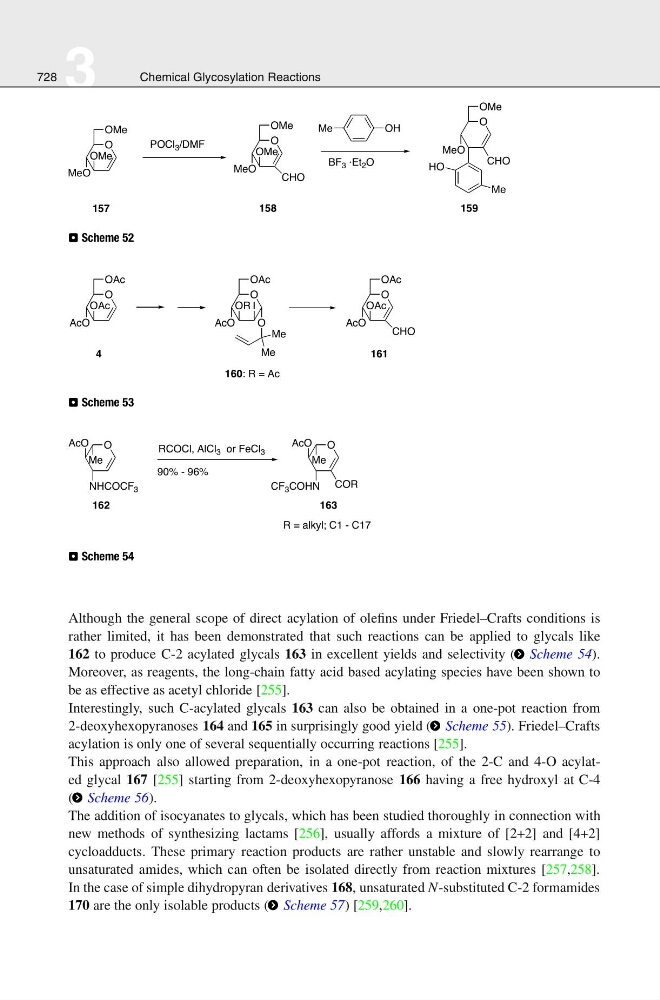
⊡ Scheme 52
⊡ Scheme 53
⊡ Scheme 54
Although the general scope of direct acylation of olefins under Friedel–Crafts conditions is
rather limited, it has been demonstrated that such reactions can be applied to glycals like
162 to produce C-2 acylated glycals 163 in excellent yields and selectivity ( > Scheme 54).
Moreover, as reagents, the long-chain fatty acid based acylating species have been shown to
be as effective as acetyl chloride [255].
Interestingly, such C-acylated glycals 163 can also be obtained in a one-pot reaction from
2-deoxyhexopyranoses 164 and 165 in surprisingly good yield ( > Scheme 55). Friedel–Crafts
acylation is only one of several sequentially occurring reactions [255].
This approach also allowed preparation, in a one-pot reaction, of the 2-C and 4-O acylated glycal 167 [255] starting from 2-deoxyhexopyranose 166 having a free hydroxyl at C-4
( > Scheme 56).
The addition of isocyanates to glycals, which has been studied thoroughly in connection with
new methods of synthesizing lactams [256], usually affords a mixture of [2+2] and [4+2]
cycloadducts. These primary reaction products are rather unstable and slowly rearrange to
unsaturated amides, which can often be isolated directly from reaction mixtures [257,258].
In the case of simple dihydropyran derivatives 168, unsaturated N-substituted C-2 formamides
170 are the only isolable products ( > Scheme 57) [259,260].