

722
3
Chemical Glycosylation Reactions
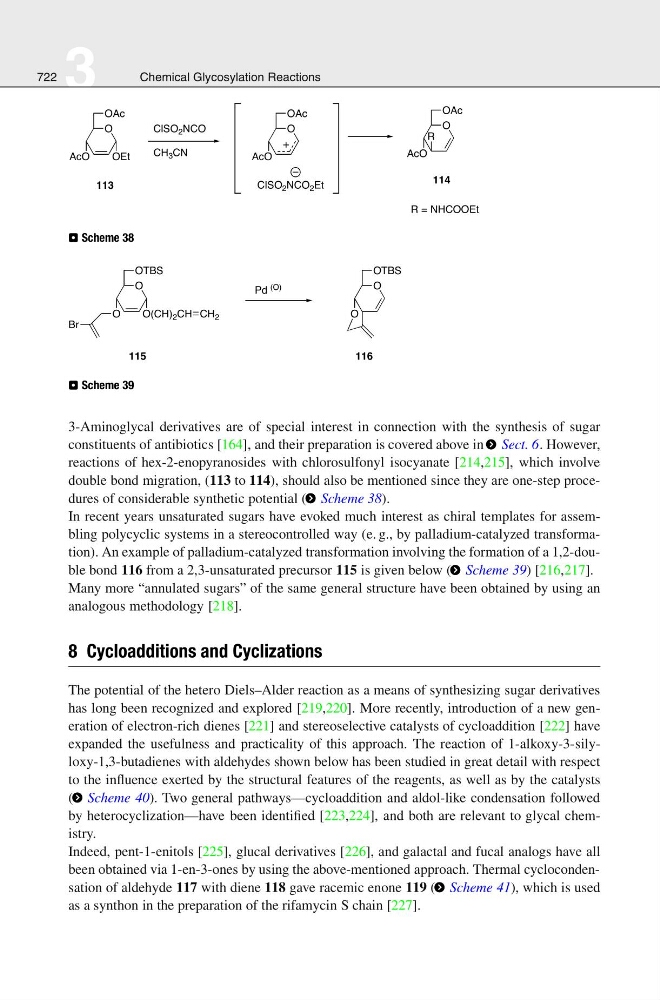
⊡ Scheme 38
⊡ Scheme 39
3-Aminoglycal derivatives are of special interest in connection with the synthesis of sugar
constituents of antibiotics [164], and their preparation is covered above in > Sect. 6. However,
reactions of hex-2-enopyranosides with chlorosulfonyl isocyanate [214,215], which involve
double bond migration, (113 to 114), should also be mentioned since they are one-step procedures of considerable synthetic potential ( > Scheme 38).
In recent years unsaturated sugars have evoked much interest as chiral templates for assembling polycyclic systems in a stereocontrolled way (e. g., by palladium-catalyzed transformation). An example of palladium-catalyzed transformation involving the formation of a 1,2-double bond 116 from a 2,3-unsaturated precursor 115 is given below ( > Scheme 39) [216,217].
Many more “annulated sugars” of the same general structure have been obtained by using an
analogous methodology [218].
8 Cycloadditions and Cyclizations
The potential of the hetero Diels–Alder reaction as a means of synthesizing sugar derivatives
has long been recognized and explored [219,220]. More recently, introduction of a new generation of electron-rich dienes [221] and stereoselective catalysts of cycloaddition [222] have
expanded the usefulness and practicality of this approach. The reaction of 1-alkoxy-3-silyloxy-1,3-butadienes with aldehydes shown below has been studied in great detail with respect
to the influence exerted by the structural features of the reagents, as well as by the catalysts
( > Scheme 40). Two general pathways—cycloaddition and aldol-like condensation followed
by heterocyclization—have been identified [223,224], and both are relevant to glycal chemistry.
Indeed, pent-1-enitols [225], glucal derivatives [226], and galactal and fucal analogs have all
been obtained via 1-en-3-ones by using the above-mentioned approach. Thermal cyclocondensation of aldehyde 117 with diene 118 gave racemic enone 119 ( > Scheme 41), which is used
as a synthon in the preparation of the rifamycin S chain [227].