

720
3
Chemical Glycosylation Reactions
The above remarks concerning the regioselectivity of the Ferrier rearrangement apply also to
reactions with C-nucleophiles but not to reactions with C-1-substituted kinetic products since
such kinetic products are not susceptible to equilibration and therefore become final products.
Anomeric allylation of glycals [199] and their reactions with enol ethers [200] are good examples of this. On the other hand, reaction of 4 with dimethylcuprate afforded mainly the S N 2
substitution product [201]. However, reaction with a number of C-nucleophiles allowed formation of all four possible alkylation products [202,203]. 2,3-Unsaturated vinyl glycosides
were shown to exhibit regioselective C-alkylating properties depending on the conditions
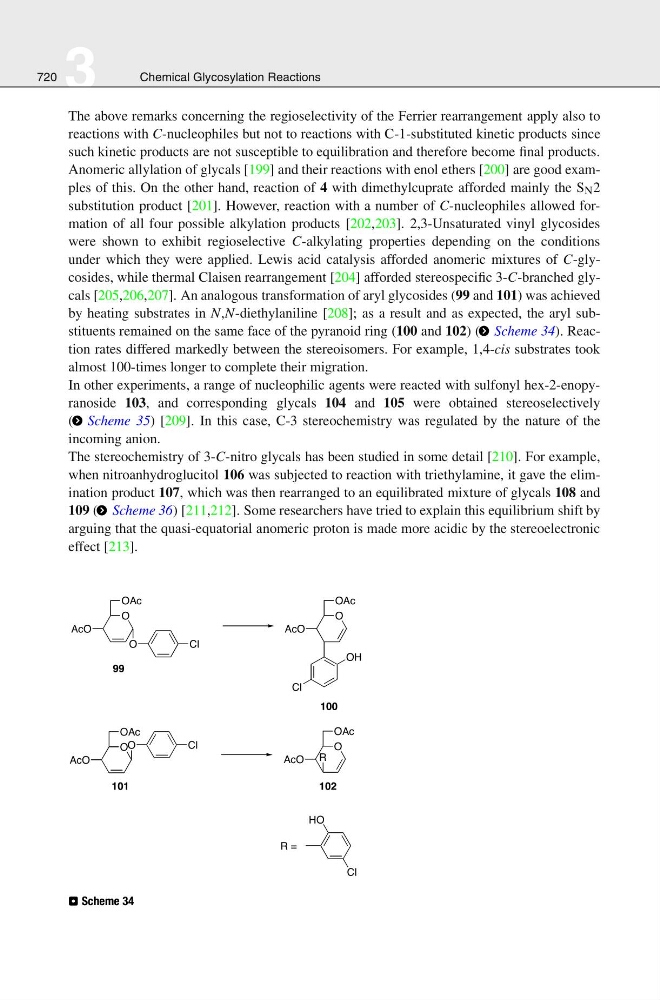
under which they were applied. Lewis acid catalysis afforded anomeric mixtures of C-glycosides, while thermal Claisen rearrangement [204] afforded stereospecific 3-C-branched glycals [205,206,207]. An analogous transformation of aryl glycosides (99 and 101) was achieved
by heating substrates in N,N-diethylaniline [208]; as a result and as expected, the aryl substituents remained on the same face of the pyranoid ring (100 and 102) ( > Scheme 34). Reaction rates differed markedly between the stereoisomers. For example, 1,4-cis substrates took
almost 100-times longer to complete their migration.
In other experiments, a range of nucleophilic agents were reacted with sulfonyl hex-2-enopyranoside 103, and corresponding glycals 104 and 105 were obtained stereoselectively
( > Scheme 35) [209]. In this case, C-3 stereochemistry was regulated by the nature of the
incoming anion.
The stereochemistry of 3-C-nitro glycals has been studied in some detail [210]. For example,
when nitroanhydroglucitol 106 was subjected to reaction with triethylamine, it gave the elimination product 107, which was then rearranged to an equilibrated mixture of glycals 108 and
109 ( > Scheme 36) [211,212]. Some researchers have tried to explain this equilibrium shift by
arguing that the quasi-equatorial anomeric proton is made more acidic by the stereoelectronic
effect [213].
⊡ Scheme 34