

712
3
Chemical Glycosylation Reactions
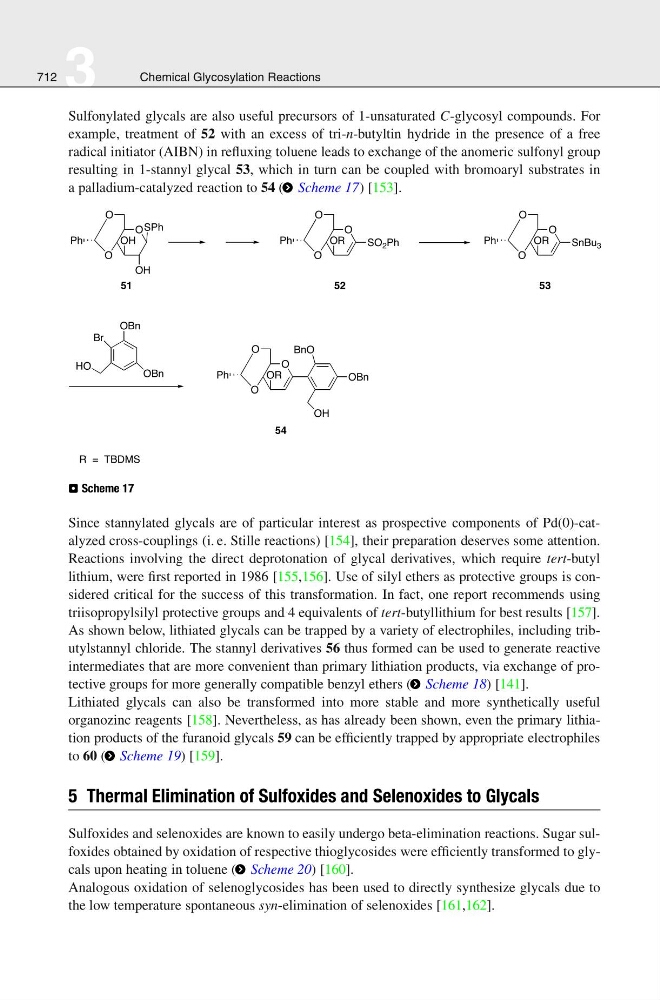
Sulfonylated glycals are also useful precursors of 1-unsaturated C-glycosyl compounds. For
example, treatment of 52 with an excess of tri-n-butyltin hydride in the presence of a free
radical initiator (AIBN) in refluxing toluene leads to exchange of the anomeric sulfonyl group
resulting in 1-stannyl glycal 53, which in turn can be coupled with bromoaryl substrates in
a palladium-catalyzed reaction to 54 ( > Scheme 17) [153].
⊡ Scheme 17
Since stannylated glycals are of particular interest as prospective components of Pd(0)-catalyzed cross-couplings (i. e. Stille reactions) [154], their preparation deserves some attention.
Reactions involving the direct deprotonation of glycal derivatives, which require tert-butyl
lithium, were first reported in 1986 [155,156]. Use of silyl ethers as protective groups is considered critical for the success of this transformation. In fact, one report recommends using
triisopropylsilyl protective groups and 4 equivalents of tert-butyllithium for best results [157].
As shown below, lithiated glycals can be trapped by a variety of electrophiles, including tributylstannyl chloride. The stannyl derivatives 56 thus formed can be used to generate reactive
intermediates that are more convenient than primary lithiation products, via exchange of protective groups for more generally compatible benzyl ethers ( > Scheme 18) [141].
Lithiated glycals can also be transformed into more stable and more synthetically useful
organozinc reagents [158]. Nevertheless, as has already been shown, even the primary lithiation products of the furanoid glycals 59 can be efficiently trapped by appropriate electrophiles
to 60 ( > Scheme 19) [159].
5 Thermal Elimination of Sulfoxides and Selenoxides to Glycals
Sulfoxides and selenoxides are known to easily undergo beta-elimination reactions. Sugar sulfoxides obtained by oxidation of respective thioglycosides were efficiently transformed to glycals upon heating in toluene ( > Scheme 20) [160].
Analogous oxidation of selenoglycosides has been used to directly synthesize glycals due to
the low temperature spontaneous syn-elimination of selenoxides [161,162].