

S-Glycosylation
3.5
689
and formation of the unprotected anomeric thiolate, utilizing the higher nucleophilicity (and
lower basicity) of sulfur in the consecutive substitution reaction is also an often used alternative.
3.2.2 The Nature of the Electrophile (Leaving Group)
In the synthesis of (1→6)-linked structures, with a primary leaving group, even less effective
leaving groups can be used. Bromides, iodides, tosylates, and triflates have been employed,
bromides and tosylates requiring harsher conditions (sodium salt, high temperature) for reaction. Obviously there is also no problem with stereochemistry, neither in the construction of
the electrophile nor in the displacement reaction. However, at secondary positions only triflates
are good enough leaving groups to allow the displacement by anomeric thiolates and the construction of thiooligosaccharides. The substitution reactions yield the inverted configuration,
which might pose a problem if the required electrophile has an unusual configuration. Accordingly, (1→4)-linked galactose and glucose derivatives are conveniently converted into each
other, as is the case with (1→2)-linked glucose and mannose derivatives. For other oligosaccharides, for instance (1→3)-linked, a more laborious construction of the electrophile is often
necessary, for example through a double inversion pathway.
Various other electrophiles have also been utilized, e. g., when their construction is more convenient than that of the corresponding triflate or when the triflate has failed to give the right
product. Ring opening of a 2,3-allo-tosylaziridine, easily available from a GlcNAc precursor, with a 1-thiofucopyranosyl derivative gave with high regioselectivity the (1→3)-linked
disaccharide ( > Scheme 56) [180,181].
Similarly, ring opening of a 2,3-talo-oxirane with the same thionucleophile gave mainly the
(1→2)-linked product ( > Scheme 57) [180,181].
After failures in the synthesis and in the use of the 3-O-allo-triflate, the corresponding cyclic
sulfamidate was constructed and reacted with the same 1-thiofucopyranosyl derivative to yield
the desired (1→3)-linked thiodisaccharide ( > Scheme 58) [182].
Other saccharide electrophiles utilized have been an α,β-unsaturated keto derivative and
ethylated thiolevoglucosan. The former yielded in a Michael addition with tetra-O-acetyl1-thio-β-D-glucopyranose the (1→4)-linked disaccharide in an excellent yield ( > Scheme 59)
[183,184]. The latter, when reacted with the sodium salt of the above glucose thiol, gave the
(1→6)-linked disaccharide as its thioethyl glycoside ( > Scheme 60) [185].
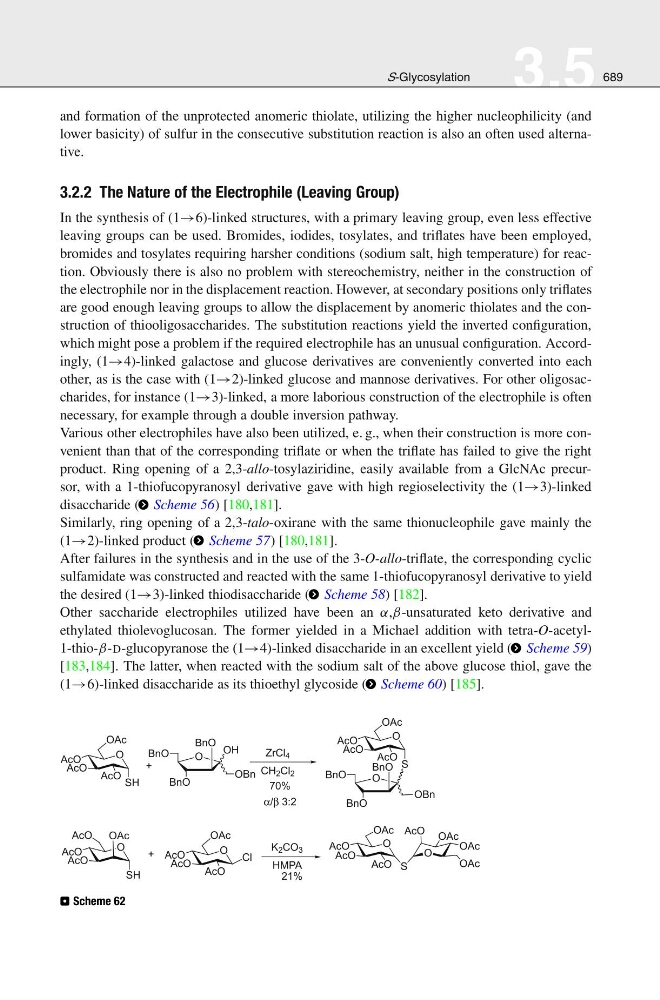
⊡ Scheme 62