

686
3
Chemical Glycosylation Reactions
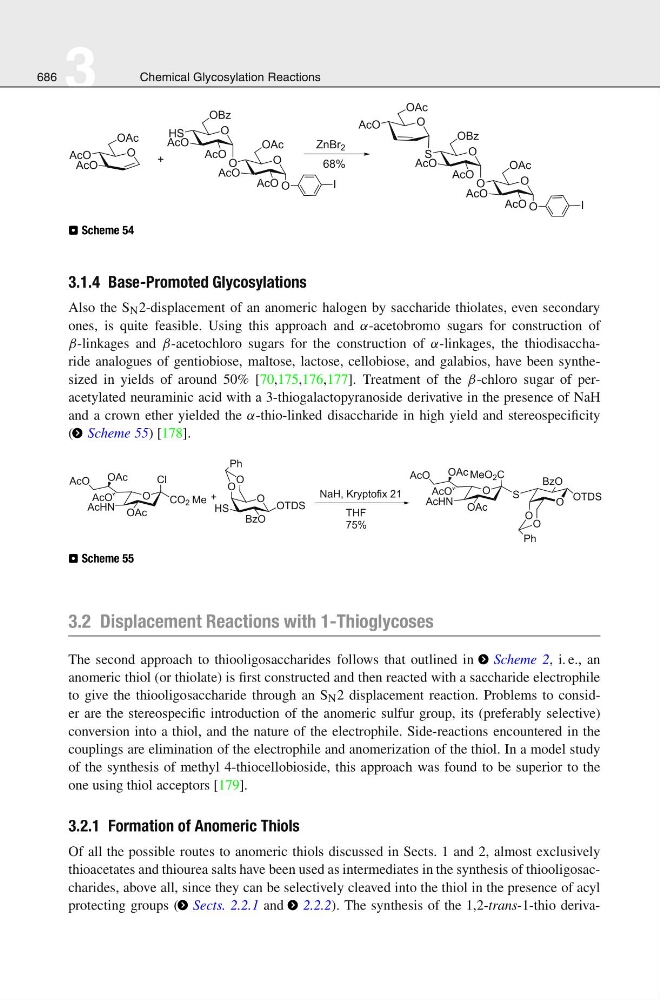
⊡ Scheme 54
3.1.4 Base-Promoted Glycosylations
Also the S N 2-displacement of an anomeric halogen by saccharide thiolates, even secondary
ones, is quite feasible. Using this approach and α-acetobromo sugars for construction of
β-linkages and β-acetochloro sugars for the construction of α-linkages, the thiodisaccharide analogues of gentiobiose, maltose, lactose, cellobiose, and galabios, have been synthesized in yields of around 50% [70,175,176,177]. Treatment of the β-chloro sugar of peracetylated neuraminic acid with a 3-thiogalactopyranoside derivative in the presence of NaH
and a crown ether yielded the α-thio-linked disaccharide in high yield and stereospecificity
( > Scheme 55) [178].
⊡ Scheme 55
3.2 Displacement Reactions with 1-Thioglycoses
The second approach to thiooligosaccharides follows that outlined in > Scheme 2, i. e., an
anomeric thiol (or thiolate) is first constructed and then reacted with a saccharide electrophile
to give the thiooligosaccharide through an S N 2 displacement reaction. Problems to consider are the stereospecific introduction of the anomeric sulfur group, its (preferably selective)
conversion into a thiol, and the nature of the electrophile. Side-reactions encountered in the
couplings are elimination of the electrophile and anomerization of the thiol. In a model study
of the synthesis of methyl 4-thiocellobioside, this approach was found to be superior to the
one using thiol acceptors [179].
3.2.1 Formation of Anomeric Thiols
Of all the possible routes to anomeric thiols discussed in Sects. 1 and 2, almost exclusively
thioacetates and thiourea salts have been used as intermediates in the synthesis of thiooligosaccharides, above all, since they can be selectively cleaved into the thiol in the presence of acyl
protecting groups ( > Sects. 2.2.1 and > 2.2.2). The synthesis of the 1,2-trans-1-thio deriva-