

Structure and Conformation of Carbohydrates
1.1
43
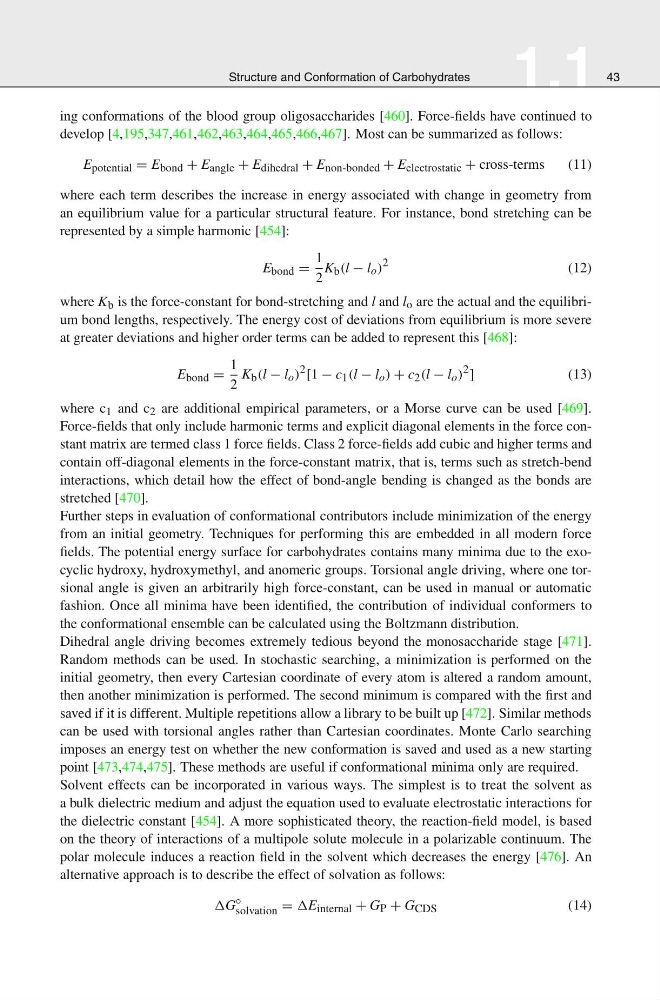
ing conformations of the blood group oligosaccharides [460]. Force-fields have continued to
develop [4,195,347,461,462,463,464,465,466,467]. Most can be summarized as follows:
E potential = E bond + E angle + E dihedral + E non-bonded + E electrostatic + cross-terms
(11)
where each term describes the increase in energy associated with change in geometry from
an equilibrium value for a particular structural feature. For instance, bond stretching can be
represented by a simple harmonic [454]:
E bond =
1
2
K b (l − l o )
2
(12)
where K b is the force-constant for bond-stretching and l and l o are the actual and the equilibrium bond lengths, respectively. The energy cost of deviations from equilibrium is more severe
at greater deviations and higher order terms can be added to represent this [468]:
E bond =
1
2
K b (l − l o )
2 [1 − c 1 (l − l o ) + c 2 (l − l o )
2 ]
(13)
where c 1 and c 2 are additional empirical parameters, or a Morse curve can be used [469].
Force-fields that only include harmonic terms and explicit diagonal elements in the force constant matrix are termed class 1 force fields. Class 2 force-fields add cubic and higher terms and
contain off-diagonal elements in the force-constant matrix, that is, terms such as stretch-bend
interactions, which detail how the effect of bond-angle bending is changed as the bonds are
stretched [470].
Further steps in evaluation of conformational contributors include minimization of the energy
from an initial geometry. Techniques for performing this are embedded in all modern force
fields. The potential energy surface for carbohydrates contains many minima due to the exocyclic hydroxy, hydroxymethyl, and anomeric groups. Torsional angle driving, where one torsional angle is given an arbitrarily high force-constant, can be used in manual or automatic
fashion. Once all minima have been identified, the contribution of individual conformers to
the conformational ensemble can be calculated using the Boltzmann distribution.
Dihedral angle driving becomes extremely tedious beyond the monosaccharide stage [471].
Random methods can be used. In stochastic searching, a minimization is performed on the
initial geometry, then every Cartesian coordinate of every atom is altered a random amount,
then another minimization is performed. The second minimum is compared with the first and
saved if it is different. Multiple repetitions allow a library to be built up [472]. Similar methods
can be used with torsional angles rather than Cartesian coordinates. Monte Carlo searching
imposes an energy test on whether the new conformation is saved and used as a new starting
point [473,474,475]. These methods are useful if conformational minima only are required.
Solvent effects can be incorporated in various ways. The simplest is to treat the solvent as
a bulk dielectric medium and adjust the equation used to evaluate electrostatic interactions for
the dielectric constant [454]. A more sophisticated theory, the reaction-field model, is based
on the theory of interactions of a multipole solute molecule in a polarizable continuum. The
polar molecule induces a reaction field in the solvent which decreases the energy [476]. An
alternative approach is to describe the effect of solvation as follows:
G
◦
solvation = E internal + G P + G CDS
(14)
1.1
43
ing conformations of the blood group oligosaccharides [460]. Force-fields have continued to
develop [4,195,347,461,462,463,464,465,466,467]. Most can be summarized as follows:
E potential = E bond + E angle + E dihedral + E non-bonded + E electrostatic + cross-terms
(11)
where each term describes the increase in energy associated with change in geometry from
an equilibrium value for a particular structural feature. For instance, bond stretching can be
represented by a simple harmonic [454]:
E bond =
1
2
K b (l − l o )
2
(12)
where K b is the force-constant for bond-stretching and l and l o are the actual and the equilibrium bond lengths, respectively. The energy cost of deviations from equilibrium is more severe
at greater deviations and higher order terms can be added to represent this [468]:
E bond =
1
2
K b (l − l o )
2 [1 − c 1 (l − l o ) + c 2 (l − l o )
2 ]
(13)
where c 1 and c 2 are additional empirical parameters, or a Morse curve can be used [469].
Force-fields that only include harmonic terms and explicit diagonal elements in the force constant matrix are termed class 1 force fields. Class 2 force-fields add cubic and higher terms and
contain off-diagonal elements in the force-constant matrix, that is, terms such as stretch-bend
interactions, which detail how the effect of bond-angle bending is changed as the bonds are
stretched [470].
Further steps in evaluation of conformational contributors include minimization of the energy
from an initial geometry. Techniques for performing this are embedded in all modern force
fields. The potential energy surface for carbohydrates contains many minima due to the exocyclic hydroxy, hydroxymethyl, and anomeric groups. Torsional angle driving, where one torsional angle is given an arbitrarily high force-constant, can be used in manual or automatic
fashion. Once all minima have been identified, the contribution of individual conformers to
the conformational ensemble can be calculated using the Boltzmann distribution.
Dihedral angle driving becomes extremely tedious beyond the monosaccharide stage [471].
Random methods can be used. In stochastic searching, a minimization is performed on the
initial geometry, then every Cartesian coordinate of every atom is altered a random amount,
then another minimization is performed. The second minimum is compared with the first and
saved if it is different. Multiple repetitions allow a library to be built up [472]. Similar methods
can be used with torsional angles rather than Cartesian coordinates. Monte Carlo searching
imposes an energy test on whether the new conformation is saved and used as a new starting
point [473,474,475]. These methods are useful if conformational minima only are required.
Solvent effects can be incorporated in various ways. The simplest is to treat the solvent as
a bulk dielectric medium and adjust the equation used to evaluate electrostatic interactions for
the dielectric constant [454]. A more sophisticated theory, the reaction-field model, is based
on the theory of interactions of a multipole solute molecule in a polarizable continuum. The
polar molecule induces a reaction field in the solvent which decreases the energy [476]. An
alternative approach is to describe the effect of solvation as follows:
G
◦
solvation = E internal + G P + G CDS
(14)