

S-Glycosylation
3.5
673
With a more acid-labile O-glycoside, the transformation into a thioglycoside can be performed
more efficiently. Accordingly, variously protected p-methoxyphenyl mono- and disaccharides
have been smoothly converted into the corresponding phenyl thioglycosides using thiophenol
and BF 3 -etherate ( > Scheme 22) [95]. With a 2-participating group the β-selectivity of the
reaction is high, but, as above, with a non-participating group in the 2-position the α-anomer
heavily prevails in the product thioglycoside.
Deoxy functions in the sugar ring also increase the acid lability of the glycoside. Thus, was
the methyl glycoside of daunosamine (2,3,6-trideoxy-3-amino-L-lyxo-hexopyranose) efficiently transformed into the corresponding aryl thioglycoside by treatment with a thiol and BF 3 -
etherate ( > Scheme 23) [96]. The reaction was highly α-selective.
2.1.6 From Glycals
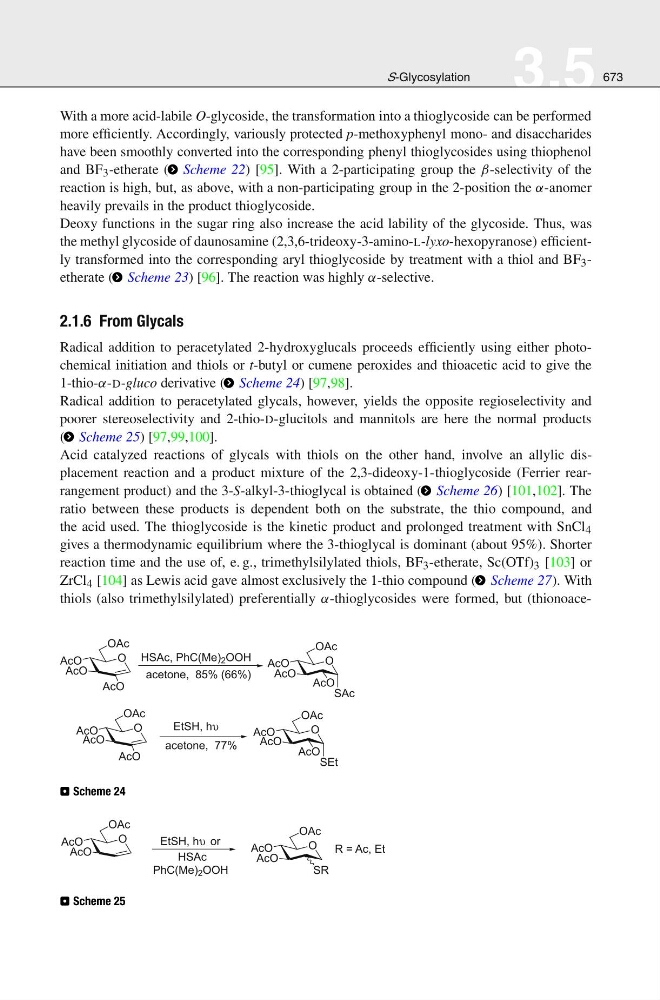
Radical addition to peracetylated 2-hydroxyglucals proceeds efficiently using either photochemical initiation and thiols or t-butyl or cumene peroxides and thioacetic acid to give the
1-thio-α-D-gluco derivative ( > Scheme 24) [97,98].
Radical addition to peracetylated glycals, however, yields the opposite regioselectivity and
poorer stereoselectivity and 2-thio-D-glucitols and mannitols are here the normal products
( > Scheme 25) [97,99,100].
Acid catalyzed reactions of glycals with thiols on the other hand, involve an allylic displacement reaction and a product mixture of the 2,3-dideoxy-1-thioglycoside (Ferrier rearrangement product) and the 3-S-alkyl-3-thioglycal is obtained ( > Scheme 26) [101,102]. The
ratio between these products is dependent both on the substrate, the thio compound, and
the acid used. The thioglycoside is the kinetic product and prolonged treatment with SnCl 4
gives a thermodynamic equilibrium where the 3-thioglycal is dominant (about 95%). Shorter
reaction time and the use of, e. g., trimethylsilylated thiols, BF 3 -etherate, Sc(OTf) 3 [103] or
ZrCl 4 [104] as Lewis acid gave almost exclusively the 1-thio compound ( > Scheme 27). With
thiols (also trimethylsilylated) preferentially α-thioglycosides were formed, but (thionoace⊡ Scheme 24
⊡ Scheme 25