

S-Glycosylation
3.5
671
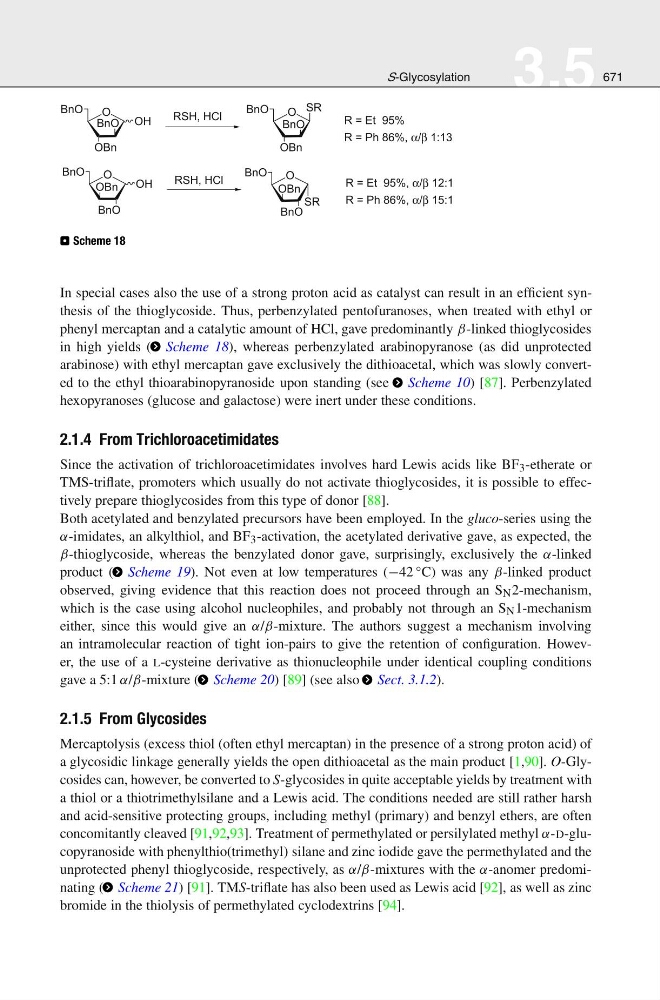
⊡ Scheme 18
In special cases also the use of a strong proton acid as catalyst can result in an efficient synthesis of the thioglycoside. Thus, perbenzylated pentofuranoses, when treated with ethyl or
phenyl mercaptan and a catalytic amount of HCl, gave predominantly β-linked thioglycosides
in high yields ( > Scheme 18), whereas perbenzylated arabinopyranose (as did unprotected
arabinose) with ethyl mercaptan gave exclusively the dithioacetal, which was slowly converted to the ethyl thioarabinopyranoside upon standing (see > Scheme 10) [87]. Perbenzylated
hexopyranoses (glucose and galactose) were inert under these conditions.
2.1.4 From Trichloroacetimidates
Since the activation of trichloroacetimidates involves hard Lewis acids like BF 3 -etherate or
TMS-triflate, promoters which usually do not activate thioglycosides, it is possible to effectively prepare thioglycosides from this type of donor [88].
Both acetylated and benzylated precursors have been employed. In the gluco-series using the
α-imidates, an alkylthiol, and BF 3 -activation, the acetylated derivative gave, as expected, the
β-thioglycoside, whereas the benzylated donor gave, surprisingly, exclusively the α-linked
product ( > Scheme 19). Not even at low temperatures (−42 °C) was any β-linked product
observed, giving evidence that this reaction does not proceed through an S N 2-mechanism,
which is the case using alcohol nucleophiles, and probably not through an S N 1-mechanism
either, since this would give an α/β-mixture. The authors suggest a mechanism involving
an intramolecular reaction of tight ion-pairs to give the retention of configuration. However, the use of a L-cysteine derivative as thionucleophile under identical coupling conditions
gave a 5:1 α/β-mixture ( > Scheme 20) [89] (see also > Sect. 3.1.2).
2.1.5 From Glycosides
Mercaptolysis (excess thiol (often ethyl mercaptan) in the presence of a strong proton acid) of
a glycosidic linkage generally yields the open dithioacetal as the main product [1,90]. O-Glycosides can, however, be converted to S-glycosides in quite acceptable yields by treatment with
a thiol or a thiotrimethylsilane and a Lewis acid. The conditions needed are still rather harsh
and acid-sensitive protecting groups, including methyl (primary) and benzyl ethers, are often
concomitantly cleaved [91,92,93]. Treatment of permethylated or persilylated methyl α-D-glucopyranoside with phenylthio(trimethyl) silane and zinc iodide gave the permethylated and the
unprotected phenyl thioglycoside, respectively, as α/β-mixtures with the α-anomer predominating ( > Scheme 21) [91]. TMS-triflate has also been used as Lewis acid [92], as well as zinc
bromide in the thiolysis of permethylated cyclodextrins [94].