

O-Glycosyl Donors
3.4
653
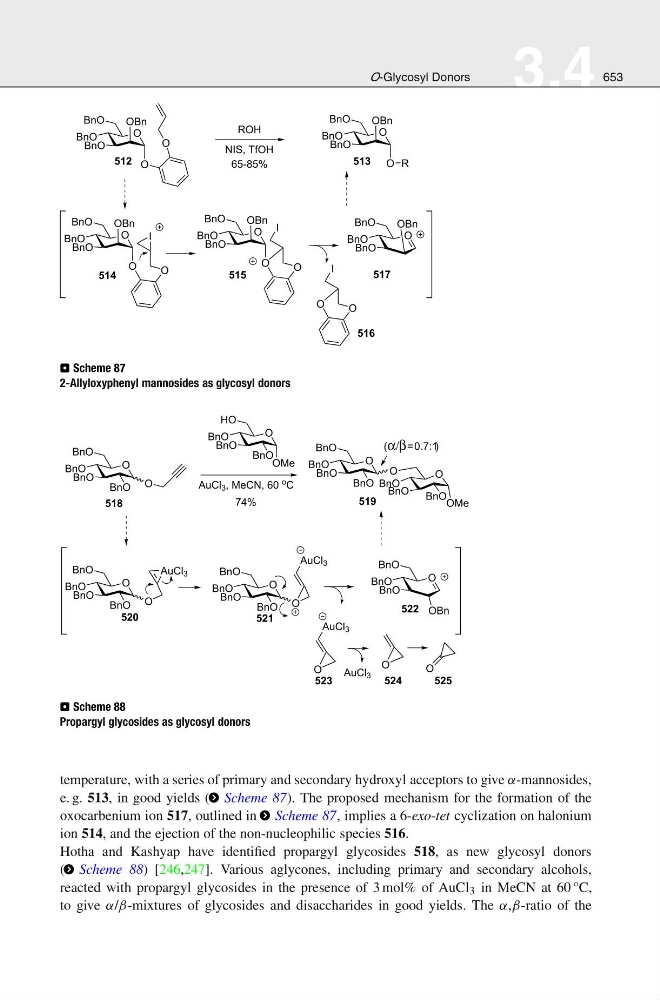
⊡ Scheme 87
2-Allyloxyphenyl mannosides as glycosyl donors
⊡ Scheme 88
Propargyl glycosides as glycosyl donors
temperature, with a series of primary and secondary hydroxyl acceptors to give α-mannosides,
e. g. 513, in good yields ( > Scheme 87). The proposed mechanism for the formation of the
oxocarbenium ion 517, outlined in > Scheme 87, implies a 6-exo-tet cyclization on halonium
ion 514, and the ejection of the non-nucleophilic species 516.
Hotha and Kashyap have identified propargyl glycosides 518, as new glycosyl donors
( > Scheme 88) [246,247]. Various aglycones, including primary and secondary alcohols,
reacted with propargyl glycosides in the presence of 3 mol% of AuCl 3 in MeCN at 60 °C,
to give α/β-mixtures of glycosides and disaccharides in good yields. The α,β-ratio of the