

Structure and Conformation of Carbohydrates
1.1
41
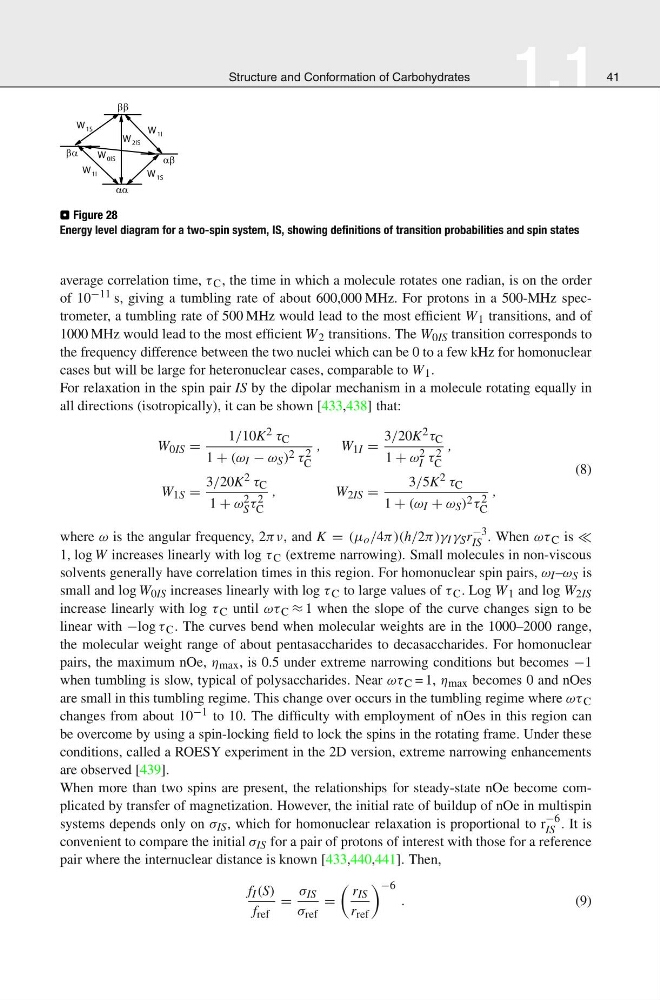
⊡ Figure 28
Energy level diagram for a two-spin system, IS, showing definitions of transition probabilities and spin states
average correlation time, τ C , the time in which a molecule rotates one radian, is on the order
of 10 −11 s, giving a tumbling rate of about 600,000 MHz. For protons in a 500-MHz spectrometer, a tumbling rate of 500 MHz would lead to the most efficient W 1 transitions, and of
1000 MHz would lead to the most efficient W 2 transitions. The W 0IS transition corresponds to
the frequency difference between the two nuclei which can be 0 to a few kHz for homonuclear
cases but will be large for heteronuclear cases, comparable to W 1 .
For relaxation in the spin pair IS by the dipolar mechanism in a molecule rotating equally in
all directions (isotropically), it can be shown [433,438] that:
W 0IS =
1/10K 2 τ C
1 + (ω I − ω S ) 2 τ 2
C
, W 1I =
3/20K 2 τ C
1 + ω 2
I τ 2
C
,
W 1S =
3/20K 2 τ C
1 + ω 2
S τ 2
C
,
W 2IS =
3/5K 2 τ C
1 + (ω I + ω S ) 2 τ 2
C
,
(8)
where ω is the angular frequency, 2πν, and K = (μ o /4π)(h/2π)γ I γ S r
−3
IS . When ωτ C is
1, log W increases linearly with log τ C (extreme narrowing). Small molecules in non-viscous
solvents generally have correlation times in this region. For homonuclear spin pairs, ω I –ω S is
small and log W 0IS increases linearly with log τ C to large values of τ C . Log W 1 and log W 2IS
increase linearly with log τ C until ωτ C ≈ 1 when the slope of the curve changes sign to be
linear with −log τ C . The curves bend when molecular weights are in the 1000–2000 range,
the molecular weight range of about pentasaccharides to decasaccharides. For homonuclear
pairs, the maximum nOe, η max , is 0.5 under extreme narrowing conditions but becomes −1
when tumbling is slow, typical of polysaccharides. Near ωτ C = 1, η max becomes 0 and nOes
are small in this tumbling regime. This change over occurs in the tumbling regime where ωτ C
changes from about 10 −1 to 10. The difficulty with employment of nOes in this region can
be overcome by using a spin-locking field to lock the spins in the rotating frame. Under these
conditions, called a ROESY experiment in the 2D version, extreme narrowing enhancements
are observed [439].
When more than two spins are present, the relationships for steady-state nOe become complicated by transfer of magnetization. However, the initial rate of buildup of nOe in multispin
systems depends only on σ IS , which for homonuclear relaxation is proportional to r
−6
IS . It is
convenient to compare the initial σ IS for a pair of protons of interest with those for a reference
pair where the internuclear distance is known [433,440,441]. Then,
f I (S)
f ref
=
σ IS
σ ref
=
r IS
r ref
−6
.
(9)
1.1
41
⊡ Figure 28
Energy level diagram for a two-spin system, IS, showing definitions of transition probabilities and spin states
average correlation time, τ C , the time in which a molecule rotates one radian, is on the order
of 10 −11 s, giving a tumbling rate of about 600,000 MHz. For protons in a 500-MHz spectrometer, a tumbling rate of 500 MHz would lead to the most efficient W 1 transitions, and of
1000 MHz would lead to the most efficient W 2 transitions. The W 0IS transition corresponds to
the frequency difference between the two nuclei which can be 0 to a few kHz for homonuclear
cases but will be large for heteronuclear cases, comparable to W 1 .
For relaxation in the spin pair IS by the dipolar mechanism in a molecule rotating equally in
all directions (isotropically), it can be shown [433,438] that:
W 0IS =
1/10K 2 τ C
1 + (ω I − ω S ) 2 τ 2
C
, W 1I =
3/20K 2 τ C
1 + ω 2
I τ 2
C
,
W 1S =
3/20K 2 τ C
1 + ω 2
S τ 2
C
,
W 2IS =
3/5K 2 τ C
1 + (ω I + ω S ) 2 τ 2
C
,
(8)
where ω is the angular frequency, 2πν, and K = (μ o /4π)(h/2π)γ I γ S r
−3
IS . When ωτ C is
1, log W increases linearly with log τ C (extreme narrowing). Small molecules in non-viscous
solvents generally have correlation times in this region. For homonuclear spin pairs, ω I –ω S is
small and log W 0IS increases linearly with log τ C to large values of τ C . Log W 1 and log W 2IS
increase linearly with log τ C until ωτ C ≈ 1 when the slope of the curve changes sign to be
linear with −log τ C . The curves bend when molecular weights are in the 1000–2000 range,
the molecular weight range of about pentasaccharides to decasaccharides. For homonuclear
pairs, the maximum nOe, η max , is 0.5 under extreme narrowing conditions but becomes −1
when tumbling is slow, typical of polysaccharides. Near ωτ C = 1, η max becomes 0 and nOes
are small in this tumbling regime. This change over occurs in the tumbling regime where ωτ C
changes from about 10 −1 to 10. The difficulty with employment of nOes in this region can
be overcome by using a spin-locking field to lock the spins in the rotating frame. Under these
conditions, called a ROESY experiment in the 2D version, extreme narrowing enhancements
are observed [439].
When more than two spins are present, the relationships for steady-state nOe become complicated by transfer of magnetization. However, the initial rate of buildup of nOe in multispin
systems depends only on σ IS , which for homonuclear relaxation is proportional to r
−6
IS . It is
convenient to compare the initial σ IS for a pair of protons of interest with those for a reference
pair where the internuclear distance is known [433,440,441]. Then,
f I (S)
f ref
=
σ IS
σ ref
=
r IS
r ref
−6
.
(9)