

O-Glycosyl Donors
3.4
649
6.3.3 MOP Glycosides in Oligosaccharide Synthesis
A solid-phase oligosaccharide synthesis based on the MOP donor/acceptor methodology was
developed by Hanessian and co-workers [224]. Thus, an O-unprotected polymer-phase bound
MOP donor is coupled with an excess of a partially esterified MOP acceptor. Selective removal
of the ester (or related protecting groups) from the new saccharides generates a new O-unprotected MOP donor to engage in a subsequent iteration.
Hanessian and co-workers also illustrated the usefulness of the MOP methodology with some
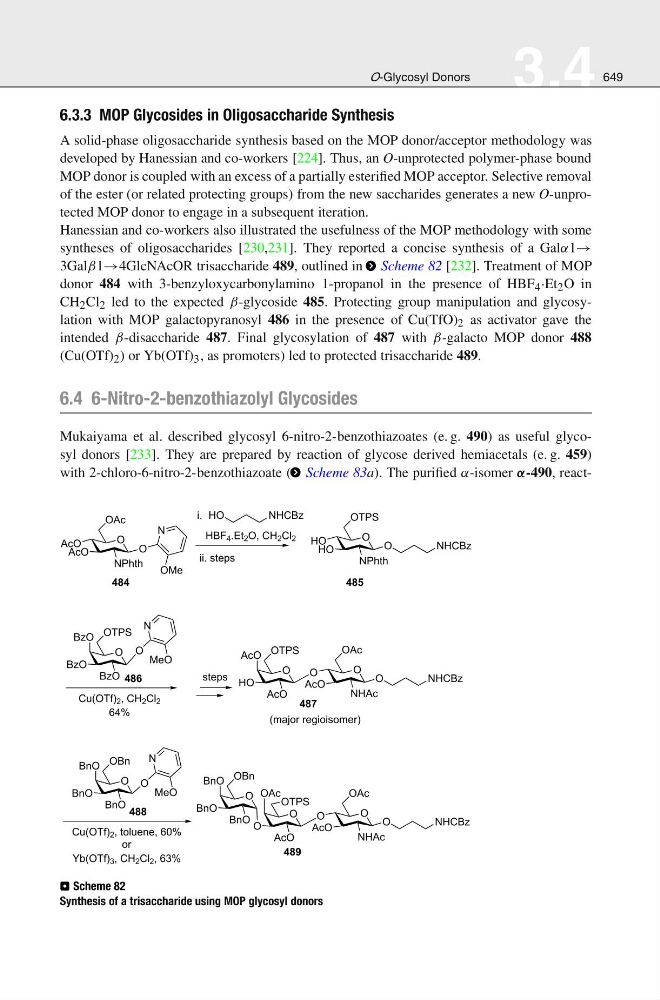
syntheses of oligosaccharides [230,231]. They reported a concise synthesis of a Galα1→
3Galβ1→4GlcNAcOR trisaccharide 489, outlined in > Scheme 82 [232]. Treatment of MOP
donor 484 with 3-benzyloxycarbonylamino 1-propanol in the presence of HBF 4 ·Et 2 O in
CH 2 Cl 2 led to the expected β-glycoside 485. Protecting group manipulation and glycosylation with MOP galactopyranosyl 486 in the presence of Cu(TfO) 2 as activator gave the
intended β-disaccharide 487. Final glycosylation of 487 with β-galacto MOP donor 488
(Cu(OTf) 2 ) or Yb(OTf) 3 , as promoters) led to protected trisaccharide 489.
6.4 6-Nitro-2-benzothiazolyl Glycosides
Mukaiyama et al. described glycosyl 6-nitro-2-benzothiazoates (e. g. 490) as useful glycosyl donors [233]. They are prepared by reaction of glycose derived hemiacetals (e. g. 459)
with 2-chloro-6-nitro-2-benzothiazoate ( > Scheme 83a). The purified α-isomer α-490, react⊡ Scheme 82
Synthesis of a trisaccharide using MOP glycosyl donors