

O-Glycosyl Donors
3.4
645
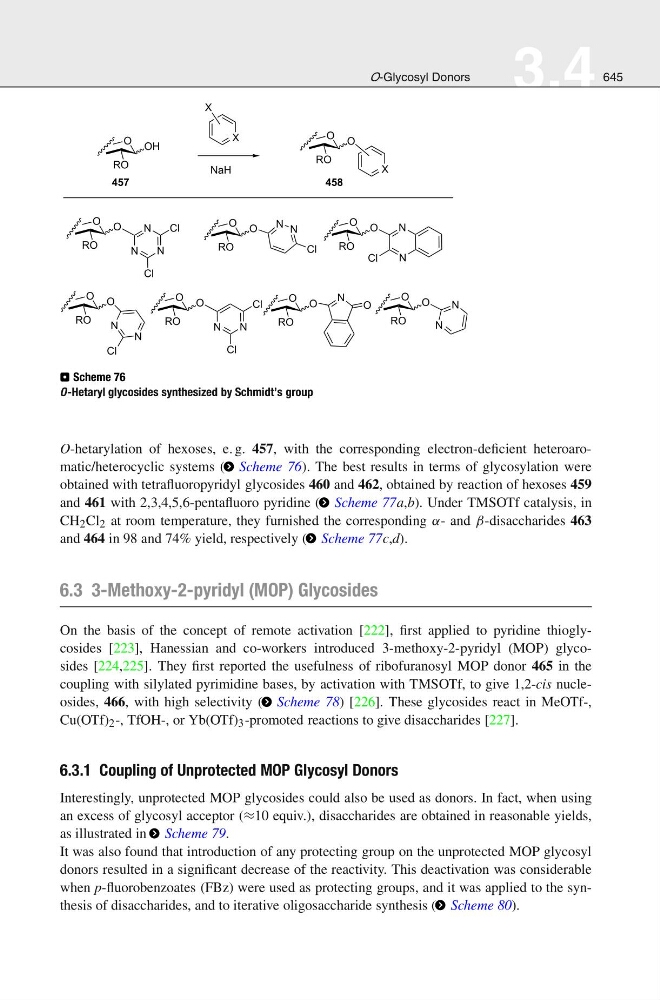
⊡ Scheme 76
O-Hetaryl glycosides synthesized by Schmidt’s group
O-hetarylation of hexoses, e. g. 457, with the corresponding electron-deficient heteroaromatic/heterocyclic systems ( > Scheme 76). The best results in terms of glycosylation were
obtained with tetrafluoropyridyl glycosides 460 and 462, obtained by reaction of hexoses 459
and 461 with 2,3,4,5,6-pentafluoro pyridine ( > Scheme 77a,b). Under TMSOTf catalysis, in
CH 2 Cl 2 at room temperature, they furnished the corresponding α- and β-disaccharides 463
and 464 in 98 and 74% yield, respectively ( > Scheme 77c,d).
6.3 3-Methoxy-2-pyridyl (MOP) Glycosides
On the basis of the concept of remote activation [222], first applied to pyridine thioglycosides [223], Hanessian and co-workers introduced 3-methoxy-2-pyridyl (MOP) glycosides [224,225]. They first reported the usefulness of ribofuranosyl MOP donor 465 in the
coupling with silylated pyrimidine bases, by activation with TMSOTf, to give 1,2-cis nucleosides, 466, with high selectivity ( > Scheme 78) [226]. These glycosides react in MeOTf-,
Cu(OTf) 2 -, TfOH-, or Yb(OTf) 3 -promoted reactions to give disaccharides [227].
6.3.1 Coupling of Unprotected MOP Glycosyl Donors
Interestingly, unprotected MOP glycosides could also be used as donors. In fact, when using
an excess of glycosyl acceptor (≈10 equiv.), disaccharides are obtained in reasonable yields,
as illustrated in > Scheme 79.
It was also found that introduction of any protecting group on the unprotected MOP glycosyl
donors resulted in a significant decrease of the reactivity. This deactivation was considerable
when p-fluorobenzoates (FBz) were used as protecting groups, and it was applied to the synthesis of disaccharides, and to iterative oligosaccharide synthesis ( > Scheme 80).