

O-Glycosyl Donors
3.4
643
5.6.4 Total Synthesis of Agelagalastatin
The total synthesis of agelagalastatin, an antineoplastic glycosphingolipid, has been described
by Kim and co-workers [217]. The retrosynthesis, outlined in > Scheme 72, involved a β-Dgalactofuranosylation, an α-D-galactofuranosylation, and a final α-D-galactopyranosylation.
The β-D-galactofuranosylation was achieved in 79% yield via neighboring group participation of the pivaloyl group at O2 in compound 445. The α-D-galactofuranosylation to 441,
took place with 91% yield with a nonparticipant benzyl group at O2 in donor 443. The final
α-D-galactopyranosylation ( > Scheme 73) was carried out with CB trisaccharide donor 441
furnishing compound 447 in 77% yield as a 1.4:1 (α/β) mixture of saccharides. The efficiency of this coupling was improved by conversion of the CB trisaccharide donor to glycosyl
fluoride 448. Treatment of 441 with TF 2 O/DTBMP followed by HF-pyridine, as a source of
fluoride, yielded glycosyl fluoride 448. The glycosylation of acceptor 442 with glycosyl fluoride 448, then gave the target protected agelagalastatin 447, in 72% yield as the pure α-isomer.
5.7 Conversion of 2 -Carboxybenzyl Glycosides
into Other Glycosyl Donors
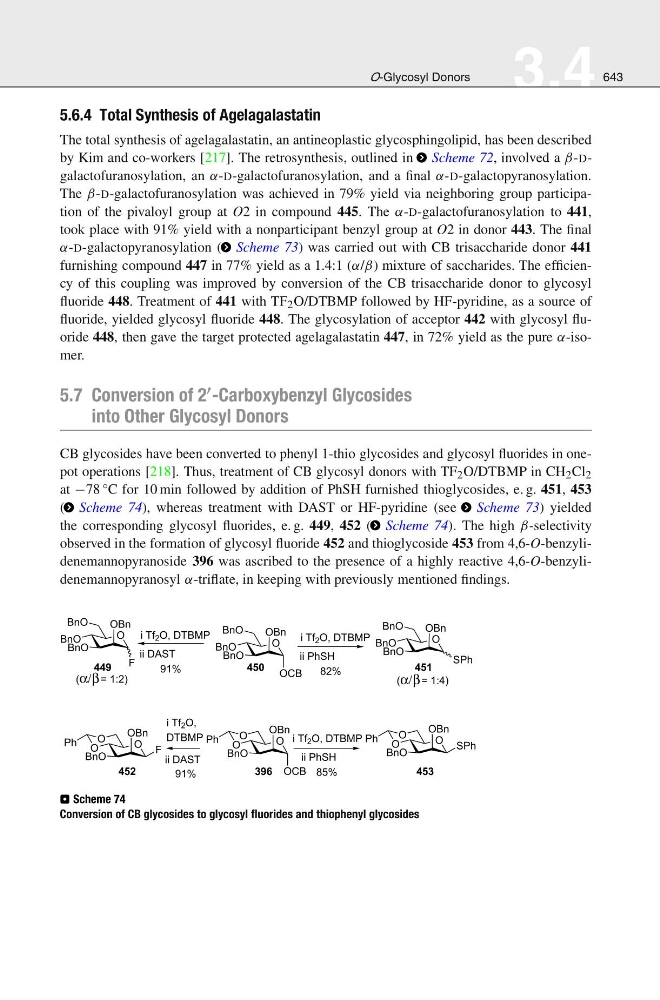
CB glycosides have been converted to phenyl 1-thio glycosides and glycosyl fluorides in onepot operations [218]. Thus, treatment of CB glycosyl donors with TF 2 O/DTBMP in CH 2 Cl 2
at −78 °C for 10 min followed by addition of PhSH furnished thioglycosides, e. g. 451, 453
( > Scheme 74), whereas treatment with DAST or HF-pyridine (see > Scheme 73) yielded
the corresponding glycosyl fluorides, e. g. 449, 452 ( > Scheme 74). The high β-selectivity
observed in the formation of glycosyl fluoride 452 and thioglycoside 453 from 4,6-O-benzylidenemannopyranoside 396 was ascribed to the presence of a highly reactive 4,6-O-benzylidenemannopyranosyl α-triflate, in keeping with previously mentioned findings.
⊡ Scheme 74
Conversion of CB glycosides to glycosyl fluorides and thiophenyl glycosides