

O-Glycosyl Donors
3.4
641
92% yield. Finally, glycosylation of 3-C-methyl mannoside, 430, with 429b yielded the target
α-trisaccharide 431, along with its β-anomer in 7:1 ratio in 80% yield. A result that indicated
that neighboring group participation is operative in CB glycosides.
5.6.2 Synthesis of Tetrasaccharide 438
The CB methodology was also applied to the synthesis of protected tetrasaccharide 438, an
analogue of the tetrasaccharide repeat unit of the O-antigen polysaccharide from the E. coli
lipopolysaccharide ( > Scheme 70) [215]. Coupling of “latent” BCB acceptor 433 with “active”
CB glycosyl donor 432 gave a mixture of α-disaccharide 434a along with its β-isomer (4:1) in
74% yield ( > Scheme 70a). Glycosylation of acceptor 436 with donor 435 gave β-mannoside
437a, that after removal of the PMB protecting group led to 437b ( > Scheme 70b). Finally,
coupling of the latter with active donor 434b, prepared from latent 434a, yielded tetrasaccharide 438, in 75% yield ( > Scheme 70c).
5.6.3 Synthesis of Tetrasaccharide Repeat Unit from E. coli O77
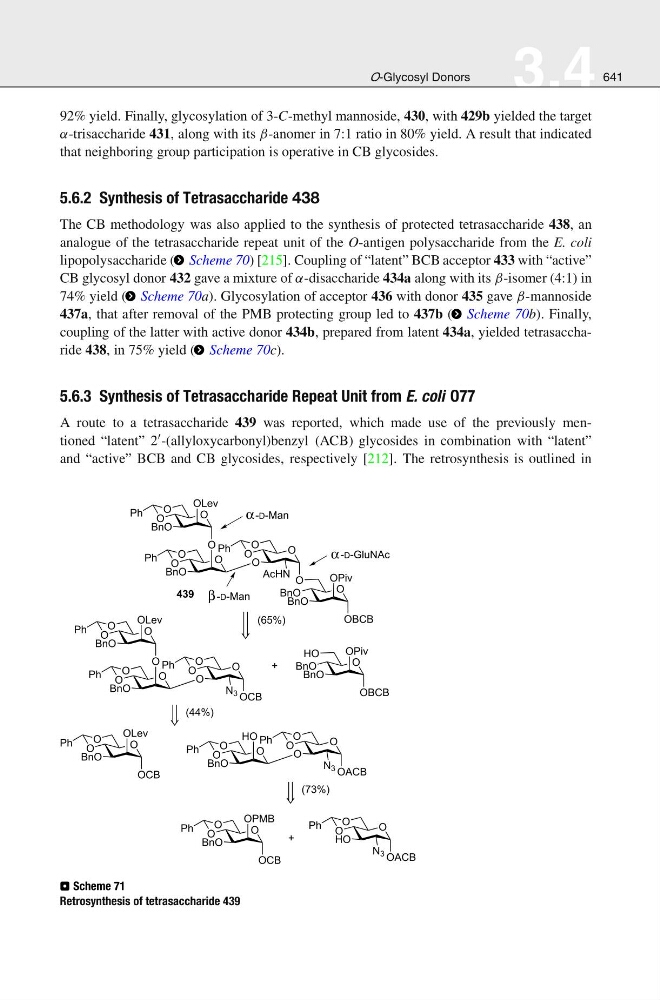
A route to a tetrasaccharide 439 was reported, which made use of the previously mentioned “latent” 2 -(allyloxycarbonyl)benzyl (ACB) glycosides in combination with “latent”
and “active” BCB and CB glycosides, respectively [212]. The retrosynthesis is outlined in
⊡ Scheme 71
Retrosynthesis of tetrasaccharide 439