

628
3
Chemical Glycosylation Reactions
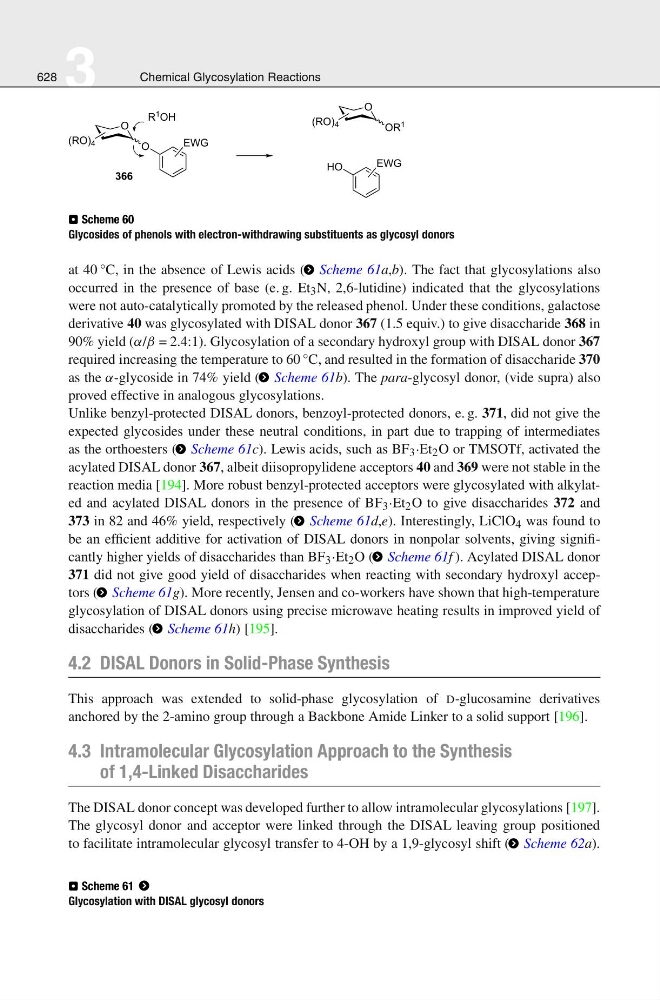
⊡ Scheme 60
Glycosides of phenols with electron-withdrawing substituents as glycosyl donors
at 40 °C, in the absence of Lewis acids ( > Scheme 61a,b). The fact that glycosylations also
occurred in the presence of base (e. g. Et 3 N, 2,6-lutidine) indicated that the glycosylations
were not auto-catalytically promoted by the released phenol. Under these conditions, galactose
derivative 40 was glycosylated with DISAL donor 367 (1.5 equiv.) to give disaccharide 368 in
90% yield (α/β = 2.4:1). Glycosylation of a secondary hydroxyl group with DISAL donor 367
required increasing the temperature to 60 °C, and resulted in the formation of disaccharide 370
as the α-glycoside in 74% yield ( > Scheme 61b). The para-glycosyl donor, (vide supra) also
proved effective in analogous glycosylations.
Unlike benzyl-protected DISAL donors, benzoyl-protected donors, e. g. 371, did not give the
expected glycosides under these neutral conditions, in part due to trapping of intermediates
as the orthoesters ( > Scheme 61c). Lewis acids, such as BF 3 ·Et 2 O or TMSOTf, activated the
acylated DISAL donor 367, albeit diisopropylidene acceptors 40 and 369 were not stable in the
reaction media [194]. More robust benzyl-protected acceptors were glycosylated with alkylated and acylated DISAL donors in the presence of BF 3 ·Et 2 O to give disaccharides 372 and
373 in 82 and 46% yield, respectively ( > Scheme 61d,e). Interestingly, LiClO 4 was found to
be an efficient additive for activation of DISAL donors in nonpolar solvents, giving significantly higher yields of disaccharides than BF 3 ·Et 2 O ( > Scheme 61f ). Acylated DISAL donor
371 did not give good yield of disaccharides when reacting with secondary hydroxyl acceptors ( > Scheme 61g). More recently, Jensen and co-workers have shown that high-temperature
glycosylation of DISAL donors using precise microwave heating results in improved yield of
disaccharides ( > Scheme 61h) [195].
4.2 DISAL Donors in Solid-Phase Synthesis
This approach was extended to solid-phase glycosylation of D-glucosamine derivatives
anchored by the 2-amino group through a Backbone Amide Linker to a solid support [196].
4.3 Intramolecular Glycosylation Approach to the Synthesis
of 1,4-Linked Disaccharides
The DISAL donor concept was developed further to allow intramolecular glycosylations [197].
The glycosyl donor and acceptor were linked through the DISAL leaving group positioned
to facilitate intramolecular glycosyl transfer to 4-OH by a 1,9-glycosyl shift ( > Scheme 62a).
⊡ Scheme 61 >
Glycosylation with DISAL glycosyl donors