

O-Glycosyl Donors
3.4
621
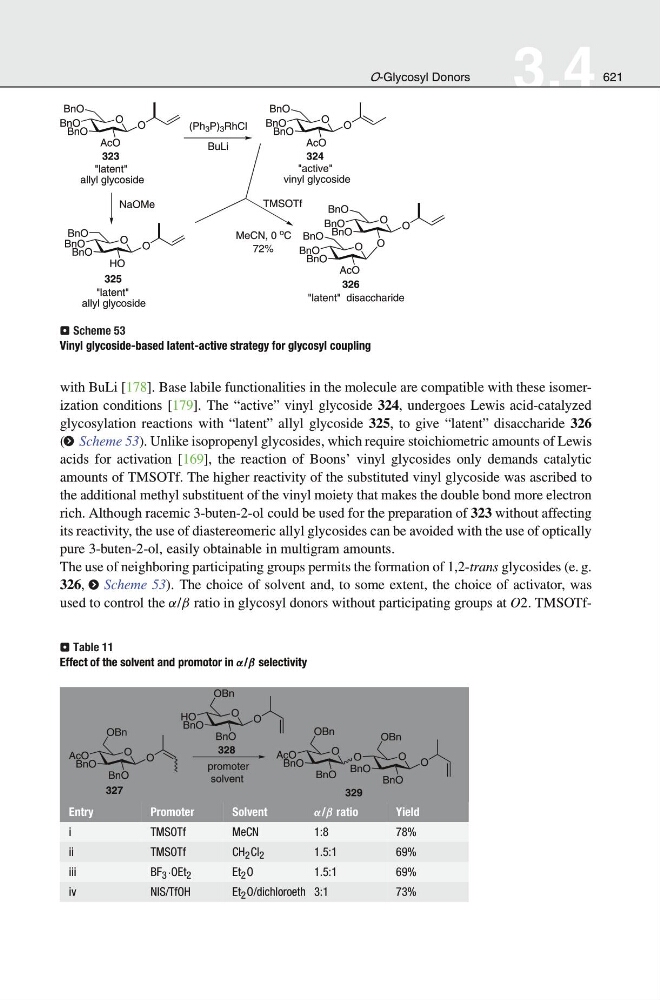
⊡ Scheme 53
Vinyl glycoside-based latent-active strategy for glycosyl coupling
with BuLi [178]. Base labile functionalities in the molecule are compatible with these isomerization conditions [179]. The “active” vinyl glycoside 324, undergoes Lewis acid-catalyzed
glycosylation reactions with “latent” allyl glycoside 325, to give “latent” disaccharide 326
( > Scheme 53). Unlike isopropenyl glycosides, which require stoichiometric amounts of Lewis
acids for activation [169], the reaction of Boons’ vinyl glycosides only demands catalytic
amounts of TMSOTf. The higher reactivity of the substituted vinyl glycoside was ascribed to
the additional methyl substituent of the vinyl moiety that makes the double bond more electron
rich. Although racemic 3-buten-2-ol could be used for the preparation of 323 without affecting
its reactivity, the use of diastereomeric allyl glycosides can be avoided with the use of optically
pure 3-buten-2-ol, easily obtainable in multigram amounts.
The use of neighboring participating groups permits the formation of 1,2-trans glycosides (e. g.
326, > Scheme 53). The choice of solvent and, to some extent, the choice of activator, was
used to control the α/β ratio in glycosyl donors without participating groups at O2. TMSOTf⊡ Table 11
Effect of the solvent and promotor in α/β selectivity
Entry
Promoter
Solvent
α/β ratio
Yield
i
TMSOTf
MeCN
1:8
78%
ii
TMSOTf
CH 2 Cl 2
1.5:1
69%
iii
BF 3 ·OEt 2
Et 2 O
1.5:1
69%
iv
NIS/TfOH
Et 2 O/dichloroethane 3:1
73%