

618
3
Chemical Glycosylation Reactions
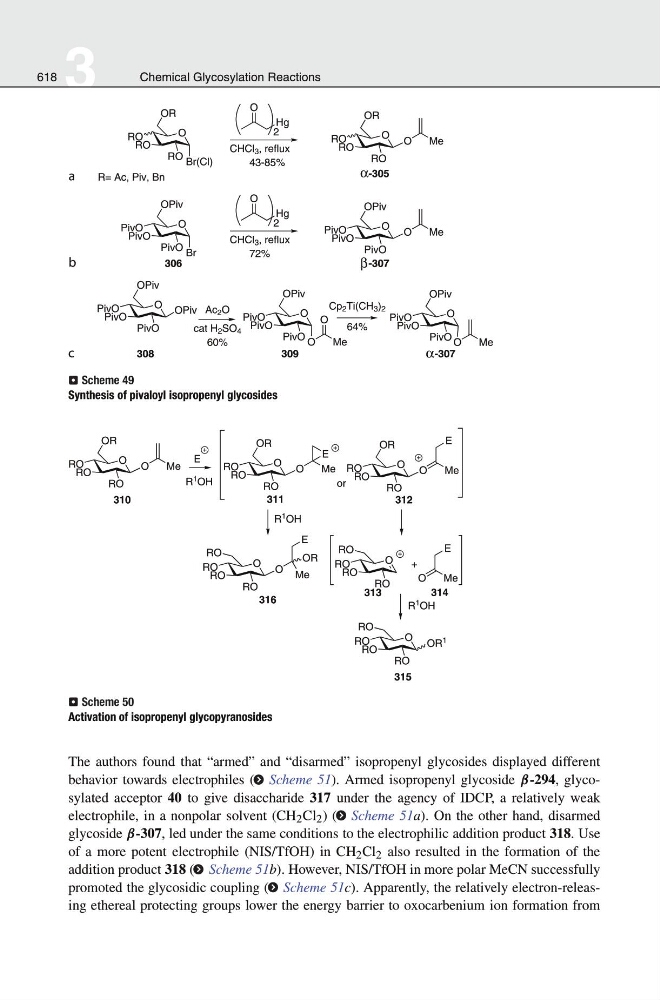
⊡ Scheme 49
Synthesis of pivaloyl isopropenyl glycosides
⊡ Scheme 50
Activation of isopropenyl glycopyranosides
The authors found that “armed” and “disarmed” isopropenyl glycosides displayed different
behavior towards electrophiles ( > Scheme 51). Armed isopropenyl glycoside β-294, glycosylated acceptor 40 to give disaccharide 317 under the agency of IDCP, a relatively weak
electrophile, in a nonpolar solvent (CH 2 Cl 2 ) ( > Scheme 51a). On the other hand, disarmed
glycoside β-307, led under the same conditions to the electrophilic addition product 318. Use
of a more potent electrophile (NIS/TfOH) in CH 2 Cl 2 also resulted in the formation of the
addition product 318 ( > Scheme 51b). However, NIS/TfOH in more polar MeCN successfully
promoted the glycosidic coupling ( > Scheme 51c). Apparently, the relatively electron-releasing ethereal protecting groups lower the energy barrier to oxocarbenium ion formation from