

O-Glycosyl Donors
3.4
615
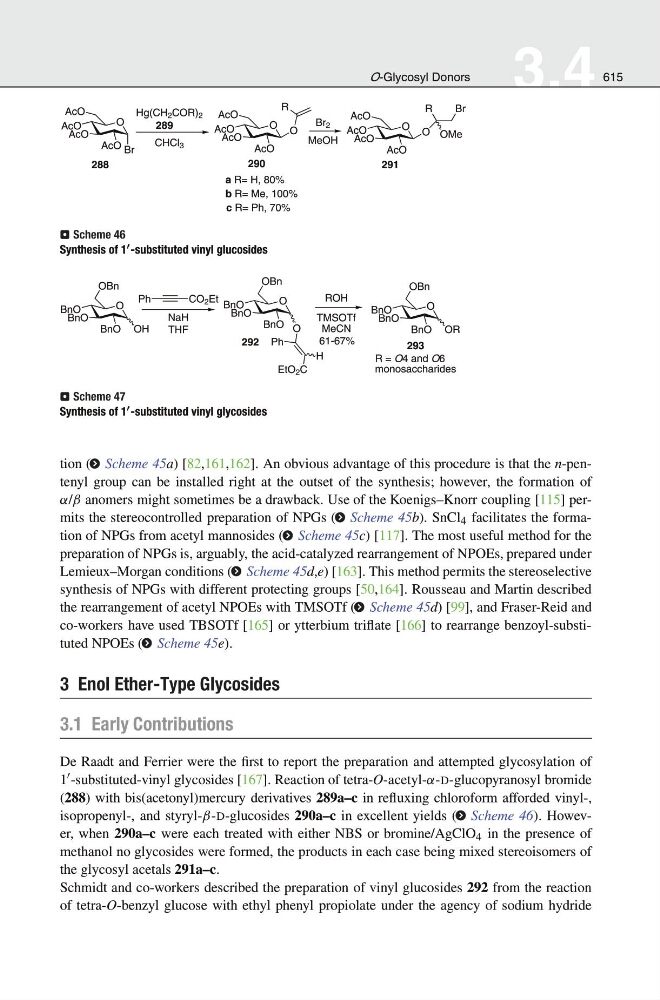
⊡ Scheme 46
Synthesis of 1 -substituted vinyl glucosides
⊡ Scheme 47
Synthesis of 1 -substituted vinyl glycosides
tion ( > Scheme 45a) [82,161,162]. An obvious advantage of this procedure is that the n-pentenyl group can be installed right at the outset of the synthesis; however, the formation of
α/β anomers might sometimes be a drawback. Use of the Koenigs–Knorr coupling [115] permits the stereocontrolled preparation of NPGs ( > Scheme 45b). SnCl 4 facilitates the formation of NPGs from acetyl mannosides ( > Scheme 45c) [117]. The most useful method for the
preparation of NPGs is, arguably, the acid-catalyzed rearrangement of NPOEs, prepared under
Lemieux–Morgan conditions ( > Scheme 45d,e) [163]. This method permits the stereoselective
synthesis of NPGs with different protecting groups [50,164]. Rousseau and Martin described
the rearrangement of acetyl NPOEs with TMSOTf ( > Scheme 45d) [99], and Fraser-Reid and
co-workers have used TBSOTf [165] or ytterbium triflate [166] to rearrange benzoyl-substituted NPOEs ( > Scheme 45e).
3 Enol Ether-Type Glycosides
3.1 Early Contributions
De Raadt and Ferrier were the first to report the preparation and attempted glycosylation of
1 -substituted-vinyl glycosides [167]. Reaction of tetra-O-acetyl-α-D-glucopyranosyl bromide
(288) with bis(acetonyl)mercury derivatives 289a–c in refluxing chloroform afforded vinyl-,
isopropenyl-, and styryl-β-D-glucosides 290a–c in excellent yields ( > Scheme 46). However, when 290a–c were each treated with either NBS or bromine/AgClO 4 in the presence of
methanol no glycosides were formed, the products in each case being mixed stereoisomers of
the glycosyl acetals 291a–c.
Schmidt and co-workers described the preparation of vinyl glucosides 292 from the reaction
of tetra-O-benzyl glucose with ethyl phenyl propiolate under the agency of sodium hydride