

586
3
Chemical Glycosylation Reactions
as β-NPGs 113a and 113b reacted with serine derivative 114 to give the sought α-glycosyl
aminoacids 115a,b, with complete stereocontrol, the corresponding α-anomers 116a,b gave
very poor yields of 115a,b (< 10%) and much slower reaction rates.
Fraser-Reid’s group advanced the synperiplanar lone-pair hypothesis (SLPH), to account for
the fact that β-D-glycopyranosides hydrolyze ≈2–3 times faster [72] than the corresponding
α-anomers [73]. This theory advocates that as the reaction progresses synperiplanar lone-pair
interactions in the energetically accessible half-chair conformation of the β-anomer are equivalent to the antiperiplanar interactions in the half-chair of the α-anomer (antiperiplanar lone
pair hypothesis, ALPH) [74]. On the other hand, the torsional effects associated with the conformational restraint imposed by the presence of the benzylidene ring might enhance this β/α
reactivity difference to the point that the α-anomer hardly reacts [75].
2-Allyloxycarbonylamino-2-deoxy D- and L-glucopyranosides 118 and 121, respectively,
have been reported by Lafont and Boullanger [76], to successfully glycosylate 10-tetradecyloxymethyl-3,6,9,12-tetraoxahexacosanol (119) and 1,3-bis(undecyloxy)propan-2-ol (122), in
the course on their studies on neoglycolipids for monolayers ( > Scheme 15). In this case, the
chemoselectivity in the reaction of the anomeric pent-4-enyl moiety in the presence of the
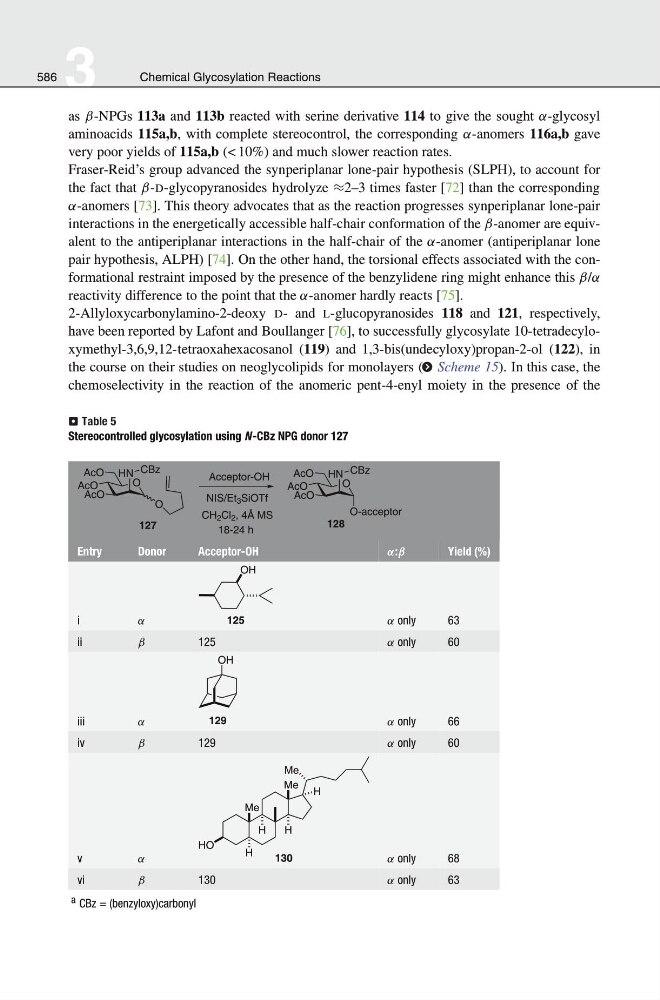
⊡ Table 5
Stereocontrolled glycosylation using N -CBz NPG donor 127
Entry
Donor
Acceptor-OH
α:β
Yield (%)
i
α
α only
63
ii
β
125
α only
60
iii
α
α only
66
iv
β
129
α only
60
v
α
α only
68
vi
β
130
α only
63
a CBz = (benzyloxy)carbonyl