

O-Glycosyl Donors
3.4
581
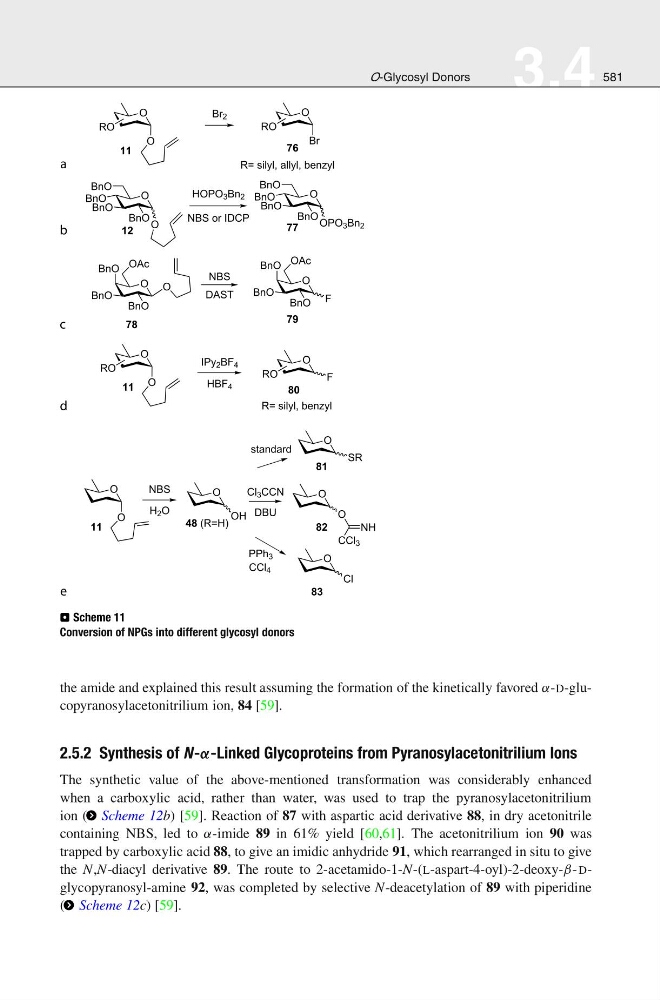
⊡ Scheme 11
Conversion of NPGs into different glycosyl donors
the amide and explained this result assuming the formation of the kinetically favored α-D-glucopyranosylacetonitrilium ion, 84 [59].
2.5.2 Synthesis of N-α-Linked Glycoproteins from Pyranosylacetonitrilium Ions
The synthetic value of the above-mentioned transformation was considerably enhanced
when a carboxylic acid, rather than water, was used to trap the pyranosylacetonitrilium
ion ( > Scheme 12b) [59]. Reaction of 87 with aspartic acid derivative 88, in dry acetonitrile
containing NBS, led to α-imide 89 in 61% yield [60,61]. The acetonitrilium ion 90 was
trapped by carboxylic acid 88, to give an imidic anhydride 91, which rearranged in situ to give
the N,N-diacyl derivative 89. The route to 2-acetamido-1-N-(L-aspart-4-oyl)-2-deoxy-β-Dglycopyranosyl-amine 92, was completed by selective N-deacetylation of 89 with piperidine
( > Scheme 12c) [59].