

578
3
Chemical Glycosylation Reactions
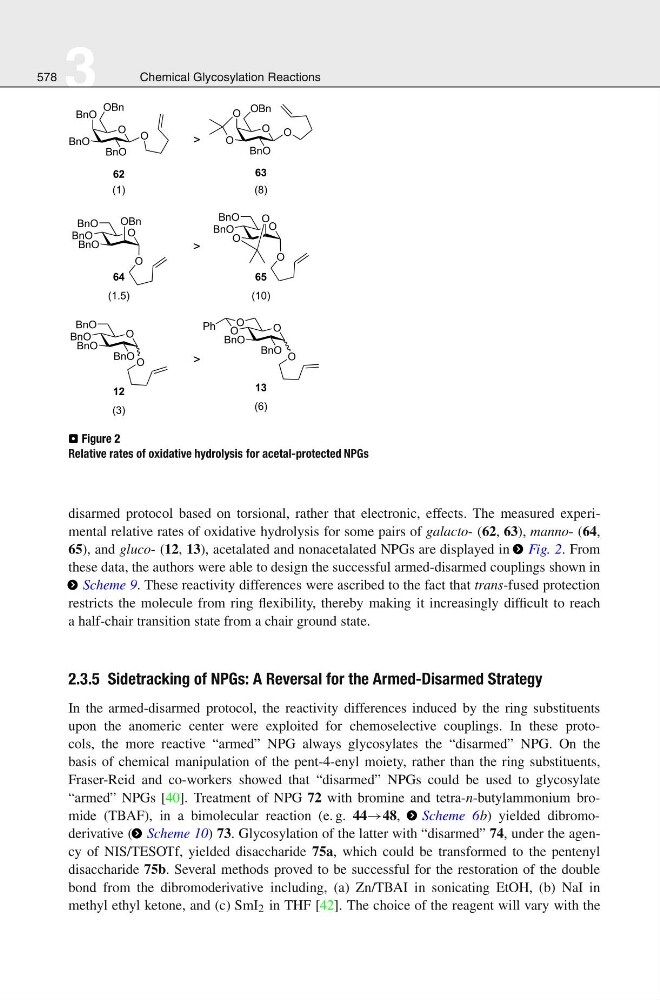
⊡ Figure 2
Relative rates of oxidative hydrolysis for acetal-protected NPGs
disarmed protocol based on torsional, rather that electronic, effects. The measured experimental relative rates of oxidative hydrolysis for some pairs of galacto- (62, 63), manno- (64,
65), and gluco- (12, 13), acetalated and nonacetalated NPGs are displayed in > Fig. 2. From
these data, the authors were able to design the successful armed-disarmed couplings shown in
> Scheme 9. These reactivity differences were ascribed to the fact that trans-fused protection
restricts the molecule from ring flexibility, thereby making it increasingly difficult to reach
a half-chair transition state from a chair ground state.
2.3.5 Sidetracking of NPGs: A Reversal for the Armed-Disarmed Strategy
In the armed-disarmed protocol, the reactivity differences induced by the ring substituents
upon the anomeric center were exploited for chemoselective couplings. In these protocols, the more reactive “armed” NPG always glycosylates the “disarmed” NPG. On the
basis of chemical manipulation of the pent-4-enyl moiety, rather than the ring substituents,
Fraser-Reid and co-workers showed that “disarmed” NPGs could be used to glycosylate
“armed” NPGs [40]. Treatment of NPG 72 with bromine and tetra-n-butylammonium bromide (TBAF), in a bimolecular reaction (e. g. 44→48, > Scheme 6b) yielded dibromoderivative ( > Scheme 10) 73. Glycosylation of the latter with “disarmed” 74, under the agency of NIS/TESOTf, yielded disaccharide 75a, which could be transformed to the pentenyl
disaccharide 75b. Several methods proved to be successful for the restoration of the double
bond from the dibromoderivative including, (a) Zn/TBAI in sonicating EtOH, (b) NaI in
methyl ethyl ketone, and (c) SmI 2 in THF [42]. The choice of the reagent will vary with the