

558
3
Chemical Glycosylation Reactions
6 Glycosylation with Donors Having Remote Acyl Groups
Takeda et al. reported a glycosylation method using glycosyl donors having the enol ether
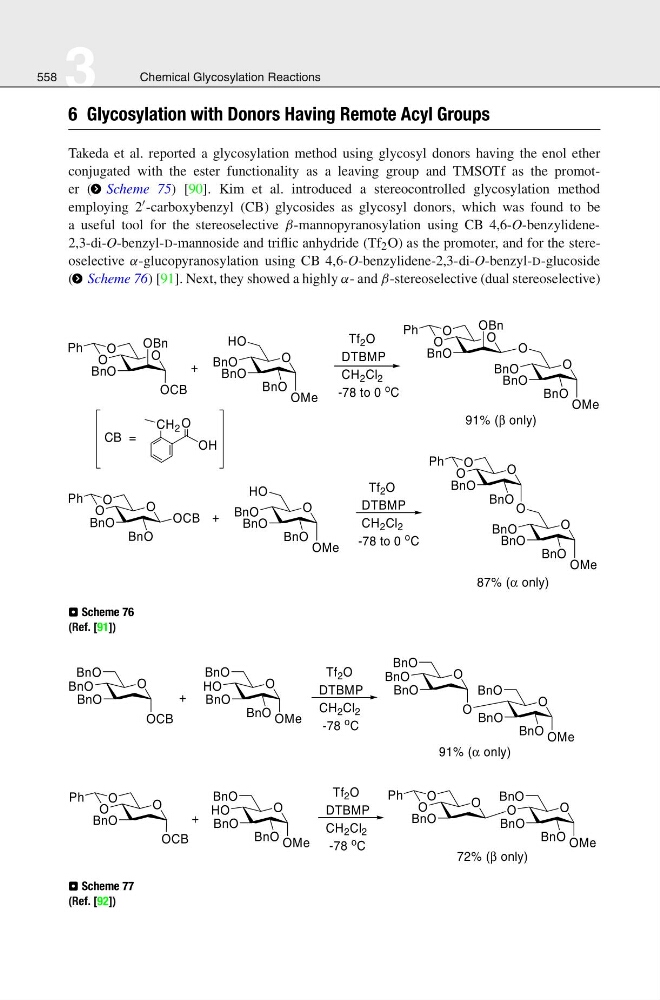
conjugated with the ester functionality as a leaving group and TMSOTf as the promoter ( > Scheme 75) [90]. Kim et al. introduced a stereocontrolled glycosylation method
employing 2 -carboxybenzyl (CB) glycosides as glycosyl donors, which was found to be
a useful tool for the stereoselective β-mannopyranosylation using CB 4,6-O-benzylidene2,3-di-O-benzyl-D-mannoside and triflic anhydride (Tf 2 O) as the promoter, and for the stereoselective α-glucopyranosylation using CB 4,6-O-benzylidene-2,3-di-O-benzyl-D-glucoside
( > Scheme 76) [91]. Next, they showed a highly α- and β-stereoselective (dual stereoselective)
⊡ Scheme 76
(Ref. [91])
⊡ Scheme 77
(Ref. [92])