

Further Anomeric Esters
3.3
551
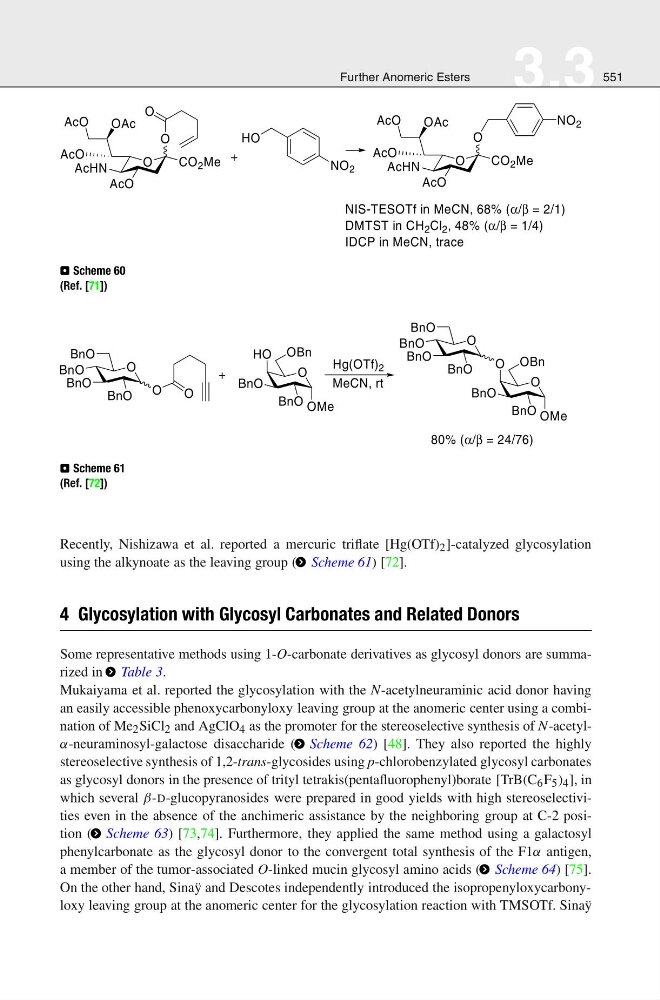
⊡ Scheme 60
(Ref. [71])
⊡ Scheme 61
(Ref. [72])
Recently, Nishizawa et al. reported a mercuric triflate [Hg(OTf) 2 ]-catalyzed glycosylation
using the alkynoate as the leaving group ( > Scheme 61) [72].
4 Glycosylation with Glycosyl Carbonates and Related Donors
Some representative methods using 1-O-carbonate derivatives as glycosyl donors are summarized in > Table 3.
Mukaiyama et al. reported the glycosylation with the N-acetylneuraminic acid donor having
an easily accessible phenoxycarbonyloxy leaving group at the anomeric center using a combination of Me 2 SiCl 2 and AgClO 4 as the promoter for the stereoselective synthesis of N-acetylα-neuraminosyl-galactose disaccharide ( > Scheme 62) [48]. They also reported the highly
stereoselective synthesis of 1,2-trans-glycosides using p-chlorobenzylated glycosyl carbonates
as glycosyl donors in the presence of trityl tetrakis(pentafluorophenyl)borate [TrB(C 6 F 5 ) 4 ], in
which several β-D-glucopyranosides were prepared in good yields with high stereoselectivities even in the absence of the anchimeric assistance by the neighboring group at C-2 position ( > Scheme 63) [73,74]. Furthermore, they applied the same method using a galactosyl
phenylcarbonate as the glycosyl donor to the convergent total synthesis of the F1α antigen,
a member of the tumor-associated O-linked mucin glycosyl amino acids ( > Scheme 64) [75].
On the other hand, Sinaÿ and Descotes independently introduced the isopropenyloxycarbonyloxy leaving group at the anomeric center for the glycosylation reaction with TMSOTf. Sinaÿ
3.3
551
⊡ Scheme 60
(Ref. [71])
⊡ Scheme 61
(Ref. [72])
Recently, Nishizawa et al. reported a mercuric triflate [Hg(OTf) 2 ]-catalyzed glycosylation
using the alkynoate as the leaving group ( > Scheme 61) [72].
4 Glycosylation with Glycosyl Carbonates and Related Donors
Some representative methods using 1-O-carbonate derivatives as glycosyl donors are summarized in > Table 3.
Mukaiyama et al. reported the glycosylation with the N-acetylneuraminic acid donor having
an easily accessible phenoxycarbonyloxy leaving group at the anomeric center using a combination of Me 2 SiCl 2 and AgClO 4 as the promoter for the stereoselective synthesis of N-acetylα-neuraminosyl-galactose disaccharide ( > Scheme 62) [48]. They also reported the highly
stereoselective synthesis of 1,2-trans-glycosides using p-chlorobenzylated glycosyl carbonates
as glycosyl donors in the presence of trityl tetrakis(pentafluorophenyl)borate [TrB(C 6 F 5 ) 4 ], in
which several β-D-glucopyranosides were prepared in good yields with high stereoselectivities even in the absence of the anchimeric assistance by the neighboring group at C-2 position ( > Scheme 63) [73,74]. Furthermore, they applied the same method using a galactosyl
phenylcarbonate as the glycosyl donor to the convergent total synthesis of the F1α antigen,
a member of the tumor-associated O-linked mucin glycosyl amino acids ( > Scheme 64) [75].
On the other hand, Sinaÿ and Descotes independently introduced the isopropenyloxycarbonyloxy leaving group at the anomeric center for the glycosylation reaction with TMSOTf. Sinaÿ