

Further Anomeric Esters
3.3
549
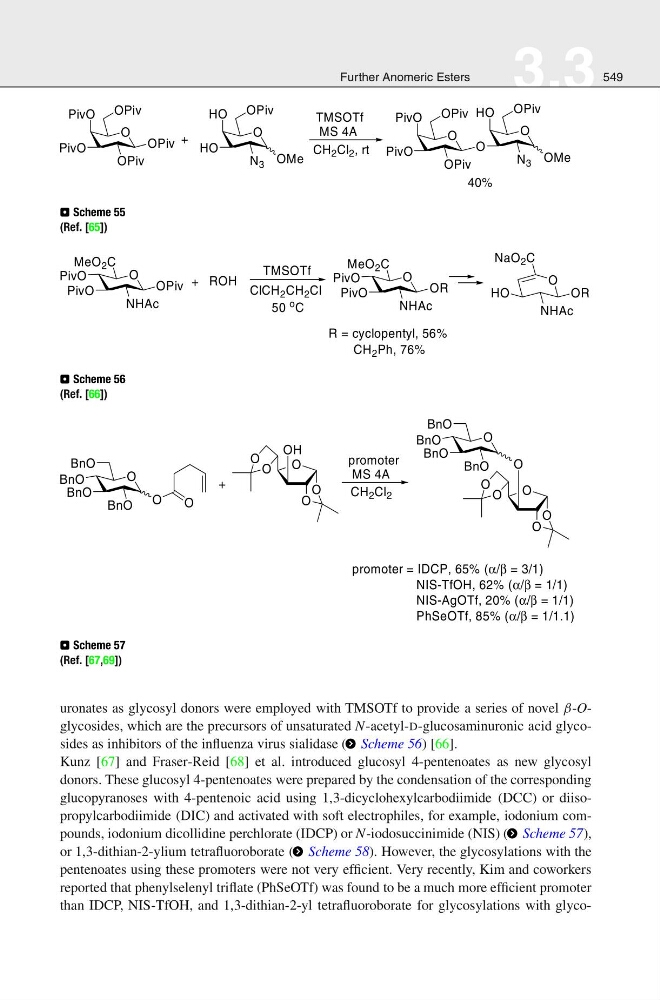
⊡ Scheme 55
(Ref. [65])
⊡ Scheme 56
(Ref. [66])
⊡ Scheme 57
(Ref. [67,69])
uronates as glycosyl donors were employed with TMSOTf to provide a series of novel β-Oglycosides, which are the precursors of unsaturated N-acetyl-D-glucosaminuronic acid glycosides as inhibitors of the influenza virus sialidase ( > Scheme 56) [66].
Kunz [67] and Fraser-Reid [68] et al. introduced glucosyl 4-pentenoates as new glycosyl
donors. These glucosyl 4-pentenoates were prepared by the condensation of the corresponding
glucopyranoses with 4-pentenoic acid using 1,3-dicyclohexylcarbodiimide (DCC) or diisopropylcarbodiimide (DIC) and activated with soft electrophiles, for example, iodonium compounds, iodonium dicollidine perchlorate (IDCP) or N-iodosuccinimide (NIS) ( > Scheme 57),
or 1,3-dithian-2-ylium tetrafluoroborate ( > Scheme 58). However, the glycosylations with the
pentenoates using these promoters were not very efficient. Very recently, Kim and coworkers
reported that phenylselenyl triflate (PhSeOTf) was found to be a much more efficient promoter
than IDCP, NIS-TfOH, and 1,3-dithian-2-yl tetrafluoroborate for glycosylations with glyco-
3.3
549
⊡ Scheme 55
(Ref. [65])
⊡ Scheme 56
(Ref. [66])
⊡ Scheme 57
(Ref. [67,69])
uronates as glycosyl donors were employed with TMSOTf to provide a series of novel β-Oglycosides, which are the precursors of unsaturated N-acetyl-D-glucosaminuronic acid glycosides as inhibitors of the influenza virus sialidase ( > Scheme 56) [66].
Kunz [67] and Fraser-Reid [68] et al. introduced glucosyl 4-pentenoates as new glycosyl
donors. These glucosyl 4-pentenoates were prepared by the condensation of the corresponding
glucopyranoses with 4-pentenoic acid using 1,3-dicyclohexylcarbodiimide (DCC) or diisopropylcarbodiimide (DIC) and activated with soft electrophiles, for example, iodonium compounds, iodonium dicollidine perchlorate (IDCP) or N-iodosuccinimide (NIS) ( > Scheme 57),
or 1,3-dithian-2-ylium tetrafluoroborate ( > Scheme 58). However, the glycosylations with the
pentenoates using these promoters were not very efficient. Very recently, Kim and coworkers
reported that phenylselenyl triflate (PhSeOTf) was found to be a much more efficient promoter
than IDCP, NIS-TfOH, and 1,3-dithian-2-yl tetrafluoroborate for glycosylations with glyco-