

Further Anomeric Esters
3.3
547
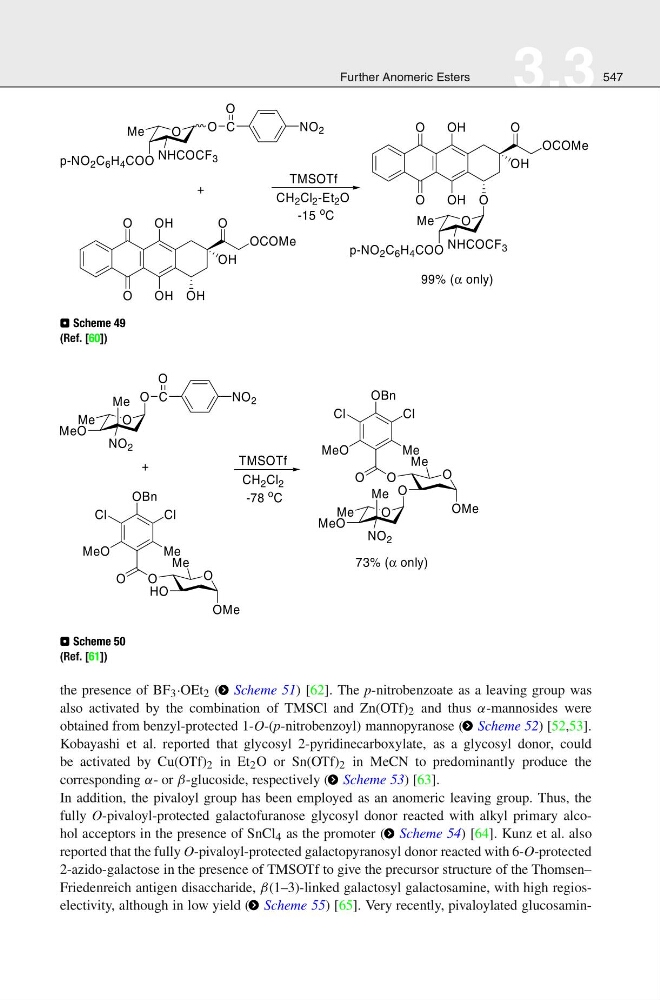
⊡ Scheme 49
(Ref. [60])
⊡ Scheme 50
(Ref. [61])
the presence of BF 3 ·OEt 2 ( > Scheme 51) [62]. The p-nitrobenzoate as a leaving group was
also activated by the combination of TMSCl and Zn(OTf) 2 and thus α-mannosides were
obtained from benzyl-protected 1-O-(p-nitrobenzoyl) mannopyranose ( > Scheme 52) [52,53].
Kobayashi et al. reported that glycosyl 2-pyridinecarboxylate, as a glycosyl donor, could
be activated by Cu(OTf) 2 in Et 2 O or Sn(OTf) 2 in MeCN to predominantly produce the
corresponding α- or β-glucoside, respectively ( > Scheme 53) [63].
In addition, the pivaloyl group has been employed as an anomeric leaving group. Thus, the
fully O-pivaloyl-protected galactofuranose glycosyl donor reacted with alkyl primary alcohol acceptors in the presence of SnCl 4 as the promoter ( > Scheme 54) [64]. Kunz et al. also
reported that the fully O-pivaloyl-protected galactopyranosyl donor reacted with 6-O-protected
2-azido-galactose in the presence of TMSOTf to give the precursor structure of the Thomsen–
Friedenreich antigen disaccharide, β(1–3)-linked galactosyl galactosamine, with high regioselectivity, although in low yield ( > Scheme 55) [65]. Very recently, pivaloylated glucosamin-
3.3
547
⊡ Scheme 49
(Ref. [60])
⊡ Scheme 50
(Ref. [61])
the presence of BF 3 ·OEt 2 ( > Scheme 51) [62]. The p-nitrobenzoate as a leaving group was
also activated by the combination of TMSCl and Zn(OTf) 2 and thus α-mannosides were
obtained from benzyl-protected 1-O-(p-nitrobenzoyl) mannopyranose ( > Scheme 52) [52,53].
Kobayashi et al. reported that glycosyl 2-pyridinecarboxylate, as a glycosyl donor, could
be activated by Cu(OTf) 2 in Et 2 O or Sn(OTf) 2 in MeCN to predominantly produce the
corresponding α- or β-glucoside, respectively ( > Scheme 53) [63].
In addition, the pivaloyl group has been employed as an anomeric leaving group. Thus, the
fully O-pivaloyl-protected galactofuranose glycosyl donor reacted with alkyl primary alcohol acceptors in the presence of SnCl 4 as the promoter ( > Scheme 54) [64]. Kunz et al. also
reported that the fully O-pivaloyl-protected galactopyranosyl donor reacted with 6-O-protected
2-azido-galactose in the presence of TMSOTf to give the precursor structure of the Thomsen–
Friedenreich antigen disaccharide, β(1–3)-linked galactosyl galactosamine, with high regioselectivity, although in low yield ( > Scheme 55) [65]. Very recently, pivaloylated glucosamin-