

Further Anomeric Esters
3.3
545
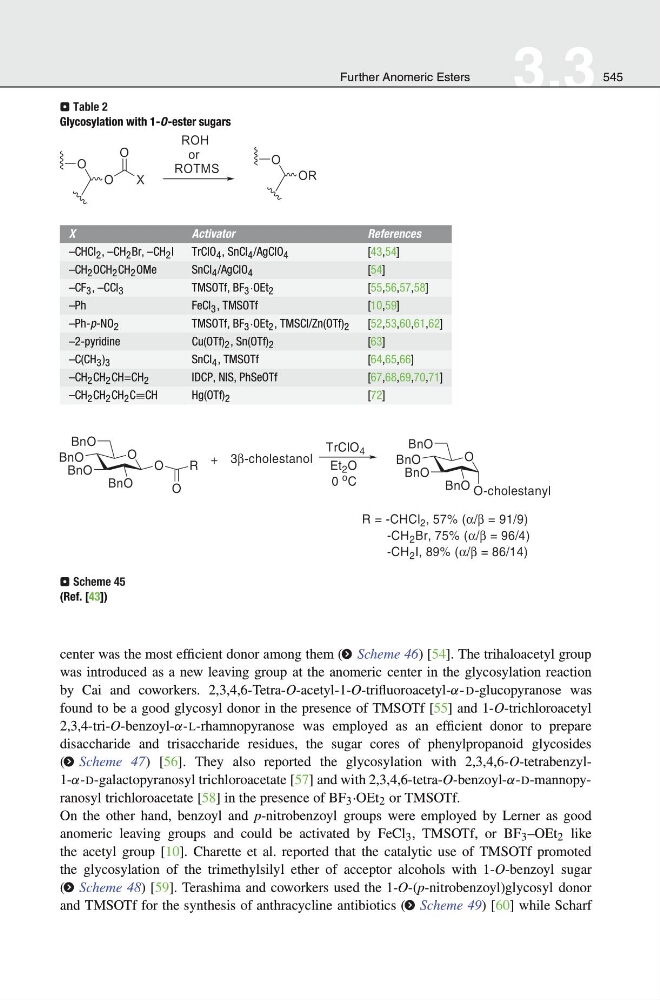
⊡ Table 2
Glycosylation with 1-O-ester sugars
X
Activator
References
–CHCl 2 , –CH 2 Br, –CH 2 I TrClO 4 , SnCl 4 /AgClO 4
[43,54]
–CH 2 OCH 2 CH 2 OMe
SnCl 4 /AgClO 4
[54]
–CF 3 , –CCl 3
TMSOTf, BF 3 ·OEt 2
[55,56,57,58]
–Ph
FeCl 3 , TMSOTf
[10,59]
–Ph-p-NO 2
TMSOTf, BF 3 ·OEt 2 , TMSCl/Zn(OTf) 2
[52,53,60,61,62]
–2-pyridine
Cu(OTf) 2 , Sn(OTf) 2
[63]
–C(CH 3 ) 3
SnCl 4 , TMSOTf
[64,65,66]
–CH 2 CH 2 CH=CH 2
IDCP, NIS, PhSeOTf
[67,68,69,70,71]
–CH 2 CH 2 CH 2 C≡CH
Hg(OTf) 2
[72]
⊡ Scheme 45
(Ref. [43])
center was the most efficient donor among them ( > Scheme 46) [54]. The trihaloacetyl group
was introduced as a new leaving group at the anomeric center in the glycosylation reaction
by Cai and coworkers. 2,3,4,6-Tetra-O-acetyl-1-O-trifluoroacetyl-α-D-glucopyranose was
found to be a good glycosyl donor in the presence of TMSOTf [55] and 1-O-trichloroacetyl
2,3,4-tri-O-benzoyl-α-L-rhamnopyranose was employed as an efficient donor to prepare
disaccharide and trisaccharide residues, the sugar cores of phenylpropanoid glycosides
( > Scheme 47) [56]. They also reported the glycosylation with 2,3,4,6-O-tetrabenzyl1-α-D-galactopyranosyl trichloroacetate [57] and with 2,3,4,6-tetra-O-benzoyl-α-D-mannopyranosyl trichloroacetate [58] in the presence of BF 3 ·OEt 2 or TMSOTf.
On the other hand, benzoyl and p-nitrobenzoyl groups were employed by Lerner as good
anomeric leaving groups and could be activated by FeCl 3 , TMSOTf, or BF 3 –OEt 2 like
the acetyl group [10]. Charette et al. reported that the catalytic use of TMSOTf promoted
the glycosylation of the trimethylsilyl ether of acceptor alcohols with 1-O-benzoyl sugar
( > Scheme 48) [59]. Terashima and coworkers used the 1-O-(p-nitrobenzoyl)glycosyl donor
and TMSOTf for the synthesis of anthracycline antibiotics ( > Scheme 49) [60] while Scharf
3.3
545
⊡ Table 2
Glycosylation with 1-O-ester sugars
X
Activator
References
–CHCl 2 , –CH 2 Br, –CH 2 I TrClO 4 , SnCl 4 /AgClO 4
[43,54]
–CH 2 OCH 2 CH 2 OMe
SnCl 4 /AgClO 4
[54]
–CF 3 , –CCl 3
TMSOTf, BF 3 ·OEt 2
[55,56,57,58]
–Ph
FeCl 3 , TMSOTf
[10,59]
–Ph-p-NO 2
TMSOTf, BF 3 ·OEt 2 , TMSCl/Zn(OTf) 2
[52,53,60,61,62]
–2-pyridine
Cu(OTf) 2 , Sn(OTf) 2
[63]
–C(CH 3 ) 3
SnCl 4 , TMSOTf
[64,65,66]
–CH 2 CH 2 CH=CH 2
IDCP, NIS, PhSeOTf
[67,68,69,70,71]
–CH 2 CH 2 CH 2 C≡CH
Hg(OTf) 2
[72]
⊡ Scheme 45
(Ref. [43])
center was the most efficient donor among them ( > Scheme 46) [54]. The trihaloacetyl group
was introduced as a new leaving group at the anomeric center in the glycosylation reaction
by Cai and coworkers. 2,3,4,6-Tetra-O-acetyl-1-O-trifluoroacetyl-α-D-glucopyranose was
found to be a good glycosyl donor in the presence of TMSOTf [55] and 1-O-trichloroacetyl
2,3,4-tri-O-benzoyl-α-L-rhamnopyranose was employed as an efficient donor to prepare
disaccharide and trisaccharide residues, the sugar cores of phenylpropanoid glycosides
( > Scheme 47) [56]. They also reported the glycosylation with 2,3,4,6-O-tetrabenzyl1-α-D-galactopyranosyl trichloroacetate [57] and with 2,3,4,6-tetra-O-benzoyl-α-D-mannopyranosyl trichloroacetate [58] in the presence of BF 3 ·OEt 2 or TMSOTf.
On the other hand, benzoyl and p-nitrobenzoyl groups were employed by Lerner as good
anomeric leaving groups and could be activated by FeCl 3 , TMSOTf, or BF 3 –OEt 2 like
the acetyl group [10]. Charette et al. reported that the catalytic use of TMSOTf promoted
the glycosylation of the trimethylsilyl ether of acceptor alcohols with 1-O-benzoyl sugar
( > Scheme 48) [59]. Terashima and coworkers used the 1-O-(p-nitrobenzoyl)glycosyl donor
and TMSOTf for the synthesis of anthracycline antibiotics ( > Scheme 49) [60] while Scharf