

540
3
Chemical Glycosylation Reactions
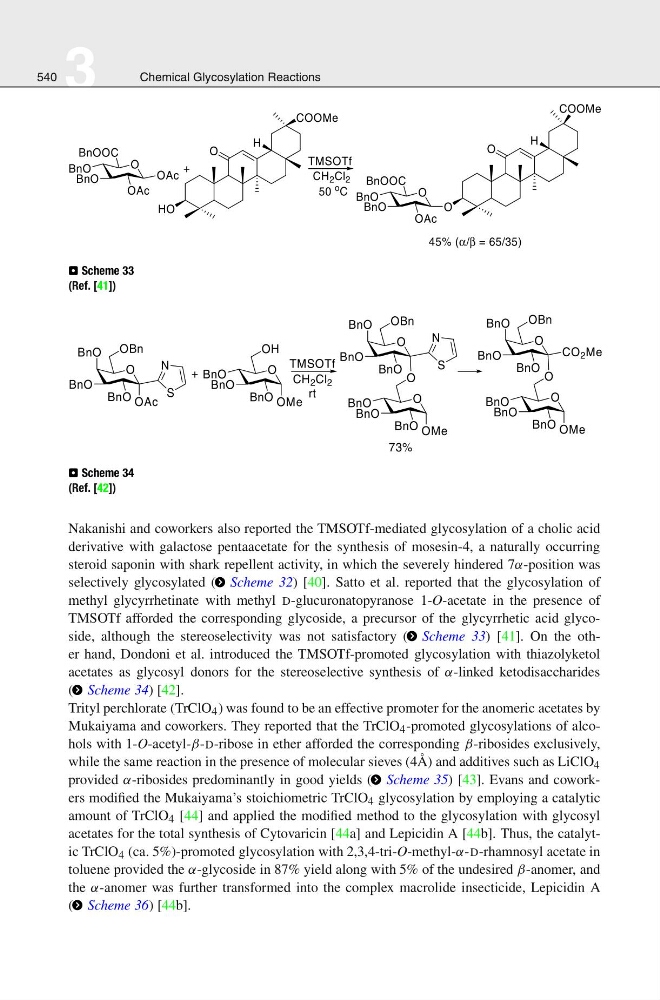
⊡ Scheme 33
(Ref. [41])
⊡ Scheme 34
(Ref. [42])
Nakanishi and coworkers also reported the TMSOTf-mediated glycosylation of a cholic acid
derivative with galactose pentaacetate for the synthesis of mosesin-4, a naturally occurring
steroid saponin with shark repellent activity, in which the severely hindered 7α-position was
selectively glycosylated ( > Scheme 32) [40]. Satto et al. reported that the glycosylation of
methyl glycyrrhetinate with methyl D-glucuronatopyranose 1-O-acetate in the presence of
TMSOTf afforded the corresponding glycoside, a precursor of the glycyrrhetic acid glycoside, although the stereoselectivity was not satisfactory ( > Scheme 33) [41]. On the other hand, Dondoni et al. introduced the TMSOTf-promoted glycosylation with thiazolyketol
acetates as glycosyl donors for the stereoselective synthesis of α-linked ketodisaccharides
( > Scheme 34) [42].
Trityl perchlorate (TrClO 4 ) was found to be an effective promoter for the anomeric acetates by
Mukaiyama and coworkers. They reported that the TrClO 4 -promoted glycosylations of alcohols with 1-O-acetyl-β-D-ribose in ether afforded the corresponding β-ribosides exclusively,
while the same reaction in the presence of molecular sieves (4Å) and additives such as LiClO 4
provided α-ribosides predominantly in good yields ( > Scheme 35) [43]. Evans and coworkers modified the Mukaiyama’s stoichiometric TrClO 4 glycosylation by employing a catalytic
amount of TrClO 4 [44] and applied the modified method to the glycosylation with glycosyl
acetates for the total synthesis of Cytovaricin [44a] and Lepicidin A [44b]. Thus, the catalytic TrClO 4 (ca. 5%)-promoted glycosylation with 2,3,4-tri-O-methyl-α-D-rhamnosyl acetate in
toluene provided the α-glycoside in 87% yield along with 5% of the undesired β-anomer, and
the α-anomer was further transformed into the complex macrolide insecticide, Lepicidin A
( > Scheme 36) [44b].
3
Chemical Glycosylation Reactions
⊡ Scheme 33
(Ref. [41])
⊡ Scheme 34
(Ref. [42])
Nakanishi and coworkers also reported the TMSOTf-mediated glycosylation of a cholic acid
derivative with galactose pentaacetate for the synthesis of mosesin-4, a naturally occurring
steroid saponin with shark repellent activity, in which the severely hindered 7α-position was
selectively glycosylated ( > Scheme 32) [40]. Satto et al. reported that the glycosylation of
methyl glycyrrhetinate with methyl D-glucuronatopyranose 1-O-acetate in the presence of
TMSOTf afforded the corresponding glycoside, a precursor of the glycyrrhetic acid glycoside, although the stereoselectivity was not satisfactory ( > Scheme 33) [41]. On the other hand, Dondoni et al. introduced the TMSOTf-promoted glycosylation with thiazolyketol
acetates as glycosyl donors for the stereoselective synthesis of α-linked ketodisaccharides
( > Scheme 34) [42].
Trityl perchlorate (TrClO 4 ) was found to be an effective promoter for the anomeric acetates by
Mukaiyama and coworkers. They reported that the TrClO 4 -promoted glycosylations of alcohols with 1-O-acetyl-β-D-ribose in ether afforded the corresponding β-ribosides exclusively,
while the same reaction in the presence of molecular sieves (4Å) and additives such as LiClO 4
provided α-ribosides predominantly in good yields ( > Scheme 35) [43]. Evans and coworkers modified the Mukaiyama’s stoichiometric TrClO 4 glycosylation by employing a catalytic
amount of TrClO 4 [44] and applied the modified method to the glycosylation with glycosyl
acetates for the total synthesis of Cytovaricin [44a] and Lepicidin A [44b]. Thus, the catalytic TrClO 4 (ca. 5%)-promoted glycosylation with 2,3,4-tri-O-methyl-α-D-rhamnosyl acetate in
toluene provided the α-glycoside in 87% yield along with 5% of the undesired β-anomer, and
the α-anomer was further transformed into the complex macrolide insecticide, Lepicidin A
( > Scheme 36) [44b].