

534
3
Chemical Glycosylation Reactions
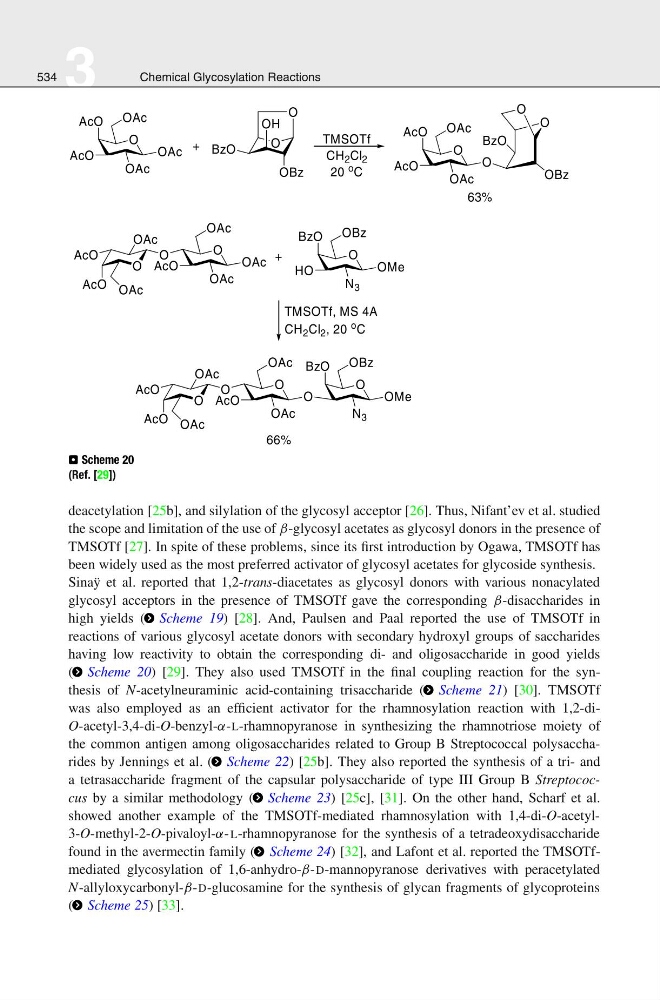
⊡ Scheme 20
(Ref. [29])
deacetylation [25b], and silylation of the glycosyl acceptor [26]. Thus, Nifant’ev et al. studied
the scope and limitation of the use of β-glycosyl acetates as glycosyl donors in the presence of
TMSOTf [27]. In spite of these problems, since its first introduction by Ogawa, TMSOTf has
been widely used as the most preferred activator of glycosyl acetates for glycoside synthesis.
Sinaÿ et al. reported that 1,2-trans-diacetates as glycosyl donors with various nonacylated
glycosyl acceptors in the presence of TMSOTf gave the corresponding β-disaccharides in
high yields ( > Scheme 19) [28]. And, Paulsen and Paal reported the use of TMSOTf in
reactions of various glycosyl acetate donors with secondary hydroxyl groups of saccharides
having low reactivity to obtain the corresponding di- and oligosaccharide in good yields
( > Scheme 20) [29]. They also used TMSOTf in the final coupling reaction for the synthesis of N-acetylneuraminic acid-containing trisaccharide ( > Scheme 21) [30]. TMSOTf
was also employed as an efficient activator for the rhamnosylation reaction with 1,2-diO-acetyl-3,4-di-O-benzyl-α-L-rhamnopyranose in synthesizing the rhamnotriose moiety of
the common antigen among oligosaccharides related to Group B Streptococcal polysaccharides by Jennings et al. ( > Scheme 22) [25b]. They also reported the synthesis of a tri- and
a tetrasaccharide fragment of the capsular polysaccharide of type III Group B Streptococcus by a similar methodology ( > Scheme 23) [25c], [31]. On the other hand, Scharf et al.
showed another example of the TMSOTf-mediated rhamnosylation with 1,4-di-O-acetyl3-O-methyl-2-O-pivaloyl-α-L-rhamnopyranose for the synthesis of a tetradeoxydisaccharide
found in the avermectin family ( > Scheme 24) [32], and Lafont et al. reported the TMSOTfmediated glycosylation of 1,6-anhydro-β-D-mannopyranose derivatives with peracetylated
N-allyloxycarbonyl-β-D-glucosamine for the synthesis of glycan fragments of glycoproteins
( > Scheme 25) [33].
3
Chemical Glycosylation Reactions
⊡ Scheme 20
(Ref. [29])
deacetylation [25b], and silylation of the glycosyl acceptor [26]. Thus, Nifant’ev et al. studied
the scope and limitation of the use of β-glycosyl acetates as glycosyl donors in the presence of
TMSOTf [27]. In spite of these problems, since its first introduction by Ogawa, TMSOTf has
been widely used as the most preferred activator of glycosyl acetates for glycoside synthesis.
Sinaÿ et al. reported that 1,2-trans-diacetates as glycosyl donors with various nonacylated
glycosyl acceptors in the presence of TMSOTf gave the corresponding β-disaccharides in
high yields ( > Scheme 19) [28]. And, Paulsen and Paal reported the use of TMSOTf in
reactions of various glycosyl acetate donors with secondary hydroxyl groups of saccharides
having low reactivity to obtain the corresponding di- and oligosaccharide in good yields
( > Scheme 20) [29]. They also used TMSOTf in the final coupling reaction for the synthesis of N-acetylneuraminic acid-containing trisaccharide ( > Scheme 21) [30]. TMSOTf
was also employed as an efficient activator for the rhamnosylation reaction with 1,2-diO-acetyl-3,4-di-O-benzyl-α-L-rhamnopyranose in synthesizing the rhamnotriose moiety of
the common antigen among oligosaccharides related to Group B Streptococcal polysaccharides by Jennings et al. ( > Scheme 22) [25b]. They also reported the synthesis of a tri- and
a tetrasaccharide fragment of the capsular polysaccharide of type III Group B Streptococcus by a similar methodology ( > Scheme 23) [25c], [31]. On the other hand, Scharf et al.
showed another example of the TMSOTf-mediated rhamnosylation with 1,4-di-O-acetyl3-O-methyl-2-O-pivaloyl-α-L-rhamnopyranose for the synthesis of a tetradeoxydisaccharide
found in the avermectin family ( > Scheme 24) [32], and Lafont et al. reported the TMSOTfmediated glycosylation of 1,6-anhydro-β-D-mannopyranose derivatives with peracetylated
N-allyloxycarbonyl-β-D-glucosamine for the synthesis of glycan fragments of glycoproteins
( > Scheme 25) [33].