

Glycosyl Trichloroacetimidates
3.2
505
5.6 Synthesis of Glycosylphosphatidyl Inositol Anchors
Glycosylphosphatidyl inositol anchors constitute a class of glycolipids that link proteins and
glycoproteins via their C-terminus to eukaryotic cell membranes. The first structure of a GPI
anchor, that of Trypanosoma brucei, was published by Ferguson et al. [262]. Since then quite
a few examples of GPI anchors were described, allowing the definition of the core structure
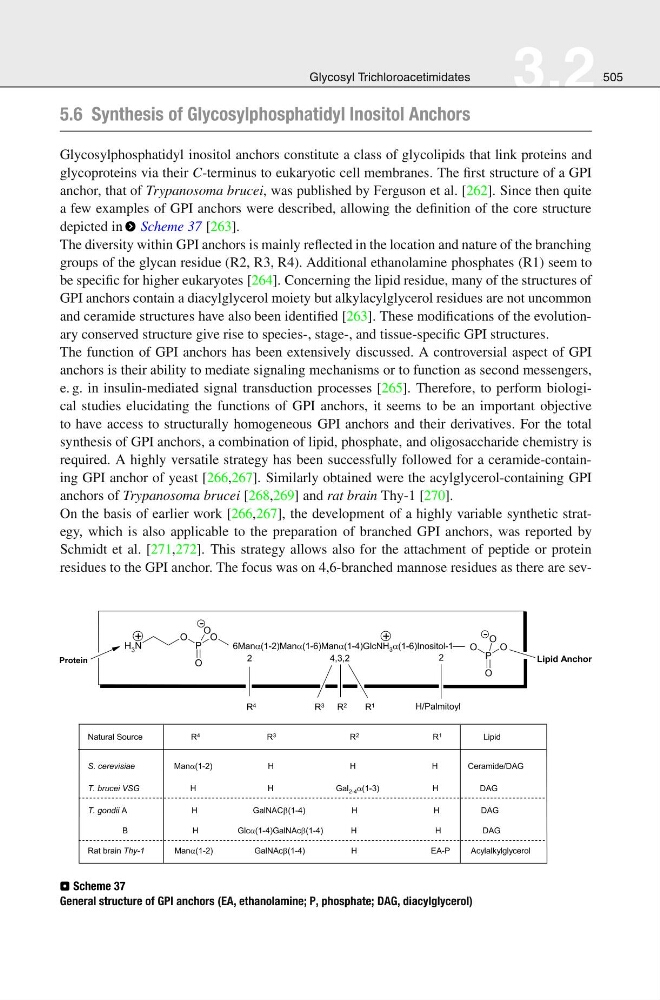
depicted in > Scheme 37 [263].
The diversity within GPI anchors is mainly reflected in the location and nature of the branching
groups of the glycan residue (R2, R3, R4). Additional ethanolamine phosphates (R1) seem to
be specific for higher eukaryotes [264]. Concerning the lipid residue, many of the structures of
GPI anchors contain a diacylglycerol moiety but alkylacylglycerol residues are not uncommon
and ceramide structures have also been identified [263]. These modifications of the evolutionary conserved structure give rise to species-, stage-, and tissue-specific GPI structures.
The function of GPI anchors has been extensively discussed. A controversial aspect of GPI
anchors is their ability to mediate signaling mechanisms or to function as second messengers,
e. g. in insulin-mediated signal transduction processes [265]. Therefore, to perform biological studies elucidating the functions of GPI anchors, it seems to be an important objective
to have access to structurally homogeneous GPI anchors and their derivatives. For the total
synthesis of GPI anchors, a combination of lipid, phosphate, and oligosaccharide chemistry is
required. A highly versatile strategy has been successfully followed for a ceramide-containing GPI anchor of yeast [266,267]. Similarly obtained were the acylglycerol-containing GPI
anchors of Trypanosoma brucei [268,269] and rat brain Thy-1 [270].
On the basis of earlier work [266,267], the development of a highly variable synthetic strategy, which is also applicable to the preparation of branched GPI anchors, was reported by
Schmidt et al. [271,272]. This strategy allows also for the attachment of peptide or protein
residues to the GPI anchor. The focus was on 4,6-branched mannose residues as there are sev⊡ Scheme 37
General structure of GPI anchors (EA, ethanolamine; P, phosphate; DAG, diacylglycerol)
3.2
505
5.6 Synthesis of Glycosylphosphatidyl Inositol Anchors
Glycosylphosphatidyl inositol anchors constitute a class of glycolipids that link proteins and
glycoproteins via their C-terminus to eukaryotic cell membranes. The first structure of a GPI
anchor, that of Trypanosoma brucei, was published by Ferguson et al. [262]. Since then quite
a few examples of GPI anchors were described, allowing the definition of the core structure
depicted in > Scheme 37 [263].
The diversity within GPI anchors is mainly reflected in the location and nature of the branching
groups of the glycan residue (R2, R3, R4). Additional ethanolamine phosphates (R1) seem to
be specific for higher eukaryotes [264]. Concerning the lipid residue, many of the structures of
GPI anchors contain a diacylglycerol moiety but alkylacylglycerol residues are not uncommon
and ceramide structures have also been identified [263]. These modifications of the evolutionary conserved structure give rise to species-, stage-, and tissue-specific GPI structures.
The function of GPI anchors has been extensively discussed. A controversial aspect of GPI
anchors is their ability to mediate signaling mechanisms or to function as second messengers,
e. g. in insulin-mediated signal transduction processes [265]. Therefore, to perform biological studies elucidating the functions of GPI anchors, it seems to be an important objective
to have access to structurally homogeneous GPI anchors and their derivatives. For the total
synthesis of GPI anchors, a combination of lipid, phosphate, and oligosaccharide chemistry is
required. A highly versatile strategy has been successfully followed for a ceramide-containing GPI anchor of yeast [266,267]. Similarly obtained were the acylglycerol-containing GPI
anchors of Trypanosoma brucei [268,269] and rat brain Thy-1 [270].
On the basis of earlier work [266,267], the development of a highly variable synthetic strategy, which is also applicable to the preparation of branched GPI anchors, was reported by
Schmidt et al. [271,272]. This strategy allows also for the attachment of peptide or protein
residues to the GPI anchor. The focus was on 4,6-branched mannose residues as there are sev⊡ Scheme 37
General structure of GPI anchors (EA, ethanolamine; P, phosphate; DAG, diacylglycerol)