

Glycosyl Trichloroacetimidates
3.2
503
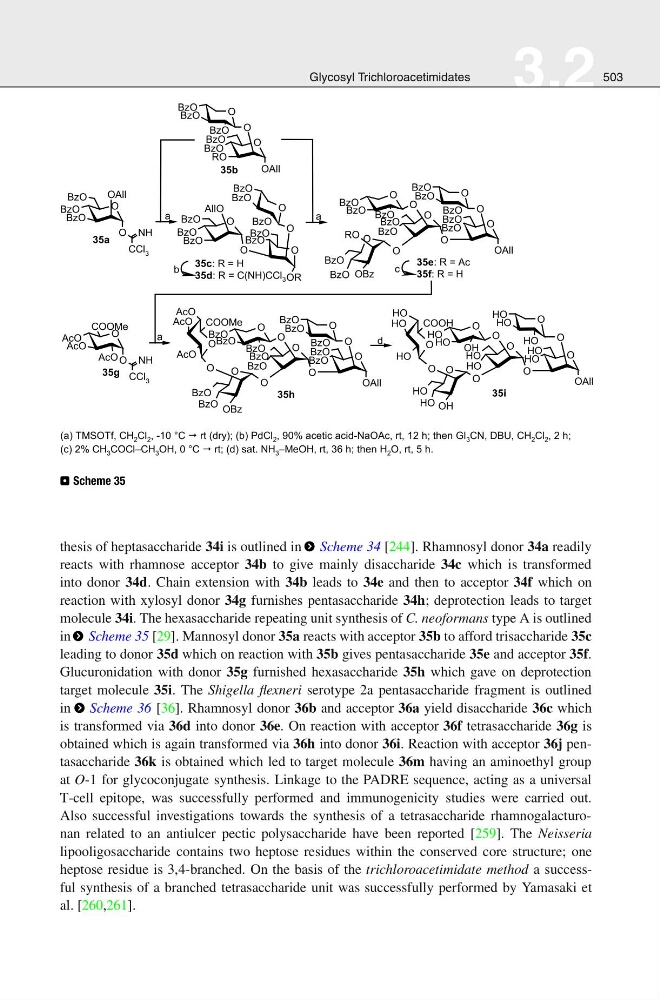
⊡ Scheme 35
thesis of heptasaccharide 34i is outlined in > Scheme 34 [244]. Rhamnosyl donor 34a readily
reacts with rhamnose acceptor 34b to give mainly disaccharide 34c which is transformed
into donor 34d. Chain extension with 34b leads to 34e and then to acceptor 34f which on
reaction with xylosyl donor 34g furnishes pentasaccharide 34h; deprotection leads to target
molecule 34i. The hexasaccharide repeating unit synthesis of C. neoformans type A is outlined
in > Scheme 35 [29]. Mannosyl donor 35a reacts with acceptor 35b to afford trisaccharide 35c
leading to donor 35d which on reaction with 35b gives pentasaccharide 35e and acceptor 35f.
Glucuronidation with donor 35g furnished hexasaccharide 35h which gave on deprotection
target molecule 35i. The Shigella flexneri serotype 2a pentasaccharide fragment is outlined
in > Scheme 36 [36]. Rhamnosyl donor 36b and acceptor 36a yield disaccharide 36c which
is transformed via 36d into donor 36e. On reaction with acceptor 36f tetrasaccharide 36g is
obtained which is again transformed via 36h into donor 36i. Reaction with acceptor 36j pentasaccharide 36k is obtained which led to target molecule 36m having an aminoethyl group
at O-1 for glycoconjugate synthesis. Linkage to the PADRE sequence, acting as a universal
T-cell epitope, was successfully performed and immunogenicity studies were carried out.
Also successful investigations towards the synthesis of a tetrasaccharide rhamnogalacturonan related to an antiulcer pectic polysaccharide have been reported [259]. The Neisseria
lipooligosaccharide contains two heptose residues within the conserved core structure; one
heptose residue is 3,4-branched. On the basis of the trichloroacetimidate method a successful synthesis of a branched tetrasaccharide unit was successfully performed by Yamasaki et
al. [260,261].
3.2
503
⊡ Scheme 35
thesis of heptasaccharide 34i is outlined in > Scheme 34 [244]. Rhamnosyl donor 34a readily
reacts with rhamnose acceptor 34b to give mainly disaccharide 34c which is transformed
into donor 34d. Chain extension with 34b leads to 34e and then to acceptor 34f which on
reaction with xylosyl donor 34g furnishes pentasaccharide 34h; deprotection leads to target
molecule 34i. The hexasaccharide repeating unit synthesis of C. neoformans type A is outlined
in > Scheme 35 [29]. Mannosyl donor 35a reacts with acceptor 35b to afford trisaccharide 35c
leading to donor 35d which on reaction with 35b gives pentasaccharide 35e and acceptor 35f.
Glucuronidation with donor 35g furnished hexasaccharide 35h which gave on deprotection
target molecule 35i. The Shigella flexneri serotype 2a pentasaccharide fragment is outlined
in > Scheme 36 [36]. Rhamnosyl donor 36b and acceptor 36a yield disaccharide 36c which
is transformed via 36d into donor 36e. On reaction with acceptor 36f tetrasaccharide 36g is
obtained which is again transformed via 36h into donor 36i. Reaction with acceptor 36j pentasaccharide 36k is obtained which led to target molecule 36m having an aminoethyl group
at O-1 for glycoconjugate synthesis. Linkage to the PADRE sequence, acting as a universal
T-cell epitope, was successfully performed and immunogenicity studies were carried out.
Also successful investigations towards the synthesis of a tetrasaccharide rhamnogalacturonan related to an antiulcer pectic polysaccharide have been reported [259]. The Neisseria
lipooligosaccharide contains two heptose residues within the conserved core structure; one
heptose residue is 3,4-branched. On the basis of the trichloroacetimidate method a successful synthesis of a branched tetrasaccharide unit was successfully performed by Yamasaki et
al. [260,261].