

496
3
Chemical Glycosylation Reactions
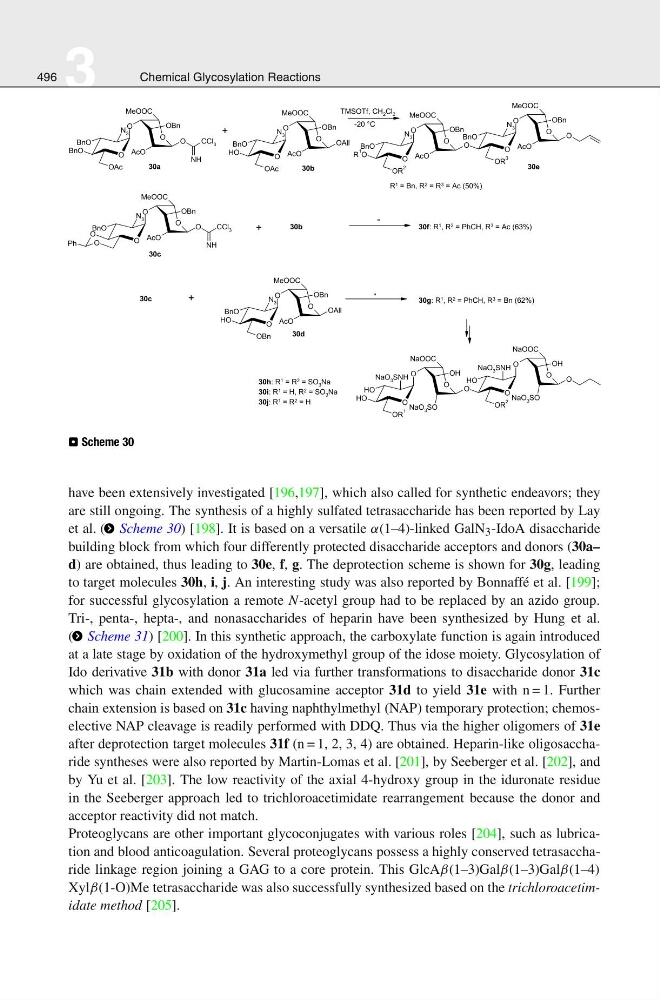
⊡ Scheme 30
have been extensively investigated [196,197], which also called for synthetic endeavors; they
are still ongoing. The synthesis of a highly sulfated tetrasaccharide has been reported by Lay
et al. ( > Scheme 30) [198]. It is based on a versatile α(1–4)-linked GalN 3 -IdoA disaccharide
building block from which four differently protected disaccharide acceptors and donors (30a–
d) are obtained, thus leading to 30e, f, g. The deprotection scheme is shown for 30g, leading
to target molecules 30h, i, j. An interesting study was also reported by Bonnaffé et al. [199];
for successful glycosylation a remote N-acetyl group had to be replaced by an azido group.
Tri-, penta-, hepta-, and nonasaccharides of heparin have been synthesized by Hung et al.
( > Scheme 31) [200]. In this synthetic approach, the carboxylate function is again introduced
at a late stage by oxidation of the hydroxymethyl group of the idose moiety. Glycosylation of
Ido derivative 31b with donor 31a led via further transformations to disaccharide donor 31c
which was chain extended with glucosamine acceptor 31d to yield 31e with n = 1. Further
chain extension is based on 31c having naphthylmethyl (NAP) temporary protection; chemoselective NAP cleavage is readily performed with DDQ. Thus via the higher oligomers of 31e
after deprotection target molecules 31f (n = 1, 2, 3, 4) are obtained. Heparin-like oligosaccharide syntheses were also reported by Martin-Lomas et al. [201], by Seeberger et al. [202], and
by Yu et al. [203]. The low reactivity of the axial 4-hydroxy group in the iduronate residue
in the Seeberger approach led to trichloroacetimidate rearrangement because the donor and
acceptor reactivity did not match.
Proteoglycans are other important glycoconjugates with various roles [204], such as lubrication and blood anticoagulation. Several proteoglycans possess a highly conserved tetrasaccharide linkage region joining a GAG to a core protein. This GlcAβ(1–3)Galβ(1–3)Galβ(1–4)
Xylβ(1-O)Me tetrasaccharide was also successfully synthesized based on the trichloroacetimidate method [205].
3
Chemical Glycosylation Reactions
⊡ Scheme 30
have been extensively investigated [196,197], which also called for synthetic endeavors; they
are still ongoing. The synthesis of a highly sulfated tetrasaccharide has been reported by Lay
et al. ( > Scheme 30) [198]. It is based on a versatile α(1–4)-linked GalN 3 -IdoA disaccharide
building block from which four differently protected disaccharide acceptors and donors (30a–
d) are obtained, thus leading to 30e, f, g. The deprotection scheme is shown for 30g, leading
to target molecules 30h, i, j. An interesting study was also reported by Bonnaffé et al. [199];
for successful glycosylation a remote N-acetyl group had to be replaced by an azido group.
Tri-, penta-, hepta-, and nonasaccharides of heparin have been synthesized by Hung et al.
( > Scheme 31) [200]. In this synthetic approach, the carboxylate function is again introduced
at a late stage by oxidation of the hydroxymethyl group of the idose moiety. Glycosylation of
Ido derivative 31b with donor 31a led via further transformations to disaccharide donor 31c
which was chain extended with glucosamine acceptor 31d to yield 31e with n = 1. Further
chain extension is based on 31c having naphthylmethyl (NAP) temporary protection; chemoselective NAP cleavage is readily performed with DDQ. Thus via the higher oligomers of 31e
after deprotection target molecules 31f (n = 1, 2, 3, 4) are obtained. Heparin-like oligosaccharide syntheses were also reported by Martin-Lomas et al. [201], by Seeberger et al. [202], and
by Yu et al. [203]. The low reactivity of the axial 4-hydroxy group in the iduronate residue
in the Seeberger approach led to trichloroacetimidate rearrangement because the donor and
acceptor reactivity did not match.
Proteoglycans are other important glycoconjugates with various roles [204], such as lubrication and blood anticoagulation. Several proteoglycans possess a highly conserved tetrasaccharide linkage region joining a GAG to a core protein. This GlcAβ(1–3)Galβ(1–3)Galβ(1–4)
Xylβ(1-O)Me tetrasaccharide was also successfully synthesized based on the trichloroacetimidate method [205].