

494
3
Chemical Glycosylation Reactions
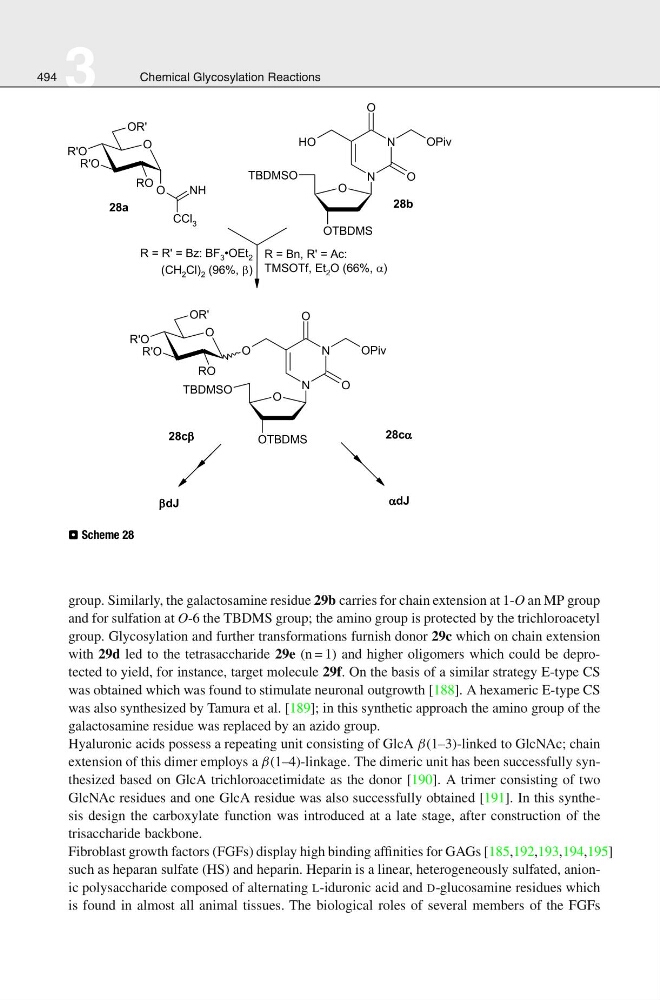
⊡ Scheme 28
group. Similarly, the galactosamine residue 29b carries for chain extension at 1-O an MP group
and for sulfation at O-6 the TBDMS group; the amino group is protected by the trichloroacetyl
group. Glycosylation and further transformations furnish donor 29c which on chain extension
with 29d led to the tetrasaccharide 29e (n = 1) and higher oligomers which could be deprotected to yield, for instance, target molecule 29f. On the basis of a similar strategy E-type CS
was obtained which was found to stimulate neuronal outgrowth [188]. A hexameric E-type CS
was also synthesized by Tamura et al. [189]; in this synthetic approach the amino group of the
galactosamine residue was replaced by an azido group.
Hyaluronic acids possess a repeating unit consisting of GlcA β(1–3)-linked to GlcNAc; chain
extension of this dimer employs a β(1–4)-linkage. The dimeric unit has been successfully synthesized based on GlcA trichloroacetimidate as the donor [190]. A trimer consisting of two
GlcNAc residues and one GlcA residue was also successfully obtained [191]. In this synthesis design the carboxylate function was introduced at a late stage, after construction of the
trisaccharide backbone.
Fibroblast growth factors (FGFs) display high binding affinities for GAGs [185,192,193,194,195]
such as heparan sulfate (HS) and heparin. Heparin is a linear, heterogeneously sulfated, anionic polysaccharide composed of alternating L-iduronic acid and D-glucosamine residues which
is found in almost all animal tissues. The biological roles of several members of the FGFs
3
Chemical Glycosylation Reactions
⊡ Scheme 28
group. Similarly, the galactosamine residue 29b carries for chain extension at 1-O an MP group
and for sulfation at O-6 the TBDMS group; the amino group is protected by the trichloroacetyl
group. Glycosylation and further transformations furnish donor 29c which on chain extension
with 29d led to the tetrasaccharide 29e (n = 1) and higher oligomers which could be deprotected to yield, for instance, target molecule 29f. On the basis of a similar strategy E-type CS
was obtained which was found to stimulate neuronal outgrowth [188]. A hexameric E-type CS
was also synthesized by Tamura et al. [189]; in this synthetic approach the amino group of the
galactosamine residue was replaced by an azido group.
Hyaluronic acids possess a repeating unit consisting of GlcA β(1–3)-linked to GlcNAc; chain
extension of this dimer employs a β(1–4)-linkage. The dimeric unit has been successfully synthesized based on GlcA trichloroacetimidate as the donor [190]. A trimer consisting of two
GlcNAc residues and one GlcA residue was also successfully obtained [191]. In this synthesis design the carboxylate function was introduced at a late stage, after construction of the
trisaccharide backbone.
Fibroblast growth factors (FGFs) display high binding affinities for GAGs [185,192,193,194,195]
such as heparan sulfate (HS) and heparin. Heparin is a linear, heterogeneously sulfated, anionic polysaccharide composed of alternating L-iduronic acid and D-glucosamine residues which
is found in almost all animal tissues. The biological roles of several members of the FGFs