

Glycosyl Trichloroacetimidates
3.2
475
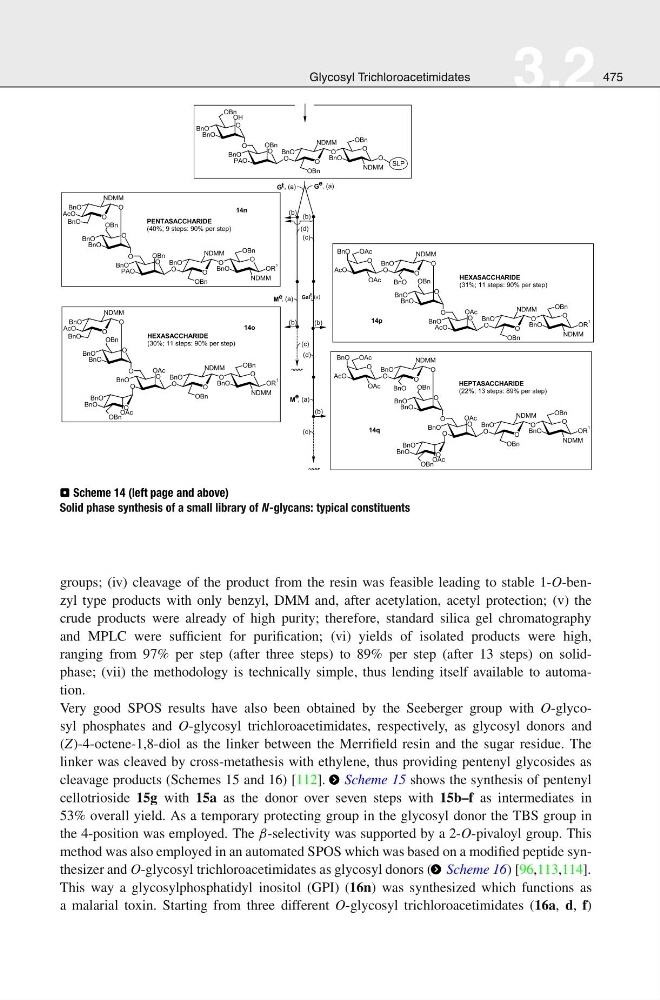
⊡ Scheme 14 (left page and above)
Solid phase synthesis of a small library of N -glycans: typical constituents
groups; (iv) cleavage of the product from the resin was feasible leading to stable 1-O-benzyl type products with only benzyl, DMM and, after acetylation, acetyl protection; (v) the
crude products were already of high purity; therefore, standard silica gel chromatography
and MPLC were sufficient for purification; (vi) yields of isolated products were high,
ranging from 97% per step (after three steps) to 89% per step (after 13 steps) on solidphase; (vii) the methodology is technically simple, thus lending itself available to automation.
Very good SPOS results have also been obtained by the Seeberger group with O-glycosyl phosphates and O-glycosyl trichloroacetimidates, respectively, as glycosyl donors and
(Z)-4-octene-1,8-diol as the linker between the Merrifield resin and the sugar residue. The
linker was cleaved by cross-metathesis with ethylene, thus providing pentenyl glycosides as
cleavage products (Schemes 15 and 16) [112]. > Scheme 15 shows the synthesis of pentenyl
cellotrioside 15g with 15a as the donor over seven steps with 15b–f as intermediates in
53% overall yield. As a temporary protecting group in the glycosyl donor the TBS group in
the 4-position was employed. The β-selectivity was supported by a 2-O-pivaloyl group. This
method was also employed in an automated SPOS which was based on a modified peptide synthesizer and O-glycosyl trichloroacetimidates as glycosyl donors ( > Scheme 16) [96,113,114].
This way a glycosylphosphatidyl inositol (GPI) (16n) was synthesized which functions as
a malarial toxin. Starting from three different O-glycosyl trichloroacetimidates (16a, d, f)
3.2
475
⊡ Scheme 14 (left page and above)
Solid phase synthesis of a small library of N -glycans: typical constituents
groups; (iv) cleavage of the product from the resin was feasible leading to stable 1-O-benzyl type products with only benzyl, DMM and, after acetylation, acetyl protection; (v) the
crude products were already of high purity; therefore, standard silica gel chromatography
and MPLC were sufficient for purification; (vi) yields of isolated products were high,
ranging from 97% per step (after three steps) to 89% per step (after 13 steps) on solidphase; (vii) the methodology is technically simple, thus lending itself available to automation.
Very good SPOS results have also been obtained by the Seeberger group with O-glycosyl phosphates and O-glycosyl trichloroacetimidates, respectively, as glycosyl donors and
(Z)-4-octene-1,8-diol as the linker between the Merrifield resin and the sugar residue. The
linker was cleaved by cross-metathesis with ethylene, thus providing pentenyl glycosides as
cleavage products (Schemes 15 and 16) [112]. > Scheme 15 shows the synthesis of pentenyl
cellotrioside 15g with 15a as the donor over seven steps with 15b–f as intermediates in
53% overall yield. As a temporary protecting group in the glycosyl donor the TBS group in
the 4-position was employed. The β-selectivity was supported by a 2-O-pivaloyl group. This
method was also employed in an automated SPOS which was based on a modified peptide synthesizer and O-glycosyl trichloroacetimidates as glycosyl donors ( > Scheme 16) [96,113,114].
This way a glycosylphosphatidyl inositol (GPI) (16n) was synthesized which functions as
a malarial toxin. Starting from three different O-glycosyl trichloroacetimidates (16a, d, f)