

Glycosyl Trichloroacetimidates
3.2
465
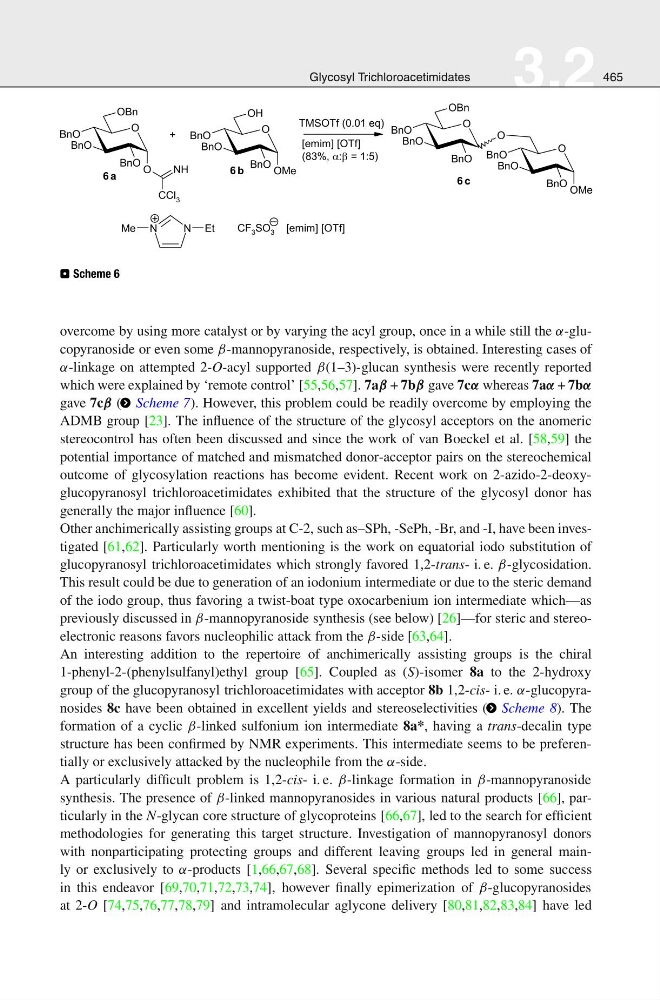
⊡ Scheme 6
overcome by using more catalyst or by varying the acyl group, once in a while still the α-glucopyranoside or even some β-mannopyranoside, respectively, is obtained. Interesting cases of
α-linkage on attempted 2-O-acyl supported β(1–3)-glucan synthesis were recently reported
which were explained by ‘remote control’ [55,56,57]. 7aβ + 7bβ gave 7cα whereas 7aα + 7bα
gave 7cβ ( > Scheme 7). However, this problem could be readily overcome by employing the
ADMB group [23]. The influence of the structure of the glycosyl acceptors on the anomeric
stereocontrol has often been discussed and since the work of van Boeckel et al. [58,59] the
potential importance of matched and mismatched donor-acceptor pairs on the stereochemical
outcome of glycosylation reactions has become evident. Recent work on 2-azido-2-deoxyglucopyranosyl trichloroacetimidates exhibited that the structure of the glycosyl donor has
generally the major influence [60].
Other anchimerically assisting groups at C-2, such as–SPh, -SePh, -Br, and -I, have been investigated [61,62]. Particularly worth mentioning is the work on equatorial iodo substitution of
glucopyranosyl trichloroacetimidates which strongly favored 1,2-trans- i. e. β-glycosidation.
This result could be due to generation of an iodonium intermediate or due to the steric demand
of the iodo group, thus favoring a twist-boat type oxocarbenium ion intermediate which—as
previously discussed in β-mannopyranoside synthesis (see below) [26]—for steric and stereoelectronic reasons favors nucleophilic attack from the β-side [63,64].
An interesting addition to the repertoire of anchimerically assisting groups is the chiral
1-phenyl-2-(phenylsulfanyl)ethyl group [65]. Coupled as (S)-isomer 8a to the 2-hydroxy
group of the glucopyranosyl trichloroacetimidates with acceptor 8b 1,2-cis- i. e. α-glucopyranosides 8c have been obtained in excellent yields and stereoselectivities ( > Scheme 8). The
formation of a cyclic β-linked sulfonium ion intermediate 8a*, having a trans-decalin type
structure has been confirmed by NMR experiments. This intermediate seems to be preferentially or exclusively attacked by the nucleophile from the α-side.
A particularly difficult problem is 1,2-cis- i. e. β-linkage formation in β-mannopyranoside
synthesis. The presence of β-linked mannopyranosides in various natural products [66], particularly in the N-glycan core structure of glycoproteins [66,67], led to the search for efficient
methodologies for generating this target structure. Investigation of mannopyranosyl donors
with nonparticipating protecting groups and different leaving groups led in general mainly or exclusively to α-products [1,66,67,68]. Several specific methods led to some success
in this endeavor [69,70,71,72,73,74], however finally epimerization of β-glucopyranosides
at 2-O [74,75,76,77,78,79] and intramolecular aglycone delivery [80,81,82,83,84] have led
3.2
465
⊡ Scheme 6
overcome by using more catalyst or by varying the acyl group, once in a while still the α-glucopyranoside or even some β-mannopyranoside, respectively, is obtained. Interesting cases of
α-linkage on attempted 2-O-acyl supported β(1–3)-glucan synthesis were recently reported
which were explained by ‘remote control’ [55,56,57]. 7aβ + 7bβ gave 7cα whereas 7aα + 7bα
gave 7cβ ( > Scheme 7). However, this problem could be readily overcome by employing the
ADMB group [23]. The influence of the structure of the glycosyl acceptors on the anomeric
stereocontrol has often been discussed and since the work of van Boeckel et al. [58,59] the
potential importance of matched and mismatched donor-acceptor pairs on the stereochemical
outcome of glycosylation reactions has become evident. Recent work on 2-azido-2-deoxyglucopyranosyl trichloroacetimidates exhibited that the structure of the glycosyl donor has
generally the major influence [60].
Other anchimerically assisting groups at C-2, such as–SPh, -SePh, -Br, and -I, have been investigated [61,62]. Particularly worth mentioning is the work on equatorial iodo substitution of
glucopyranosyl trichloroacetimidates which strongly favored 1,2-trans- i. e. β-glycosidation.
This result could be due to generation of an iodonium intermediate or due to the steric demand
of the iodo group, thus favoring a twist-boat type oxocarbenium ion intermediate which—as
previously discussed in β-mannopyranoside synthesis (see below) [26]—for steric and stereoelectronic reasons favors nucleophilic attack from the β-side [63,64].
An interesting addition to the repertoire of anchimerically assisting groups is the chiral
1-phenyl-2-(phenylsulfanyl)ethyl group [65]. Coupled as (S)-isomer 8a to the 2-hydroxy
group of the glucopyranosyl trichloroacetimidates with acceptor 8b 1,2-cis- i. e. α-glucopyranosides 8c have been obtained in excellent yields and stereoselectivities ( > Scheme 8). The
formation of a cyclic β-linked sulfonium ion intermediate 8a*, having a trans-decalin type
structure has been confirmed by NMR experiments. This intermediate seems to be preferentially or exclusively attacked by the nucleophile from the α-side.
A particularly difficult problem is 1,2-cis- i. e. β-linkage formation in β-mannopyranoside
synthesis. The presence of β-linked mannopyranosides in various natural products [66], particularly in the N-glycan core structure of glycoproteins [66,67], led to the search for efficient
methodologies for generating this target structure. Investigation of mannopyranosyl donors
with nonparticipating protecting groups and different leaving groups led in general mainly or exclusively to α-products [1,66,67,68]. Several specific methods led to some success
in this endeavor [69,70,71,72,73,74], however finally epimerization of β-glucopyranosides
at 2-O [74,75,76,77,78,79] and intramolecular aglycone delivery [80,81,82,83,84] have led