

Glycosyl Trichloroacetimidates
3.2
463
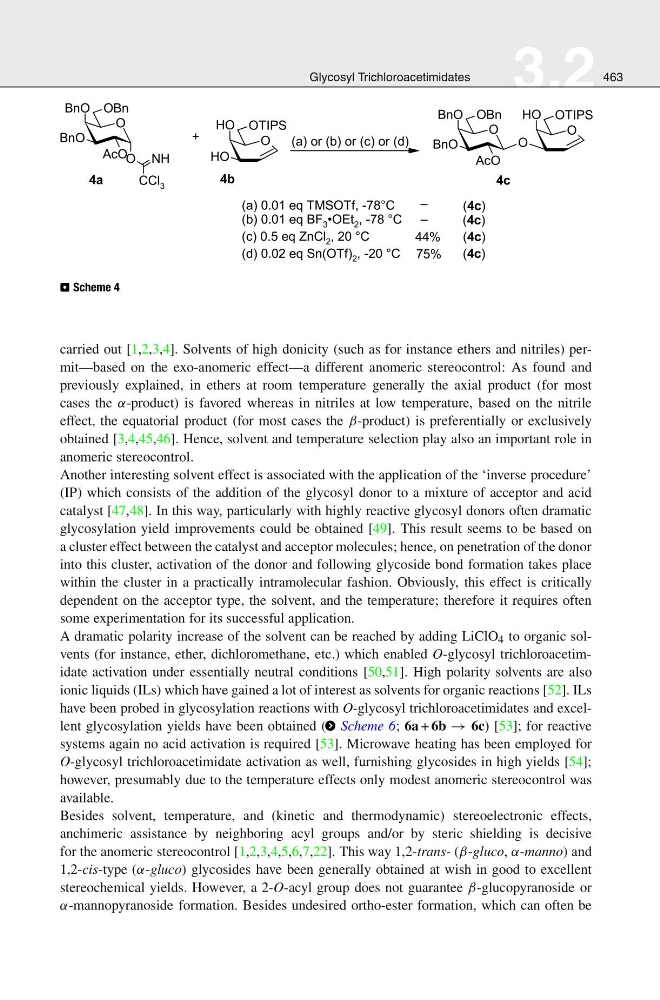
⊡ Scheme 4
carried out [1,2,3,4]. Solvents of high donicity (such as for instance ethers and nitriles) permit—based on the exo-anomeric effect—a different anomeric stereocontrol: As found and
previously explained, in ethers at room temperature generally the axial product (for most
cases the α-product) is favored whereas in nitriles at low temperature, based on the nitrile
effect, the equatorial product (for most cases the β-product) is preferentially or exclusively
obtained [3,4,45,46]. Hence, solvent and temperature selection play also an important role in
anomeric stereocontrol.
Another interesting solvent effect is associated with the application of the ‘inverse procedure’
(IP) which consists of the addition of the glycosyl donor to a mixture of acceptor and acid
catalyst [47,48]. In this way, particularly with highly reactive glycosyl donors often dramatic
glycosylation yield improvements could be obtained [49]. This result seems to be based on
a cluster effect between the catalyst and acceptor molecules; hence, on penetration of the donor
into this cluster, activation of the donor and following glycoside bond formation takes place
within the cluster in a practically intramolecular fashion. Obviously, this effect is critically
dependent on the acceptor type, the solvent, and the temperature; therefore it requires often
some experimentation for its successful application.
A dramatic polarity increase of the solvent can be reached by adding LiClO 4 to organic solvents (for instance, ether, dichloromethane, etc.) which enabled O-glycosyl trichloroacetimidate activation under essentially neutral conditions [50,51]. High polarity solvents are also
ionic liquids (ILs) which have gained a lot of interest as solvents for organic reactions [52]. ILs
have been probed in glycosylation reactions with O-glycosyl trichloroacetimidates and excellent glycosylation yields have been obtained ( > Scheme 6; 6a + 6b → 6c) [53]; for reactive
systems again no acid activation is required [53]. Microwave heating has been employed for
O-glycosyl trichloroacetimidate activation as well, furnishing glycosides in high yields [54];
however, presumably due to the temperature effects only modest anomeric stereocontrol was
available.
Besides solvent, temperature, and (kinetic and thermodynamic) stereoelectronic effects,
anchimeric assistance by neighboring acyl groups and/or by steric shielding is decisive
for the anomeric stereocontrol [1,2,3,4,5,6,7,22]. This way 1,2-trans- (β-gluco, α-manno) and
1,2-cis-type (α-gluco) glycosides have been generally obtained at wish in good to excellent
stereochemical yields. However, a 2-O-acyl group does not guarantee β-glucopyranoside or
α-mannopyranoside formation. Besides undesired ortho-ester formation, which can often be
3.2
463
⊡ Scheme 4
carried out [1,2,3,4]. Solvents of high donicity (such as for instance ethers and nitriles) permit—based on the exo-anomeric effect—a different anomeric stereocontrol: As found and
previously explained, in ethers at room temperature generally the axial product (for most
cases the α-product) is favored whereas in nitriles at low temperature, based on the nitrile
effect, the equatorial product (for most cases the β-product) is preferentially or exclusively
obtained [3,4,45,46]. Hence, solvent and temperature selection play also an important role in
anomeric stereocontrol.
Another interesting solvent effect is associated with the application of the ‘inverse procedure’
(IP) which consists of the addition of the glycosyl donor to a mixture of acceptor and acid
catalyst [47,48]. In this way, particularly with highly reactive glycosyl donors often dramatic
glycosylation yield improvements could be obtained [49]. This result seems to be based on
a cluster effect between the catalyst and acceptor molecules; hence, on penetration of the donor
into this cluster, activation of the donor and following glycoside bond formation takes place
within the cluster in a practically intramolecular fashion. Obviously, this effect is critically
dependent on the acceptor type, the solvent, and the temperature; therefore it requires often
some experimentation for its successful application.
A dramatic polarity increase of the solvent can be reached by adding LiClO 4 to organic solvents (for instance, ether, dichloromethane, etc.) which enabled O-glycosyl trichloroacetimidate activation under essentially neutral conditions [50,51]. High polarity solvents are also
ionic liquids (ILs) which have gained a lot of interest as solvents for organic reactions [52]. ILs
have been probed in glycosylation reactions with O-glycosyl trichloroacetimidates and excellent glycosylation yields have been obtained ( > Scheme 6; 6a + 6b → 6c) [53]; for reactive
systems again no acid activation is required [53]. Microwave heating has been employed for
O-glycosyl trichloroacetimidate activation as well, furnishing glycosides in high yields [54];
however, presumably due to the temperature effects only modest anomeric stereocontrol was
available.
Besides solvent, temperature, and (kinetic and thermodynamic) stereoelectronic effects,
anchimeric assistance by neighboring acyl groups and/or by steric shielding is decisive
for the anomeric stereocontrol [1,2,3,4,5,6,7,22]. This way 1,2-trans- (β-gluco, α-manno) and
1,2-cis-type (α-gluco) glycosides have been generally obtained at wish in good to excellent
stereochemical yields. However, a 2-O-acyl group does not guarantee β-glucopyranoside or
α-mannopyranoside formation. Besides undesired ortho-ester formation, which can often be