

22
1
General Principles
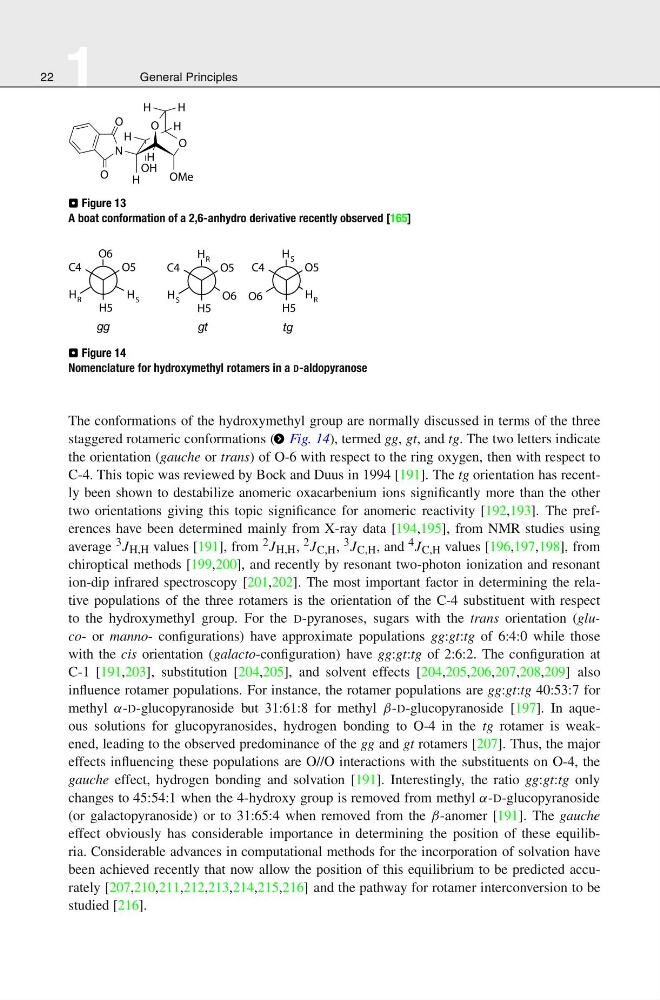
⊡ Figure 13
A boat conformation of a 2,6-anhydro derivative recently observed [165]
⊡ Figure 14
Nomenclature for hydroxymethyl rotamers in a D-aldopyranose
The conformations of the hydroxymethyl group are normally discussed in terms of the three
staggered rotameric conformations ( > Fig. 14), termed gg, gt, and tg. The two letters indicate
the orientation (gauche or trans) of O-6 with respect to the ring oxygen, then with respect to
C-4. This topic was reviewed by Bock and Duus in 1994 [191]. The tg orientation has recently been shown to destabilize anomeric oxacarbenium ions significantly more than the other
two orientations giving this topic significance for anomeric reactivity [192,193]. The preferences have been determined mainly from X-ray data [194,195], from NMR studies using
average 3 J H,H values [191], from 2 J H,H , 2 J C,H , 3 J C,H , and 4 J C,H values [196,197,198], from
chiroptical methods [199,200], and recently by resonant two-photon ionization and resonant
ion-dip infrared spectroscopy [201,202]. The most important factor in determining the relative populations of the three rotamers is the orientation of the C-4 substituent with respect
to the hydroxymethyl group. For the D-pyranoses, sugars with the trans orientation (gluco- or manno- configurations) have approximate populations gg:gt:tg of 6:4:0 while those
with the cis orientation (galacto-configuration) have gg:gt:tg of 2:6:2. The configuration at
C-1 [191,203], substitution [204,205], and solvent effects [204,205,206,207,208,209] also
influence rotamer populations. For instance, the rotamer populations are gg:gt:tg 40:53:7 for
methyl α-D-glucopyranoside but 31:61:8 for methyl β-D-glucopyranoside [197]. In aqueous solutions for glucopyranosides, hydrogen bonding to O-4 in the tg rotamer is weakened, leading to the observed predominance of the gg and gt rotamers [207]. Thus, the major
effects influencing these populations are O//O interactions with the substituents on O-4, the
gauche effect, hydrogen bonding and solvation [191]. Interestingly, the ratio gg:gt:tg only
changes to 45:54:1 when the 4-hydroxy group is removed from methyl α-D-glucopyranoside
(or galactopyranoside) or to 31:65:4 when removed from the β-anomer [191]. The gauche
effect obviously has considerable importance in determining the position of these equilibria. Considerable advances in computational methods for the incorporation of solvation have
been achieved recently that now allow the position of this equilibrium to be predicted accurately [207,210,211,212,213,214,215,216] and the pathway for rotamer interconversion to be
studied [216].
1
General Principles
⊡ Figure 13
A boat conformation of a 2,6-anhydro derivative recently observed [165]
⊡ Figure 14
Nomenclature for hydroxymethyl rotamers in a D-aldopyranose
The conformations of the hydroxymethyl group are normally discussed in terms of the three
staggered rotameric conformations ( > Fig. 14), termed gg, gt, and tg. The two letters indicate
the orientation (gauche or trans) of O-6 with respect to the ring oxygen, then with respect to
C-4. This topic was reviewed by Bock and Duus in 1994 [191]. The tg orientation has recently been shown to destabilize anomeric oxacarbenium ions significantly more than the other
two orientations giving this topic significance for anomeric reactivity [192,193]. The preferences have been determined mainly from X-ray data [194,195], from NMR studies using
average 3 J H,H values [191], from 2 J H,H , 2 J C,H , 3 J C,H , and 4 J C,H values [196,197,198], from
chiroptical methods [199,200], and recently by resonant two-photon ionization and resonant
ion-dip infrared spectroscopy [201,202]. The most important factor in determining the relative populations of the three rotamers is the orientation of the C-4 substituent with respect
to the hydroxymethyl group. For the D-pyranoses, sugars with the trans orientation (gluco- or manno- configurations) have approximate populations gg:gt:tg of 6:4:0 while those
with the cis orientation (galacto-configuration) have gg:gt:tg of 2:6:2. The configuration at
C-1 [191,203], substitution [204,205], and solvent effects [204,205,206,207,208,209] also
influence rotamer populations. For instance, the rotamer populations are gg:gt:tg 40:53:7 for
methyl α-D-glucopyranoside but 31:61:8 for methyl β-D-glucopyranoside [197]. In aqueous solutions for glucopyranosides, hydrogen bonding to O-4 in the tg rotamer is weakened, leading to the observed predominance of the gg and gt rotamers [207]. Thus, the major
effects influencing these populations are O//O interactions with the substituents on O-4, the
gauche effect, hydrogen bonding and solvation [191]. Interestingly, the ratio gg:gt:tg only
changes to 45:54:1 when the 4-hydroxy group is removed from methyl α-D-glucopyranoside
(or galactopyranoside) or to 31:65:4 when removed from the β-anomer [191]. The gauche
effect obviously has considerable importance in determining the position of these equilibria. Considerable advances in computational methods for the incorporation of solvation have
been achieved recently that now allow the position of this equilibrium to be predicted accurately [207,210,211,212,213,214,215,216] and the pathway for rotamer interconversion to be
studied [216].