

Glycosyl Trichloroacetimidates
3.2
461
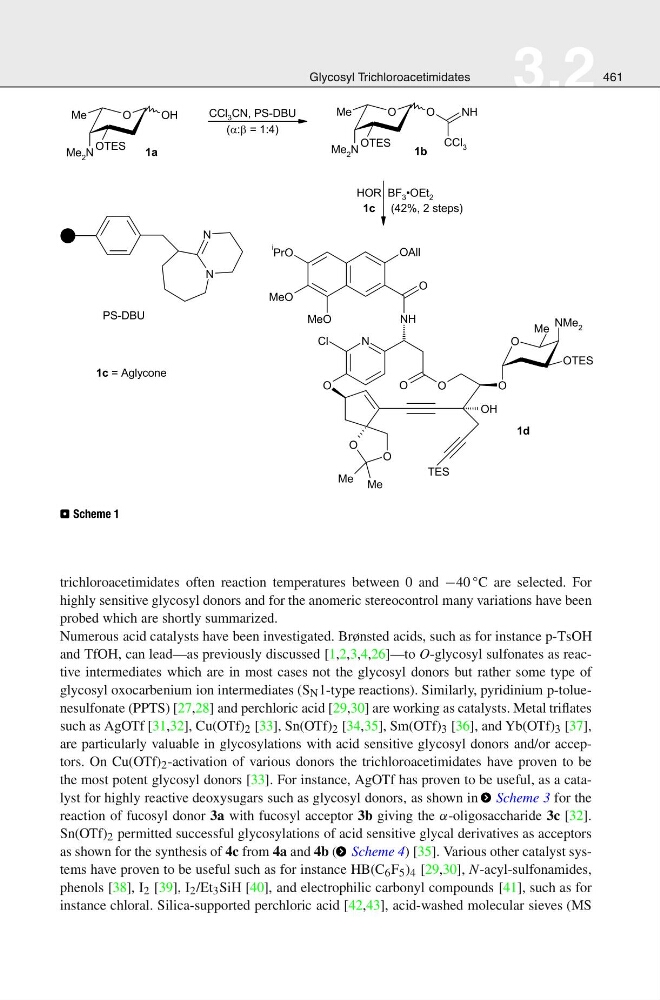
⊡ Scheme 1
trichloroacetimidates often reaction temperatures between 0 and −40 °C are selected. For
highly sensitive glycosyl donors and for the anomeric stereocontrol many variations have been
probed which are shortly summarized.
Numerous acid catalysts have been investigated. Brønsted acids, such as for instance p-TsOH
and TfOH, can lead—as previously discussed [1,2,3,4,26]—to O-glycosyl sulfonates as reactive intermediates which are in most cases not the glycosyl donors but rather some type of
glycosyl oxocarbenium ion intermediates (S N 1-type reactions). Similarly, pyridinium p-toluenesulfonate (PPTS) [27,28] and perchloric acid [29,30] are working as catalysts. Metal triflates
such as AgOTf [31,32], Cu(OTf) 2 [33], Sn(OTf) 2 [34,35], Sm(OTf) 3 [36], and Yb(OTf) 3 [37],
are particularly valuable in glycosylations with acid sensitive glycosyl donors and/or acceptors. On Cu(OTf) 2 -activation of various donors the trichloroacetimidates have proven to be
the most potent glycosyl donors [33]. For instance, AgOTf has proven to be useful, as a catalyst for highly reactive deoxysugars such as glycosyl donors, as shown in > Scheme 3 for the
reaction of fucosyl donor 3a with fucosyl acceptor 3b giving the α-oligosaccharide 3c [32].
Sn(OTf) 2 permitted successful glycosylations of acid sensitive glycal derivatives as acceptors
as shown for the synthesis of 4c from 4a and 4b ( > Scheme 4) [35]. Various other catalyst systems have proven to be useful such as for instance HB(C 6 F 5 ) 4 [29,30], N-acyl-sulfonamides,
phenols [38], I 2 [39], I 2 /Et 3 SiH [40], and electrophilic carbonyl compounds [41], such as for
instance chloral. Silica-supported perchloric acid [42,43], acid-washed molecular sieves (MS
3.2
461
⊡ Scheme 1
trichloroacetimidates often reaction temperatures between 0 and −40 °C are selected. For
highly sensitive glycosyl donors and for the anomeric stereocontrol many variations have been
probed which are shortly summarized.
Numerous acid catalysts have been investigated. Brønsted acids, such as for instance p-TsOH
and TfOH, can lead—as previously discussed [1,2,3,4,26]—to O-glycosyl sulfonates as reactive intermediates which are in most cases not the glycosyl donors but rather some type of
glycosyl oxocarbenium ion intermediates (S N 1-type reactions). Similarly, pyridinium p-toluenesulfonate (PPTS) [27,28] and perchloric acid [29,30] are working as catalysts. Metal triflates
such as AgOTf [31,32], Cu(OTf) 2 [33], Sn(OTf) 2 [34,35], Sm(OTf) 3 [36], and Yb(OTf) 3 [37],
are particularly valuable in glycosylations with acid sensitive glycosyl donors and/or acceptors. On Cu(OTf) 2 -activation of various donors the trichloroacetimidates have proven to be
the most potent glycosyl donors [33]. For instance, AgOTf has proven to be useful, as a catalyst for highly reactive deoxysugars such as glycosyl donors, as shown in > Scheme 3 for the
reaction of fucosyl donor 3a with fucosyl acceptor 3b giving the α-oligosaccharide 3c [32].
Sn(OTf) 2 permitted successful glycosylations of acid sensitive glycal derivatives as acceptors
as shown for the synthesis of 4c from 4a and 4b ( > Scheme 4) [35]. Various other catalyst systems have proven to be useful such as for instance HB(C 6 F 5 ) 4 [29,30], N-acyl-sulfonamides,
phenols [38], I 2 [39], I 2 /Et 3 SiH [40], and electrophilic carbonyl compounds [41], such as for
instance chloral. Silica-supported perchloric acid [42,43], acid-washed molecular sieves (MS