

458
3
Chemical Glycosylation Reactions
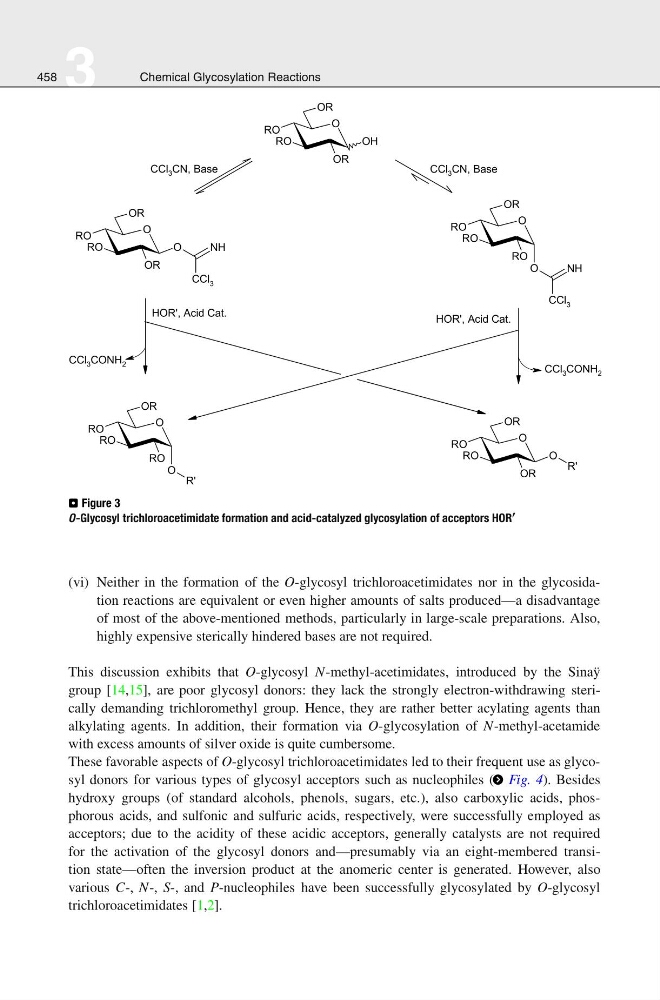
⊡ Figure 3
O-Glycosyl trichloroacetimidate formation and acid-catalyzed glycosylation of acceptors HOR
(vi) Neither in the formation of the O-glycosyl trichloroacetimidates nor in the glycosidation reactions are equivalent or even higher amounts of salts produced—a disadvantage
of most of the above-mentioned methods, particularly in large-scale preparations. Also,
highly expensive sterically hindered bases are not required.
This discussion exhibits that O-glycosyl N-methyl-acetimidates, introduced by the Sinaÿ
group [14,15], are poor glycosyl donors: they lack the strongly electron-withdrawing sterically demanding trichloromethyl group. Hence, they are rather better acylating agents than
alkylating agents. In addition, their formation via O-glycosylation of N-methyl-acetamide
with excess amounts of silver oxide is quite cumbersome.
These favorable aspects of O-glycosyl trichloroacetimidates led to their frequent use as glycosyl donors for various types of glycosyl acceptors such as nucleophiles ( > Fig. 4). Besides
hydroxy groups (of standard alcohols, phenols, sugars, etc.), also carboxylic acids, phosphorous acids, and sulfonic and sulfuric acids, respectively, were successfully employed as
acceptors; due to the acidity of these acidic acceptors, generally catalysts are not required
for the activation of the glycosyl donors and—presumably via an eight-membered transition state—often the inversion product at the anomeric center is generated. However, also
various C-, N-, S-, and P-nucleophiles have been successfully glycosylated by O-glycosyl
trichloroacetimidates [1,2].
3
Chemical Glycosylation Reactions
⊡ Figure 3
O-Glycosyl trichloroacetimidate formation and acid-catalyzed glycosylation of acceptors HOR
(vi) Neither in the formation of the O-glycosyl trichloroacetimidates nor in the glycosidation reactions are equivalent or even higher amounts of salts produced—a disadvantage
of most of the above-mentioned methods, particularly in large-scale preparations. Also,
highly expensive sterically hindered bases are not required.
This discussion exhibits that O-glycosyl N-methyl-acetimidates, introduced by the Sinaÿ
group [14,15], are poor glycosyl donors: they lack the strongly electron-withdrawing sterically demanding trichloromethyl group. Hence, they are rather better acylating agents than
alkylating agents. In addition, their formation via O-glycosylation of N-methyl-acetamide
with excess amounts of silver oxide is quite cumbersome.
These favorable aspects of O-glycosyl trichloroacetimidates led to their frequent use as glycosyl donors for various types of glycosyl acceptors such as nucleophiles ( > Fig. 4). Besides
hydroxy groups (of standard alcohols, phenols, sugars, etc.), also carboxylic acids, phosphorous acids, and sulfonic and sulfuric acids, respectively, were successfully employed as
acceptors; due to the acidity of these acidic acceptors, generally catalysts are not required
for the activation of the glycosyl donors and—presumably via an eight-membered transition state—often the inversion product at the anomeric center is generated. However, also
various C-, N-, S-, and P-nucleophiles have been successfully glycosylated by O-glycosyl
trichloroacetimidates [1,2].