

456
3
Chemical Glycosylation Reactions
its acid-catalyzed activation in the glycosylation step. This approach should also satisfy the
demand for simplicity in combination with efficiency which is decisive for general acceptance.
Obviously, for achieving stereocontrolled activation of the anomeric oxygen atom, the anomerization of the anomeric hydroxy group or the anomeric oxide ion, respectively, has to be considered. Thus, in a reversible activation process and with the help of kinetic and thermodynamic reaction control, possibly both activated anomers should be accessible. From these considerations it was concluded that suitable triple-bond systems A≡B (or compounds containing
cumulative double bond systems A=B=C) might be found that add pyranoses and furanoses
under base catalysis directly and reversibly in a stereocontrolled manner [ > Fig. 1, (D)].
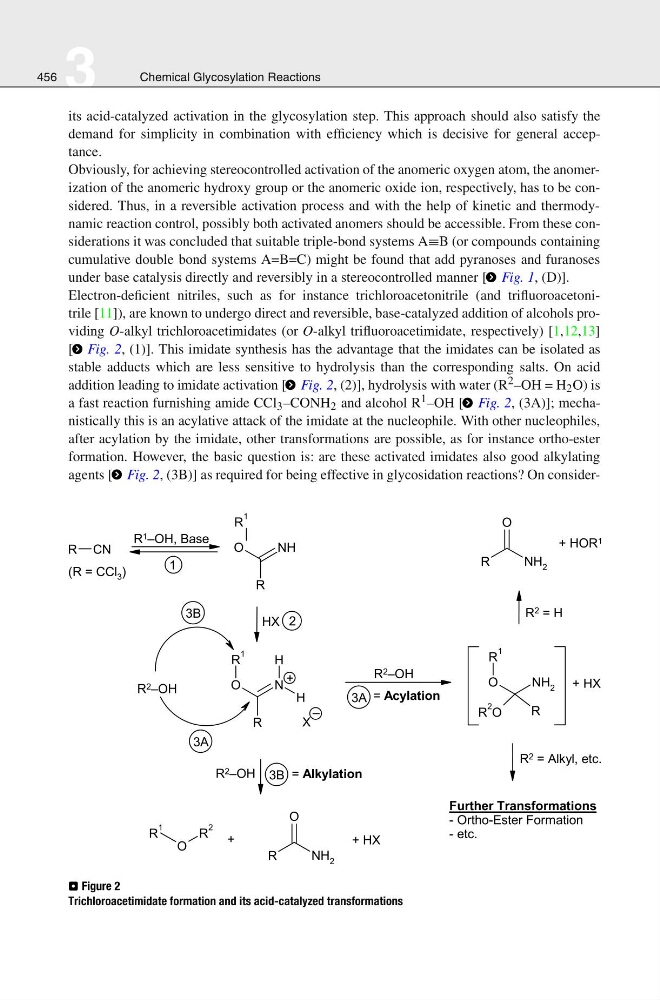
Electron-deficient nitriles, such as for instance trichloroacetonitrile (and trifluoroacetonitrile [11]), are known to undergo direct and reversible, base-catalyzed addition of alcohols providing O-alkyl trichloroacetimidates (or O-alkyl trifluoroacetimidate, respectively) [1,12,13]
[ > Fig. 2, (1)]. This imidate synthesis has the advantage that the imidates can be isolated as
stable adducts which are less sensitive to hydrolysis than the corresponding salts. On acid
addition leading to imidate activation [ > Fig. 2, (2)], hydrolysis with water (R 2 –OH = H 2 O) is
a fast reaction furnishing amide CCl 3 –CONH 2 and alcohol R 1 –OH [ > Fig. 2, (3A)]; mechanistically this is an acylative attack of the imidate at the nucleophile. With other nucleophiles,
after acylation by the imidate, other transformations are possible, as for instance ortho-ester
formation. However, the basic question is: are these activated imidates also good alkylating
agents [ > Fig. 2, (3B)] as required for being effective in glycosidation reactions? On consider⊡ Figure 2
Trichloroacetimidate formation and its acid-catalyzed transformations
3
Chemical Glycosylation Reactions
its acid-catalyzed activation in the glycosylation step. This approach should also satisfy the
demand for simplicity in combination with efficiency which is decisive for general acceptance.
Obviously, for achieving stereocontrolled activation of the anomeric oxygen atom, the anomerization of the anomeric hydroxy group or the anomeric oxide ion, respectively, has to be considered. Thus, in a reversible activation process and with the help of kinetic and thermodynamic reaction control, possibly both activated anomers should be accessible. From these considerations it was concluded that suitable triple-bond systems A≡B (or compounds containing
cumulative double bond systems A=B=C) might be found that add pyranoses and furanoses
under base catalysis directly and reversibly in a stereocontrolled manner [ > Fig. 1, (D)].
Electron-deficient nitriles, such as for instance trichloroacetonitrile (and trifluoroacetonitrile [11]), are known to undergo direct and reversible, base-catalyzed addition of alcohols providing O-alkyl trichloroacetimidates (or O-alkyl trifluoroacetimidate, respectively) [1,12,13]
[ > Fig. 2, (1)]. This imidate synthesis has the advantage that the imidates can be isolated as
stable adducts which are less sensitive to hydrolysis than the corresponding salts. On acid
addition leading to imidate activation [ > Fig. 2, (2)], hydrolysis with water (R 2 –OH = H 2 O) is
a fast reaction furnishing amide CCl 3 –CONH 2 and alcohol R 1 –OH [ > Fig. 2, (3A)]; mechanistically this is an acylative attack of the imidate at the nucleophile. With other nucleophiles,
after acylation by the imidate, other transformations are possible, as for instance ortho-ester
formation. However, the basic question is: are these activated imidates also good alkylating
agents [ > Fig. 2, (3B)] as required for being effective in glycosidation reactions? On consider⊡ Figure 2
Trichloroacetimidate formation and its acid-catalyzed transformations