

446
3
Chemical Glycosylation Reactions
others for the stereocontrolled glycosylation with α-mannopyranosyl fluoride. Thus, the glycosylations of perbenzylated α-mannopyranosyl and and alcohols using SO 4 /ZrO 2 in MeCN
exclusively gave the corresponding α-glycosides. On the other hand, the corresponding β-glycosides were selectively obtained by the glycosylations employing SO 4 /ZrO 2 in the presence
of MS 5A in Et 2 O ( > Scheme 34). Furthermore, this method could be applied to the stereocontrolled glycosylation of 2-deoxy-α-glucopyranosyl fluoride.
Mukaiyama et al. developed the glycosylations of glycosyl fluorides using carbocationic
species paired with tetrakis(pentafluorophenyl) borate or trifluoromethanesulfonate [75]. In
this study, it was found that the glycosylation using the former catalyst in CH 2 Cl 2 containing
t-BuCN gave the β-glycoside selectively while the α-glycoside was predominately obtained
by the glycosylation using the latter catalyst in CH 2 Cl 2 containing Et 2 O ( > Scheme 35). In
addition, they found that the use of a 1:2 combination of SnCl 4 and AgB(C 6 F 5 ) 4 was very
effective for the glycosylations of glycosyl fluorides possessing phthaloyl or dichlorophthaloyl
protecting group for the C-2 amino function [76].
In contrast to Toshima’s glycosylations of glycosyl fluorides using heterogeneous protic acids
such as montmorillonite K-10, Nafion-H ® , and SO 4 /ZrO 2 [74], Mukaiyama and coworkers
demonstrated the catalytic glycosylations using various homogeneous protic acids such as
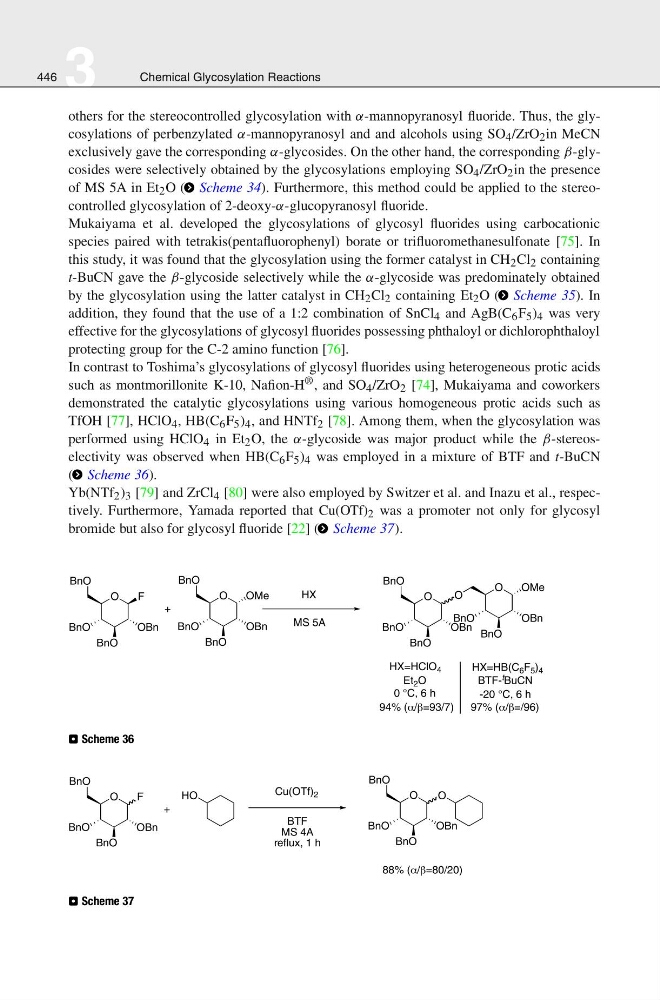
TfOH [77], HClO 4 , HB(C 6 F 5 ) 4 , and HNTf 2 [78]. Among them, when the glycosylation was
performed using HClO 4 in Et 2 O, the α-glycoside was major product while the β-stereoselectivity was observed when HB(C 6 F 5 ) 4 was employed in a mixture of BTF and t-BuCN
( > Scheme 36).
Yb(NTf 2 ) 3 [79] and ZrCl 4 [80] were also employed by Switzer et al. and Inazu et al., respectively. Furthermore, Yamada reported that Cu(OTf) 2 was a promoter not only for glycosyl
bromide but also for glycosyl fluoride [22] ( > Scheme 37).
⊡ Scheme 36
⊡ Scheme 37
3
Chemical Glycosylation Reactions
others for the stereocontrolled glycosylation with α-mannopyranosyl fluoride. Thus, the glycosylations of perbenzylated α-mannopyranosyl and and alcohols using SO 4 /ZrO 2 in MeCN
exclusively gave the corresponding α-glycosides. On the other hand, the corresponding β-glycosides were selectively obtained by the glycosylations employing SO 4 /ZrO 2 in the presence
of MS 5A in Et 2 O ( > Scheme 34). Furthermore, this method could be applied to the stereocontrolled glycosylation of 2-deoxy-α-glucopyranosyl fluoride.
Mukaiyama et al. developed the glycosylations of glycosyl fluorides using carbocationic
species paired with tetrakis(pentafluorophenyl) borate or trifluoromethanesulfonate [75]. In
this study, it was found that the glycosylation using the former catalyst in CH 2 Cl 2 containing
t-BuCN gave the β-glycoside selectively while the α-glycoside was predominately obtained
by the glycosylation using the latter catalyst in CH 2 Cl 2 containing Et 2 O ( > Scheme 35). In
addition, they found that the use of a 1:2 combination of SnCl 4 and AgB(C 6 F 5 ) 4 was very
effective for the glycosylations of glycosyl fluorides possessing phthaloyl or dichlorophthaloyl
protecting group for the C-2 amino function [76].
In contrast to Toshima’s glycosylations of glycosyl fluorides using heterogeneous protic acids
such as montmorillonite K-10, Nafion-H ® , and SO 4 /ZrO 2 [74], Mukaiyama and coworkers
demonstrated the catalytic glycosylations using various homogeneous protic acids such as
TfOH [77], HClO 4 , HB(C 6 F 5 ) 4 , and HNTf 2 [78]. Among them, when the glycosylation was
performed using HClO 4 in Et 2 O, the α-glycoside was major product while the β-stereoselectivity was observed when HB(C 6 F 5 ) 4 was employed in a mixture of BTF and t-BuCN
( > Scheme 36).
Yb(NTf 2 ) 3 [79] and ZrCl 4 [80] were also employed by Switzer et al. and Inazu et al., respectively. Furthermore, Yamada reported that Cu(OTf) 2 was a promoter not only for glycosyl
bromide but also for glycosyl fluoride [22] ( > Scheme 37).
⊡ Scheme 36
⊡ Scheme 37