

444
3
Chemical Glycosylation Reactions
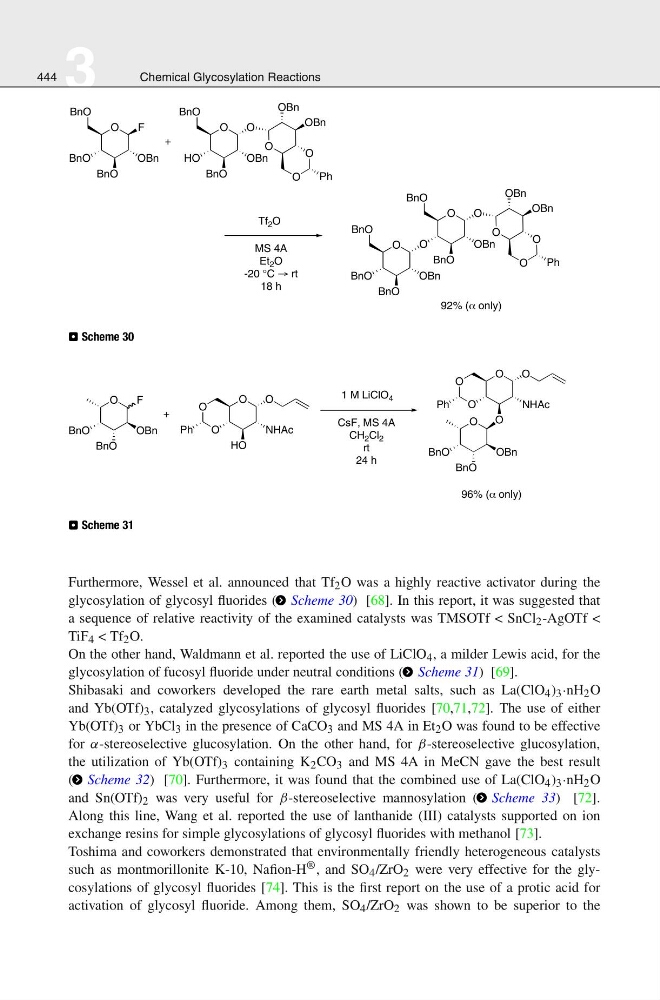
⊡ Scheme 30
⊡ Scheme 31
Furthermore, Wessel et al. announced that Tf 2 O was a highly reactive activator during the
glycosylation of glycosyl fluorides ( > Scheme 30) [68]. In this report, it was suggested that
a sequence of relative reactivity of the examined catalysts was TMSOTf < SnCl 2 -AgOTf <
TiF 4 < Tf 2 O.
On the other hand, Waldmann et al. reported the use of LiClO 4 , a milder Lewis acid, for the
glycosylation of fucosyl fluoride under neutral conditions ( > Scheme 31) [69].
Shibasaki and coworkers developed the rare earth metal salts, such as La(ClO 4 ) 3 ·nH 2 O
and Yb(OTf) 3 , catalyzed glycosylations of glycosyl fluorides [70,71,72]. The use of either
Yb(OTf) 3 or YbCl 3 in the presence of CaCO 3 and MS 4A in Et 2 O was found to be effective
for α-stereoselective glucosylation. On the other hand, for β-stereoselective glucosylation,
the utilization of Yb(OTf) 3 containing K 2 CO 3 and MS 4A in MeCN gave the best result
( > Scheme 32) [70]. Furthermore, it was found that the combined use of La(ClO 4 ) 3 ·nH 2 O
and Sn(OTf) 2 was very useful for β-stereoselective mannosylation ( > Scheme 33) [72].
Along this line, Wang et al. reported the use of lanthanide (III) catalysts supported on ion
exchange resins for simple glycosylations of glycosyl fluorides with methanol [73].
Toshima and coworkers demonstrated that environmentally friendly heterogeneous catalysts
such as montmorillonite K-10, Nafion-H ® , and SO 4 /ZrO 2 were very effective for the glycosylations of glycosyl fluorides [74]. This is the first report on the use of a protic acid for
activation of glycosyl fluoride. Among them, SO 4 /ZrO 2 was shown to be superior to the
3
Chemical Glycosylation Reactions
⊡ Scheme 30
⊡ Scheme 31
Furthermore, Wessel et al. announced that Tf 2 O was a highly reactive activator during the
glycosylation of glycosyl fluorides ( > Scheme 30) [68]. In this report, it was suggested that
a sequence of relative reactivity of the examined catalysts was TMSOTf < SnCl 2 -AgOTf <
TiF 4 < Tf 2 O.
On the other hand, Waldmann et al. reported the use of LiClO 4 , a milder Lewis acid, for the
glycosylation of fucosyl fluoride under neutral conditions ( > Scheme 31) [69].
Shibasaki and coworkers developed the rare earth metal salts, such as La(ClO 4 ) 3 ·nH 2 O
and Yb(OTf) 3 , catalyzed glycosylations of glycosyl fluorides [70,71,72]. The use of either
Yb(OTf) 3 or YbCl 3 in the presence of CaCO 3 and MS 4A in Et 2 O was found to be effective
for α-stereoselective glucosylation. On the other hand, for β-stereoselective glucosylation,
the utilization of Yb(OTf) 3 containing K 2 CO 3 and MS 4A in MeCN gave the best result
( > Scheme 32) [70]. Furthermore, it was found that the combined use of La(ClO 4 ) 3 ·nH 2 O
and Sn(OTf) 2 was very useful for β-stereoselective mannosylation ( > Scheme 33) [72].
Along this line, Wang et al. reported the use of lanthanide (III) catalysts supported on ion
exchange resins for simple glycosylations of glycosyl fluorides with methanol [73].
Toshima and coworkers demonstrated that environmentally friendly heterogeneous catalysts
such as montmorillonite K-10, Nafion-H ® , and SO 4 /ZrO 2 were very effective for the glycosylations of glycosyl fluorides [74]. This is the first report on the use of a protic acid for
activation of glycosyl fluoride. Among them, SO 4 /ZrO 2 was shown to be superior to the