

Glycosyl Halides
3.1
437
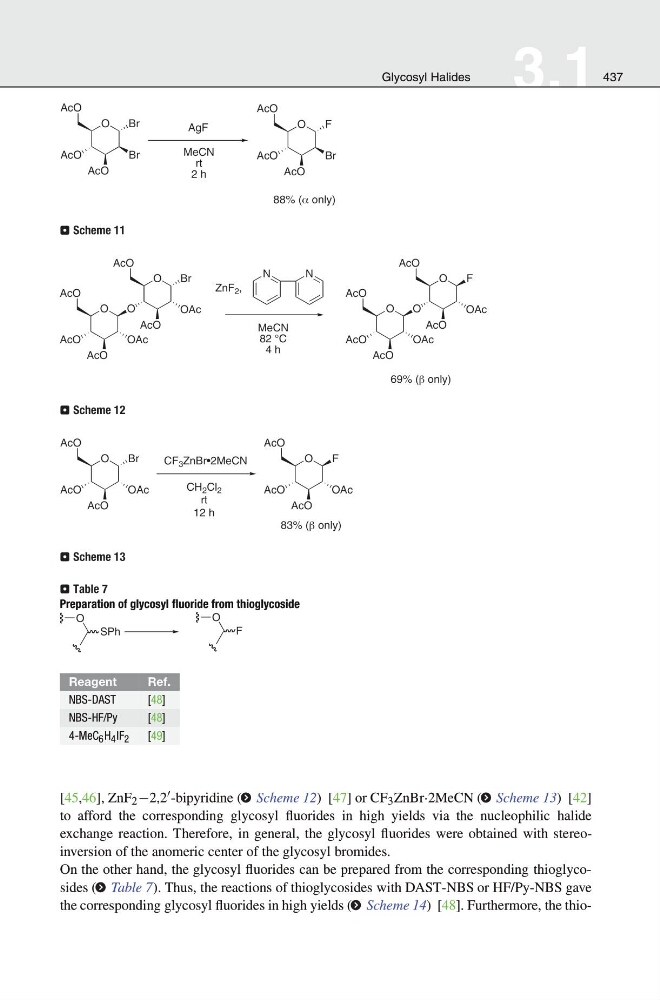
⊡ Scheme 11
⊡ Scheme 12
⊡ Scheme 13
⊡ Table 7
Preparation of glycosyl fluoride from thioglycoside
Reagent
Ref.
NBS-DAST
[48]
NBS-HF/Py
[48]
4-MeC 6 H 4 IF 2
[49]
[45,46], ZnF 2 −2,2 -bipyridine ( > Scheme 12) [47] or CF 3 ZnBr·2MeCN ( > Scheme 13) [42]
to afford the corresponding glycosyl fluorides in high yields via the nucleophilic halide
exchange reaction. Therefore, in general, the glycosyl fluorides were obtained with stereoinversion of the anomeric center of the glycosyl bromides.
On the other hand, the glycosyl fluorides can be prepared from the corresponding thioglycosides ( > Table 7). Thus, the reactions of thioglycosides with DAST-NBS or HF/Py-NBS gave
the corresponding glycosyl fluorides in high yields ( > Scheme 14) [48]. Furthermore, the thio-
3.1
437
⊡ Scheme 11
⊡ Scheme 12
⊡ Scheme 13
⊡ Table 7
Preparation of glycosyl fluoride from thioglycoside
Reagent
Ref.
NBS-DAST
[48]
NBS-HF/Py
[48]
4-MeC 6 H 4 IF 2
[49]
[45,46], ZnF 2 −2,2 -bipyridine ( > Scheme 12) [47] or CF 3 ZnBr·2MeCN ( > Scheme 13) [42]
to afford the corresponding glycosyl fluorides in high yields via the nucleophilic halide
exchange reaction. Therefore, in general, the glycosyl fluorides were obtained with stereoinversion of the anomeric center of the glycosyl bromides.
On the other hand, the glycosyl fluorides can be prepared from the corresponding thioglycosides ( > Table 7). Thus, the reactions of thioglycosides with DAST-NBS or HF/Py-NBS gave
the corresponding glycosyl fluorides in high yields ( > Scheme 14) [48]. Furthermore, the thio-