

434
3
Chemical Glycosylation Reactions
⊡ Table 5
Preparation of glycosyl fluoride from aldose
Reagent
Ref.
2-F-C 5 H 4 NMe·OTs-Et 3 N
[37]
DAST
[38,39]
HF/Py
[40,41]
TiF 4
[42]
CF 3 ZnBr·2MeCN-TiF 4
[42]
M 2 C = C(F)NMe 2
[43]
DEAD-PPh 3 -Et 3 OBF 3
[44]
⊡ Scheme 4
and iodides. Therefore, the glycosyl fluoride can be generally purified by the appropriate distillation and even by column chromatography with silica gel. The practical use of glycosyl
fluoride as a glycosyl donor was first introduced by Mukaiyama et al. in 1981 [36]. After the
significant advance in this field, a number of effective methods for fluorinating the anomeric center of several types of sugars have been developed. The representative methods for the
conversion of a free anomeric hydroxyl group of sugars into the fluoride are summarized in
> Table 5.
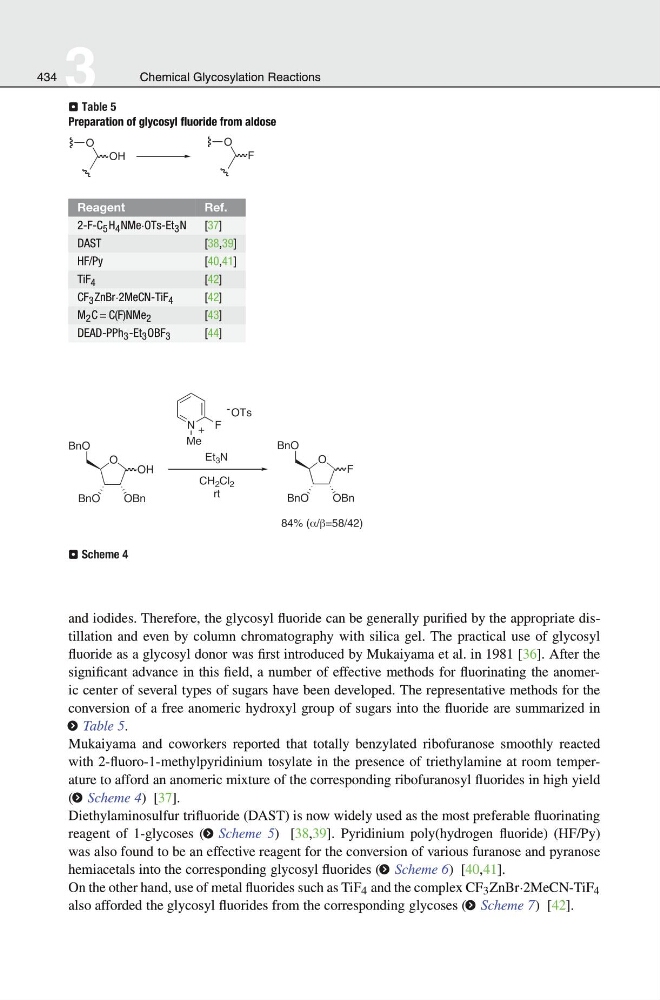
Mukaiyama and coworkers reported that totally benzylated ribofuranose smoothly reacted
with 2-fluoro-1-methylpyridinium tosylate in the presence of triethylamine at room temperature to afford an anomeric mixture of the corresponding ribofuranosyl fluorides in high yield
( > Scheme 4) [37].
Diethylaminosulfur trifluoride (DAST) is now widely used as the most preferable fluorinating
reagent of 1-glycoses ( > Scheme 5) [38,39]. Pyridinium poly(hydrogen fluoride) (HF/Py)
was also found to be an effective reagent for the conversion of various furanose and pyranose
hemiacetals into the corresponding glycosyl fluorides ( > Scheme 6) [40,41].
On the other hand, use of metal fluorides such as TiF 4 and the complex CF 3 ZnBr·2MeCN-TiF 4
also afforded the glycosyl fluorides from the corresponding glycoses ( > Scheme 7) [42].
3
Chemical Glycosylation Reactions
⊡ Table 5
Preparation of glycosyl fluoride from aldose
Reagent
Ref.
2-F-C 5 H 4 NMe·OTs-Et 3 N
[37]
DAST
[38,39]
HF/Py
[40,41]
TiF 4
[42]
CF 3 ZnBr·2MeCN-TiF 4
[42]
M 2 C = C(F)NMe 2
[43]
DEAD-PPh 3 -Et 3 OBF 3
[44]
⊡ Scheme 4
and iodides. Therefore, the glycosyl fluoride can be generally purified by the appropriate distillation and even by column chromatography with silica gel. The practical use of glycosyl
fluoride as a glycosyl donor was first introduced by Mukaiyama et al. in 1981 [36]. After the
significant advance in this field, a number of effective methods for fluorinating the anomeric center of several types of sugars have been developed. The representative methods for the
conversion of a free anomeric hydroxyl group of sugars into the fluoride are summarized in
> Table 5.
Mukaiyama and coworkers reported that totally benzylated ribofuranose smoothly reacted
with 2-fluoro-1-methylpyridinium tosylate in the presence of triethylamine at room temperature to afford an anomeric mixture of the corresponding ribofuranosyl fluorides in high yield
( > Scheme 4) [37].
Diethylaminosulfur trifluoride (DAST) is now widely used as the most preferable fluorinating
reagent of 1-glycoses ( > Scheme 5) [38,39]. Pyridinium poly(hydrogen fluoride) (HF/Py)
was also found to be an effective reagent for the conversion of various furanose and pyranose
hemiacetals into the corresponding glycosyl fluorides ( > Scheme 6) [40,41].
On the other hand, use of metal fluorides such as TiF 4 and the complex CF 3 ZnBr·2MeCN-TiF 4
also afforded the glycosyl fluorides from the corresponding glycoses ( > Scheme 7) [42].